Band 5.5 IELTS Writing Task 1 Model Answer
Overall Band Score: 5.5 · Cambridge IELTS 20 · 2026-11-17
IELTS Writing Task 1 question
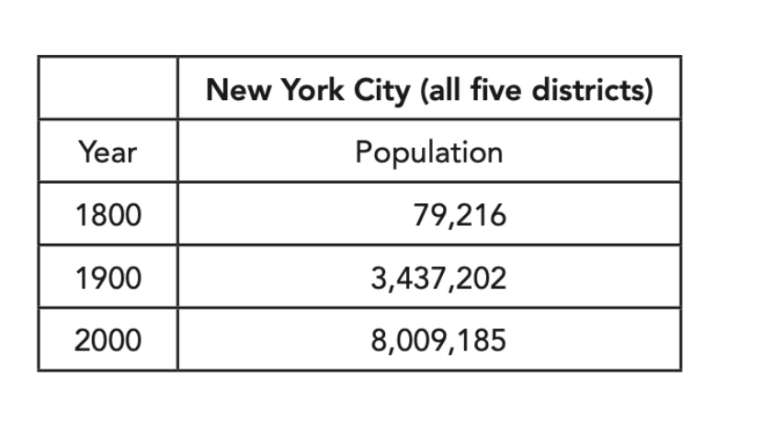
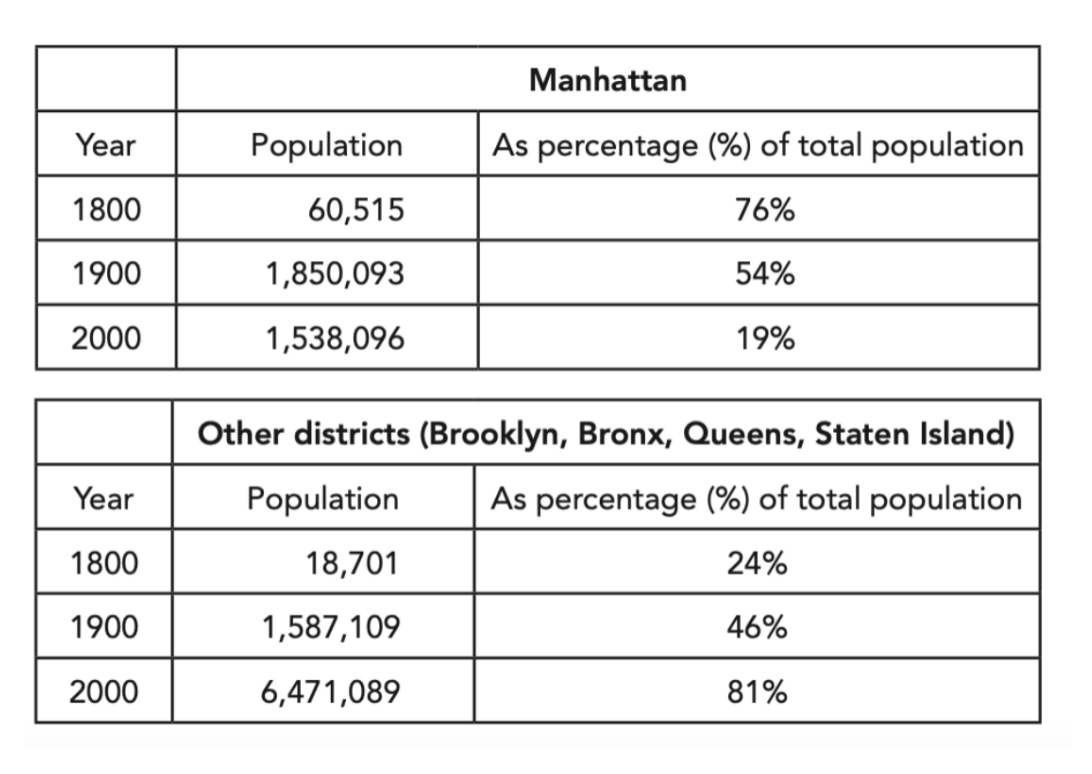
The first table below shows changes in the total population of New York City from 1800 to 2000. The second and third tables show changes in the population of the five districts of the city (Manhattan, Brooklyn, Bronx, Queens, Staten Island) over the same period.
Summarise the information by selecting and reporting the main features, and make comparisons where relevant.
Student answer (Band 5.5)
The tables below describe the changes in population of city and its districts between 1800 and 2000.
Overall, the population of New york city faced a dramatical incease. Meanwhile, the population of Manhattan slightly got less whereas, the four other districts had a significant increase i n their population over hte time.
In 1800, the population of New York City were almost eighty thousand. Other than that, the population in Manhattan were around 60 thousand with the percentage of 76% and the other four districts had almost 19thousand which has a percentage of 24%. Therefore in 1900, population in New York City kept growing whereas, the Manhattan's population had a slight increase aswell which is 54% and in other four districts it become higher with the percentage of 46%.
In 2000, New York City had a really big incrase in it's population while the Manhattan had a decreased amount of population with a percentage of 19%, The ohther four districts become more and more populated arount the same period with a percentage of 81%.
AI examiner evaluation
| Criterion | Band |
|---|---|
| Task Achievement / Task Response | 6.0 |
| Coherence and Cohesion | 6.0 |
| Lexical Resource | 5.0 |
| Grammatical Range and Accuracy | 5.0 |
| Overall | 5.5 |
Task Achievement / Task Response: Band 6.0
You identify the main overall contrast: New York City grew substantially, while Manhattan’s share fell and the other districts’ share rose. You also include relevant figures for 1800 and the percentage changes across the three dates. However, some key information is unclear or inaccurate. In 1900, Manhattan’s population increased to 1,850,093, but you describe its population as having a “slight increase” while giving only its 54% share; by 2000, its actual population had fallen to 1,538,096. The city’s total growth is mentioned but not quantified, and the other districts’ population figures are omitted. Report the main population totals alongside the percentages so the comparisons are fully supported.
Coherence and Cohesion: Band 6.0
The response has a recognisable structure: an introduction, an overview, and paragraphs describing the earlier and later years. This gives the reader a basic progression through the data. However, the comparisons within the body are sometimes difficult to follow because population totals and percentage shares are mixed together. For example, “Manhattan’s population had a slight increase aswell which is 54%” makes it unclear that 54% is its share, not its population. Linking expressions such as “Other than that” and repeated “whereas” are not always appropriate, and the final paragraph largely repeats the trend without adding precise comparisons. Grouping the figures by year and clearly distinguishing totals from shares would improve cohesion.
Lexical Resource: Band 5.0
You use some relevant vocabulary for describing data, including “population,” “percentage,” “increase,” and “decreased,” so the topic is generally clear. However, the range is limited and several choices are imprecise or informal, such as “really big increase,” “got less,” and “more and more populated.” There are also noticeable spelling errors, including “dramatical,” “incease,” “incrase,” and “ohther,” which reduce the accuracy and polish of the report. Use standard data-reporting collocations such as “rose sharply,” “declined,” and “accounted for,” and check spelling carefully. More precise vocabulary would help distinguish changes in population numbers from changes in percentage shares.
Grammatical Range and Accuracy: Band 5.0
You attempt both simple and more complex sentences, and the overall meaning is usually recoverable. However, errors in agreement, tense, articles, and sentence boundaries recur. For example, “the population … were” should be “the population … was,” while “it become higher” needs a past-tense form such as “became higher.” The sentence beginning “In 2000” joins contrasting ideas with a comma, creating a run-on structure, and “whereas, the four other districts” uses punctuation awkwardly. Some sentences also make the relationship between a population figure and its percentage unclear. Practise accurate past-tense reporting and use shorter, clearly punctuated comparisons; this will make your range of sentence forms more controlled.
See this exact question answered at other band scores. The same prompt compared across bands.
Browse more IELTS Writing model answers or get your own writing scored by the same AI examiner.