Band 5.5 IELTS Writing Task 1 Model Answer
Overall Band Score: 5.5 · Cambridge IELTS 20 · 2026-11-17
IELTS Writing Task 1 question
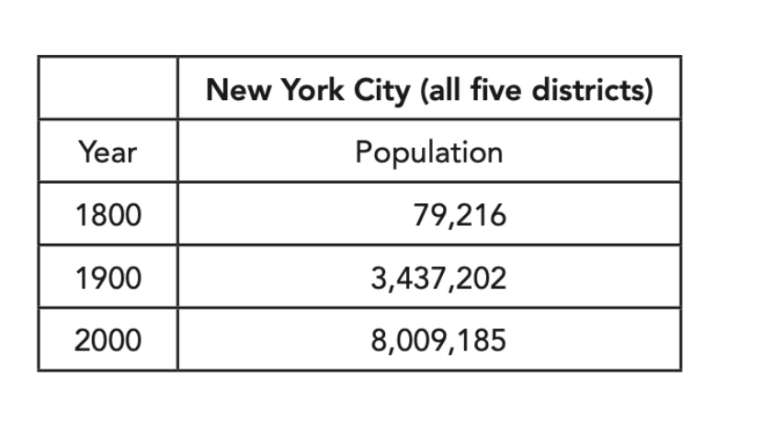
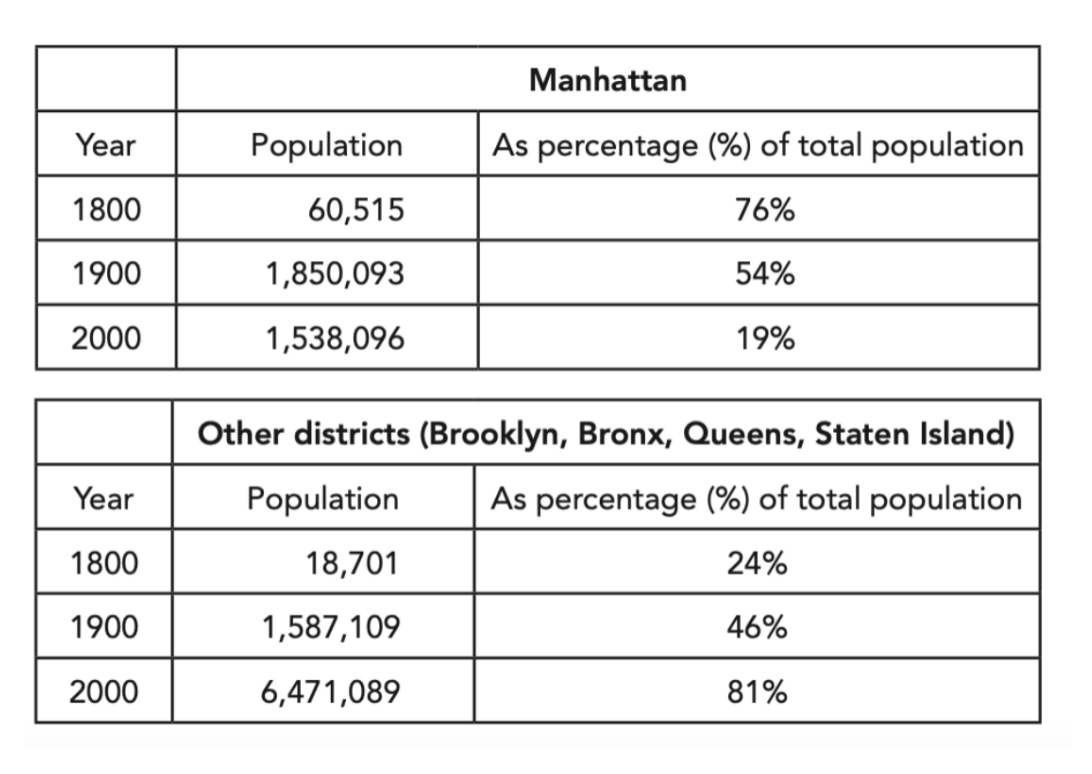
The first table below shows changes in the total population of New York City from 1800 to 2000. The second and third tables show changes in the population of the five districts of the city (Manhattan, Brooklyn, Bronx, Queens, Staten Island) over the same period.
Summarise the information by selecting and reporting the main features, and make comparisons where relevant.
Student answer (Band 5.5)
The first table illustrates the varriations of all residents that lived in New York from 1800 to 2000. The other two tables demonstrate the updates of inhabitants of five cities during the same time.
Overall, these three tables give details about whole population collectively in whole city and individually in all districts.
In second table, the whole city had 79,216 citizens in 1800 year. During 1900 year, the amout of people were became tetralet from the previous years and in 2000year, 8,009,185 population were lived in all five districts of New York City.
The second table give information of Manhattan region in which 76% inhabitants stayed from the total population in 1800. almost 54% and 19% public lived in this area from 1900 to 2000. The last table represents the community of other four sectors of whole New York City. In 1800 and 1900, only 24% and 46% public settled in these cities and that is very less residents. During 2000, 81% of survivors survived in these four regions that is the higest amount of population of whole city
AI examiner evaluation
| Criterion | Band |
|---|---|
| Task Achievement / Task Response | 5.5 |
| Coherence and Cohesion | 5.5 |
| Lexical Resource | 5.0 |
| Grammatical Range and Accuracy | 5.0 |
| Overall | 5.5 |
Task Achievement / Task Response: Band 5.5
You identify the broad subject and report several relevant figures, including the city’s population in 1800 and 2000 and the changing shares for Manhattan and the other districts. The clearest overview is that Manhattan’s share fell while the other districts’ share rose, although this is not explicitly summarised as the main trend. Coverage is partial because the total for 1900 is not accurately reported: the response says the population “became tetralet” without giving the figure, and the district population totals are omitted. Some descriptions are also unclear, such as calling the other districts “very less residents.” To strengthen the response, state the overall growth across all three years and compare the district populations as well as their percentages.
Coherence and Cohesion: Band 5.5
The response has a basic sequence: an introduction, a brief overview, and then details about the total population and district shares. This gives the reader some organisation, and time markers such as “In 1800” and “During 2000” help locate information. However, the progression is not consistently clear. The overview mainly says the tables give information, rather than identifying the key trends, and the paragraphing does not clearly separate the total-population data from the district comparisons. References such as “the second table” are confusing because the tables are not identified consistently. Some linking phrases, including “and that is very less residents,” do not express the relationship clearly. Group the figures by trend and use precise references to the city and districts.
Lexical Resource: Band 5.0
You use some task-related vocabulary, including “population,” “inhabitants,” “districts,” and “percentage,” so the topic is generally understandable. However, the range is limited and several word choices or collocations are inaccurate enough to make parts difficult to interpret. For example, “updates of inhabitants” is not a natural way to describe population changes, “public lived” is unsuitable for residents, and “survivors survived” does not convey population figures. There are also noticeable spelling errors, such as “varriations,” “amout,” and “higest.” Prefer precise, familiar terms such as “population,” “residents,” “increased,” and “accounted for,” and check spelling carefully. Avoid replacing standard terms with unusual alternatives when they reduce clarity.
Grammatical Range and Accuracy: Band 5.0
You attempt both simple and longer sentence forms, and the response is usually recognisable despite grammatical problems. However, control is inconsistent, particularly in verb forms, agreement, articles, and sentence construction. For example, “the amout of people were became” combines incompatible verb forms, while “8,009,185 population were lived” has incorrect agreement and an unsuitable passive construction. In “The second table give information,” the subject and verb do not agree, and “in 1800 year” is missing a natural article or preposition pattern. Capitalisation and punctuation are also inconsistent, as in “almost 54%.” Build accurate short sentences first—for example, “The city’s population was 79,216 in 1800”—then add comparisons using controlled clauses.
See this exact question answered at other band scores. The same prompt compared across bands.
Browse more IELTS Writing model answers or get your own writing scored by the same AI examiner.