Band 5.5 IELTS Writing Task 1 Model Answer
Overall Band Score: 5.5 · Cambridge IELTS 20 · 2026-11-17
IELTS Writing Task 1 question
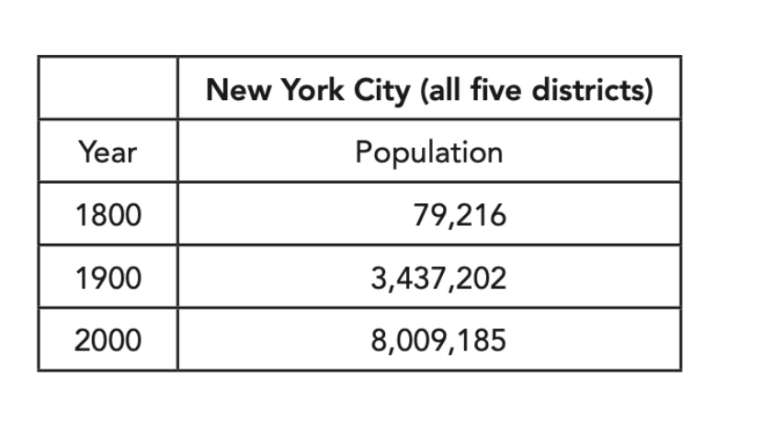
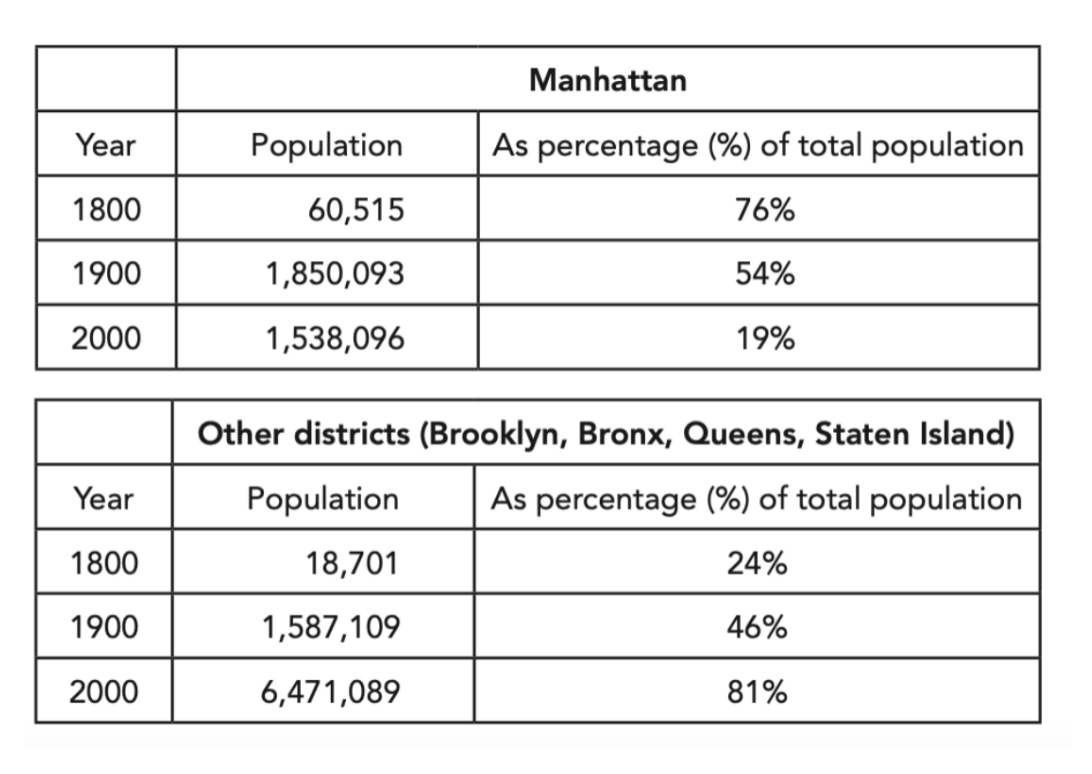
The first table below shows changes in the total population of New York City from 1800 to 2000. The second and third tables show changes in the population of the five districts of the city (Manhattan, Brooklyn, Bronx, Queens, Staten Island) over the same period.
Summarise the information by selecting and reporting the main features, and make comparisons where relevant.
Student answer (Band 5.5)
The tabular data illustrates overall population growth of New York City for over past 200 years from 1800 to 2000, the data also displays the variations in the polpulation of the five districts of the city.
Overall, from the data it is evident that there is a significant growth of people living in the New York City from the year 1800 to 2000, the maximum contribution of overall population among the districts in the state was in Manhattan in the year 1800 which relatively decreased in the year 2000.
From the 200 years of population data it is clear that the population drastically rose from nearly 80,000 in 1800 to around 8 lakhs in the year 2000, mostly due the migration of people for better living.
Earlier Manhattan contributed the most in the overall population with 76% among other districts in the year 1800 which reduced to only 19% in the year 2000. However, Brooklyn, Bronx, Queens and Staten Island's combined population rose from 24% to 81% in the year 2000.
AI examiner evaluation
| Criterion | Band |
|---|---|
| Task Achievement / Task Response | 5.5 |
| Coherence and Cohesion | 5.5 |
| Lexical Resource | 5.5 |
| Grammatical Range and Accuracy | 5.5 |
| Overall | 5.5 |
Task Achievement / Task Response: Band 5.5
You identify the broad rise in New York City’s population and the shift in the districts’ shares from Manhattan to the other four districts. However, the account is only partial and includes a major numerical error: the total population in 2000 was about 8 million, not “around 8 lakhs.” You also omit the important 1900 figures, when the city had about 3.4 million people and Manhattan still accounted for 54% of the total. The claim that Manhattan had the largest contribution in 1800 is accurate, but the overview would be stronger if it described the overall pattern across all three dates and noted that Manhattan’s population itself peaked in 1900 before falling by 2000. Avoid unsupported explanations such as migration for better living, which the tables do not establish.
Coherence and Cohesion: Band 5.5
The response has a recognisable structure: an introduction, an overview, and paragraphs giving details. This helps the reader follow the main topic, and transitions such as “Overall” and “However” signal relationships between points. Nevertheless, progression is limited because the details are not organised around all three dates: 1900 is largely absent, and the final paragraph repeats the change in district shares already mentioned in the overview. Some linking is also awkward, as in “From the 200 years of population data,” while the sentence about migration interrupts the reporting of the figures with an unsupported explanation. Group the total population figures together, then compare Manhattan with the other districts across 1800, 1900 and 2000, using clear references to each year.
Lexical Resource: Band 5.5
You use some relevant vocabulary for describing data, including “overall population growth,” “contributed,” “reduced,” and “combined population.” These choices make the general comparison understandable. However, the range is limited and several expressions are imprecise or unnatural, such as “maximum contribution of overall population,” “growth of people living in the New York City,” and “rose … to around 8 lakhs.” The spelling “polpulation” is also inaccurate, and “lakhs” is not an appropriate way to report this figure in an IELTS response for an international readership; use “8 million.” Aim for precise terms such as “population share,” “accounted for,” and “increased,” and use them consistently to distinguish population totals from percentages.
Grammatical Range and Accuracy: Band 5.5
You attempt both simple and more complex sentences, including a relative clause in “which relatively decreased” and a contrast introduced by “However.” The main meaning is generally recoverable, but errors in sentence construction and grammatical patterns are noticeable. For example, “for over past 200 years” needs an article and a more natural time expression, while “from the year 1800 to 2000” is awkwardly formed. The opening sentence joins two independent ideas with a comma, and “mostly due the migration” is missing “to.” There are also problems with articles and prepositions in “in the New York City” and “among other districts.” Use shorter, controlled sentences and check articles, prepositions, and punctuation when revising.
See this exact question answered at other band scores. The same prompt compared across bands.
Browse more IELTS Writing model answers or get your own writing scored by the same AI examiner.