Band 6.0 IELTS Writing Task 1 Model Answer
Overall Band Score: 6.0 · Cambridge IELTS 20 · 2026-11-17
IELTS Writing Task 1 question
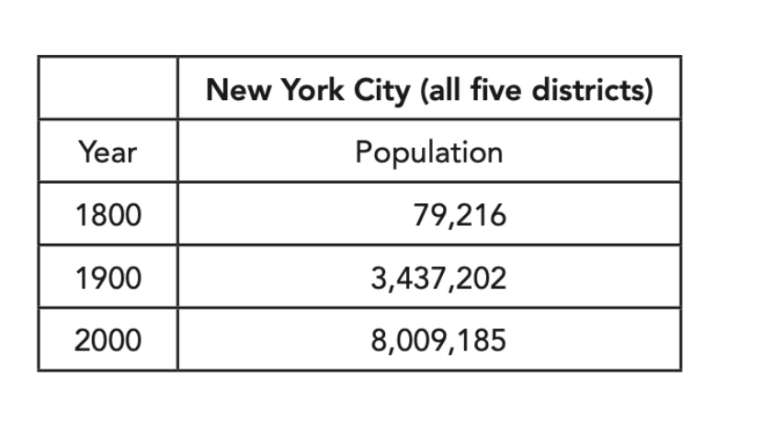
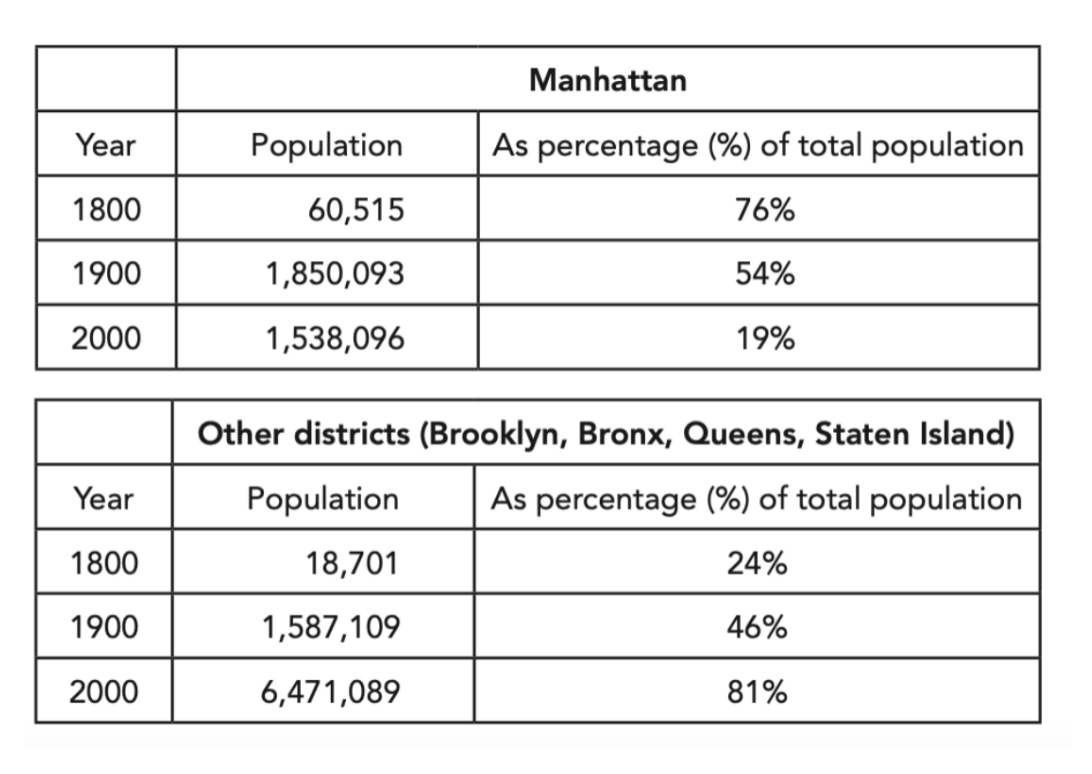
The first table below shows changes in the total population of New York City from 1800 to 2000. The second and third tables show changes in the population of the five districts of the city (Manhattan, Brooklyn, Bronx, Queens, Staten Island) over the same period.
Summarise the information by selecting and reporting the main features, and make comparisons where relevant.
Student answer (Band 6.0)
The first table illustrates the changes in the population of New York City ( all five districts). While the other two tables shows the population of the five distracts of the city - Manhattan, Brooklyn, Bronx, Queens and Staten Island - between 1800 and 2000.
Overall, the total population of New York City from 1800 and 2000 experienced a noticable growth. At the same period, the population Manhattan fluctuated. In addiction, the other districts population increased dramatically.
To begin with, New York City's inhabitans ( all five districts ) rose up from 79,216 in 1800, continuing to increase in 1900 to reach 3,437,202. In 2000, the population increased significantly to 8,009,185.
Furthermore, the public of Manhattan was in 1800 60,515 (76% of total population), than it experienced a substantial increase in 1900 to reach 1,850,093 (54%). While in 2000 the population declined slightly to 1,538,096 (19%).
Morever, for the other districts (Brooklyn, Bronx, Queens, Staten Island) the residents grew considerably from 18,701 (24%) in 1800 to reach 1,587,109 (46%) in 1900. Not only that, but it kept increasing to 6,471,089 (81%) in 2000.
AI examiner evaluation
| Criterion | Band |
|---|---|
| Task Achievement / Task Response | 6.5 |
| Coherence and Cohesion | 6.0 |
| Lexical Resource | 5.5 |
| Grammatical Range and Accuracy | 5.5 |
| Overall | 6.0 |
Task Achievement / Task Response: Band 6.5
You cover the main information and provide a clear overview: the city’s total population rose substantially, while Manhattan’s share fell and the other districts’ share grew. The figures you report match the tables, including the 2000 totals and percentages. This gives the response a solid, relevant account of the changes. However, the overview says Manhattan’s population “fluctuated,” which is imprecise: it rose sharply from 1800 to 1900, then declined by 2000. The description of the other districts is also mainly a sequence of figures, with limited comparison to Manhattan’s contrasting trend. To strengthen the response further, make the overview more exact and explain the shift in the population balance across the three dates.
Coherence and Cohesion: Band 6.0
The response has a clear overall arrangement: an introduction, an overview, and separate paragraphs for the city total, Manhattan, and the other districts. This makes the information easy to locate, and transitions such as “To begin with,” “Furthermore,” and “Moreover” help signal the sequence. However, some linking is mechanical, and the opening sentence’s “While” does not establish a clear contrast between the tables. The overview also groups the trends without clearly explaining their relationship. Use fewer formulaic transitions and connect comparisons more directly—for example, show how Manhattan’s share fell as the other districts’ share rose. This would make the progression more integrated and references clearer.
Lexical Resource: Band 5.5
You use a reasonable range of vocabulary for describing change, including “substantial increase,” “declined,” “dramatically,” and “grew considerably.” The meaning is generally clear, and the response includes relevant terms such as “population” and “total.” However, several inaccurate or unnatural choices weaken precision: “inhabitans” is misspelled, “public of Manhattan” is not an appropriate way to describe its population, and “in addiction” appears to be a mistaken form of “in addition.” “Rose up” and “kept increasing” are also less suitable for formal data reporting. Aim for accurate, natural collocations and check spelling; using “population,” “accounted for,” and “continued to rise” would make the description more precise and consistently academic.
Grammatical Range and Accuracy: Band 5.5
You attempt a mix of simple and more complex sentence forms, including clauses beginning with “While” and “Not only that, but…”. Most of the data remains understandable, but some grammatical errors are noticeable. For example, “the other two tables shows” has subject–verb disagreement, and “the population Manhattan” is missing a possessive or preposition. The construction “the population of New York City from 1800 and 2000” also uses an incorrect preposition, while “the population of Manhattan was in 1800 60,515” has awkward word order. Some sentence fragments or incomplete contrasts occur after “While.” Review agreement, prepositions, and clause structure, and use complete sentences when contrasting the years.
See this exact question answered at other band scores. The same prompt compared across bands.
Browse more IELTS Writing model answers or get your own writing scored by the same AI examiner.