Band 6.5 IELTS Writing Task 1 Model Answer
Overall Band Score: 6.5 · Cambridge IELTS 20 · 2026-11-17
IELTS Writing Task 1 question
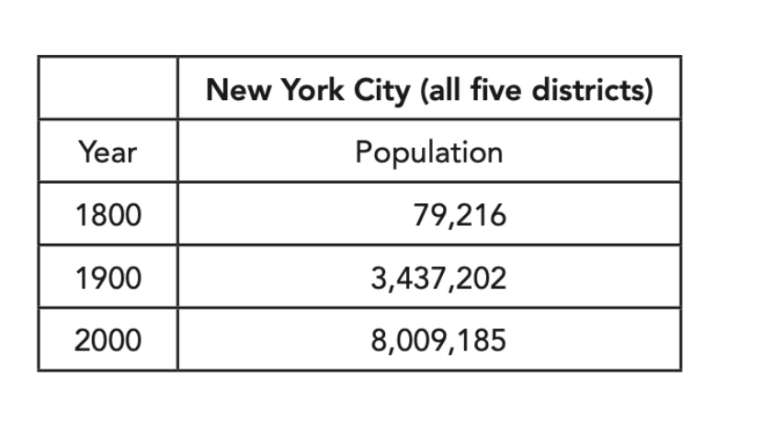
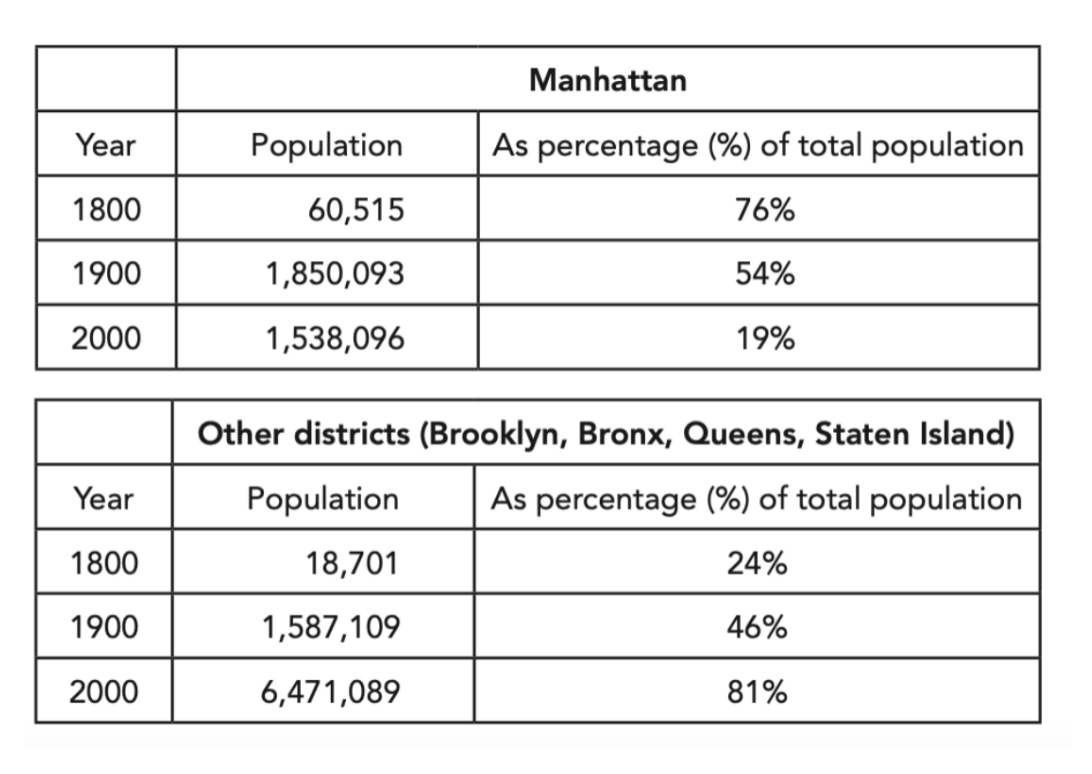
The first table below shows changes in the total population of New York City from 1800 to 2000. The second and third tables show changes in the population of the five districts of the city (Manhattan, Brooklyn, Bronx, Queens, Staten Island) over the same period.
Summarise the information by selecting and reporting the main features, and make comparisons where relevant.
Student answer (Band 6.5)
The first figure illustrates the total population of New York City of 1800, 1900, and 2000. The second and third data displays the percentage share in Manhattan and the other four boroughs.
Overall, the number of people from all five districts has increased. Manhattan had most of the shares from the total population, whereas, it was replaced by other four boroughs of New York City by 2000.
In 1800, Manhattan was a popular place to live, with the number of 60,515 people and 76% share of total population. In 1900, the count of population rose to 1,850,093, with the total shares of 54%, but in 2000, both shares and population declined to 19% and 1,538,096, respectively.
As for the other four boroughs, in 1800 the count and shares of population were the least, 18,701 and 24%, respectively. While in 1900 it rose to 1,587,109 with 46% shares of the all population. In 2000, the population rose drastically to 6,471,089, with the shares of 81% and became the most populated area of New York City.
AI examiner evaluation
| Criterion | Band |
|---|---|
| Task Achievement / Task Response | 7.0 |
| Coherence and Cohesion | 7.0 |
| Lexical Resource | 6.0 |
| Grammatical Range and Accuracy | 6.0 |
| Overall | 6.5 |
Task Achievement / Task Response: Band 7.0
The response identifies the main overall pattern: New York City’s population grew substantially, while Manhattan’s share fell and the other four districts became dominant by 2000. It supports this overview with accurate figures for all three years, including Manhattan’s rise to 1,850,093 in 1900 before declining, and the other districts’ increase to 6,471,089. This gives the report clear coverage of the key comparisons. The overview could be more precise by stating the citywide totals—79,216, 3,437,202 and 8,009,185—and explicitly noting that the total population rose at each point. Also, “Manhattan had most of the shares” is too broad for the full period, since its share was below half by 2000; qualify this as true in 1800 and 1900.
Coherence and Cohesion: Band 7.0
The four-paragraph structure is appropriate: an introduction, a concise overview, and separate paragraphs comparing Manhattan with the other districts. The sequence from 1800 to 1900 and then 2000 is easy to follow, and transitions such as “Overall,” “In 1800,” and “As for” help signal the organisation. Some linking is less controlled, however. The sentence beginning “While in 1900” is a fragment, and “whereas” in the overview is awkwardly punctuated and does not clearly connect the contrast. The report would progress more smoothly if each comparison used complete, parallel sentences and if the citywide totals were incorporated into the overview or a comparison paragraph. These refinements would make the relationships between the figures more explicit.
Lexical Resource: Band 6.0
The vocabulary is adequate for describing the tables, and the response uses relevant terms such as “percentage share,” “declined,” “rose,” and “drastically.” It also avoids excessive repetition of the same verb when describing changes. However, several expressions are imprecise or unnatural for statistical reporting: “the number of people from all five districts has increased” is less direct than describing the city’s total population, while “the count of population” and “the total shares” are awkward collocations. “Popular place to live” also introduces an unsupported judgement about popularity; the figures show population, not preference. Aim for precise data language, such as “population,” “accounted for,” and “proportion,” and use “boroughs” or “districts” consistently. These adjustments would improve naturalness and accuracy.
Grammatical Range and Accuracy: Band 6.0
The response includes a mix of simple and more complex forms, including time clauses and contrastive structures, and the intended meaning is generally clear. Some grammatical errors remain. The opening says “population of New York City of 1800,” where the time relationship needs a preposition such as “in.” “The second and third data displays” has a plural subject but a singular verb (“displays”), and “Manhattan had most of the shares … whereas, it was replaced” has faulty punctuation and an unclear clause connection. The sentence beginning “While in 1900” is incomplete because it lacks a main clause. There are also article and number-pattern issues in phrases such as “the other four boroughs.” Check subject–verb agreement, complete subordinate clauses, and punctuation around contrastive linkers while retaining the range of sentence forms attempted.
See this exact question answered at other band scores. The same prompt compared across bands.
Browse more IELTS Writing model answers or get your own writing scored by the same AI examiner.