Band 5.5 IELTS Writing Task 1 Model Answer
Overall Band Score: 5.5 · Cambridge IELTS 20 · 2026-11-18
IELTS Writing Task 1 question
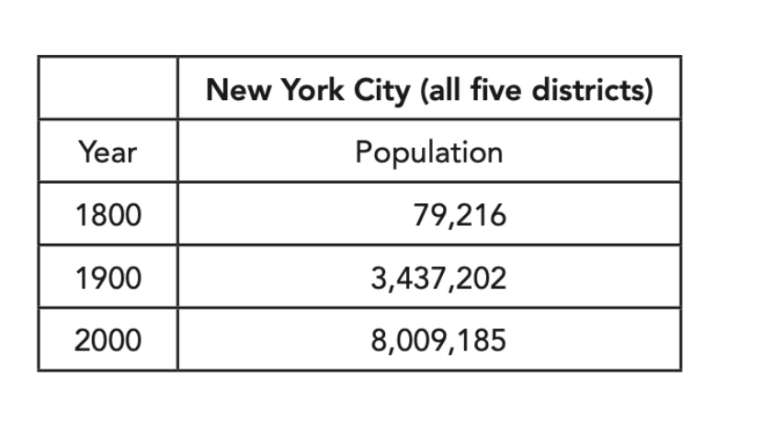
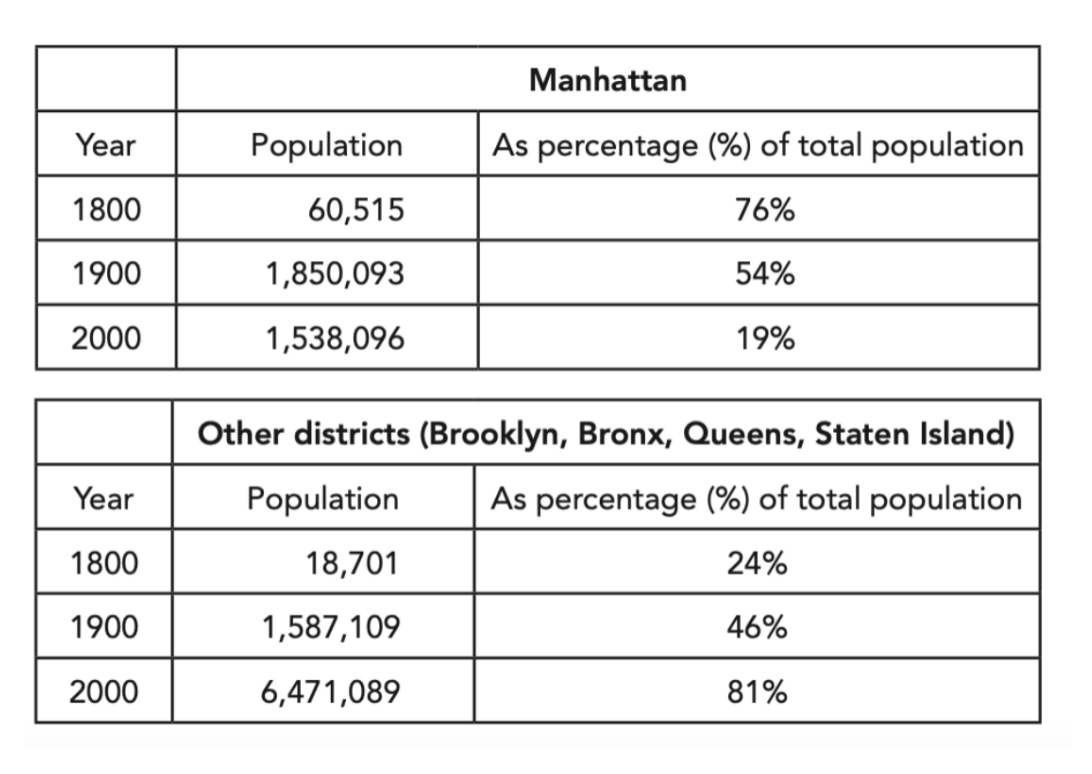
The first table below shows changes in the total population of New York City from 1800 to 2000. The second and third tables show changes in the population of the five districts of the city (Manhattan, Brooklyn, Bronx, Queens, Staten Island) over the same period.
Summarise the information by selecting and reporting the main features, and make comparisons where relevant.
Student answer (Band 5.5)
The tables illustrate the information about population in New York City and its five districts from year 1800 to 2000. Five districts of new york are Manhattan, Brooklyn, Bronx, Queens, and Staten island.
Firstly, the population of new york city has risen in the most significant way from 18th century till 20th century. In 1800, the total population of New York City for all five district was just 79,216, but it jumps to huge change 8,009,185 in 2000. The population increased in the district of manhattan in 1900 to interesting numbers of 1,850,093 which equals to 54%, but in 2000 it falls to 1,538,096 19%. Moreover, the cities like, Brooklyn, Bronx, Queens, and Staten island are the main parts of the new york's poupulation because these cities seen most significant increase in population, For instance, in 1800, the population of all these districts was just 18,701 which is 24%, but in 2000, in rises upto 81% of population which was the most prominent number 6,471,089.
In conclusion, i believe that Brooklyn, Bronx, Queens, and Staten island were the main districts and key districts which increases the poulation of New York City.
AI examiner evaluation
| Criterion | Band |
|---|---|
| Task Achievement / Task Response | 6.0 |
| Coherence and Cohesion | 6.0 |
| Lexical Resource | 5.0 |
| Grammatical Range and Accuracy | 5.0 |
| Overall | 5.5 |
Task Achievement / Task Response: Band 6.0
You identify the overall rise in New York City’s population and the major shift from Manhattan toward the other four districts. Several figures are accurately reported, including the 1800 total, Manhattan’s 1900 and 2000 populations, and the other districts’ 2000 share and population. However, the account is uneven: it omits the 1900 city total and the 1800 and 1900 figures for the other districts, and it does not clearly explain that Manhattan’s population rose to a peak in 1900 before declining. The conclusion repeats the claim that the other districts were key contributors rather than adding a clear summary of the main changes. Select the most important comparisons and describe each period more fully.
Coherence and Cohesion: Band 6.0
The response has a recognisable structure, moving from an introduction to a body paragraph and a concluding statement. Sequencing words such as “Firstly,” “Moreover,” and “In conclusion” help signal progression, and the reader can generally follow the comparison between Manhattan and the other districts. However, the body paragraph combines several trends in a long sequence, so the relationship between the citywide growth and district-level changes is not always clear. The conclusion also repeats an earlier point, while the introduction’s list of all five districts does little to guide the comparison. Organise the data into clearer stages or contrasting groups, and use references such as “the latter group” consistently to make connections smoother.
Lexical Resource: Band 5.0
You use some relevant vocabulary for describing data, including “population,” “increased,” “falls,” and “percentage,” so the main comparisons remain understandable. However, the range is limited and several expressions are unnatural or imprecise, such as “jumps to huge change,” “interesting numbers,” and “the most prominent number.” Repetition of “population” and “districts” also makes the description less flexible. There are spelling errors in “poupulation” and “upto,” and inconsistent capitalisation of place names. Choose conventional data-reporting collocations and check spelling and proper nouns; this will make the account more precise and appropriately formal.
Grammatical Range and Accuracy: Band 5.0
You attempt both simple and more complex sentences, including a contrast between Manhattan’s figures in 1900 and 2000. The main meaning is usually recoverable, but some errors in agreement, tense, articles, and sentence construction reduce accuracy. For example, “the population … was just 79,216, but it jumps” shifts tense, while “all five district was” has a number-agreement error. The clause beginning “Moreover, the cities like…” runs into a long sentence with unclear punctuation, and “in rises” is not a correct verb form. Use past tense consistently for the historical data, check singular and plural forms, and divide long sentences so each comparison is grammatically controlled.
See this exact question answered at other band scores. The same prompt compared across bands.
Browse more IELTS Writing model answers or get your own writing scored by the same AI examiner.