Band 5.5 IELTS Writing Task 1 Model Answer
Overall Band Score: 5.5 · Cambridge IELTS 20 · 2026-11-18
IELTS Writing Task 1 question
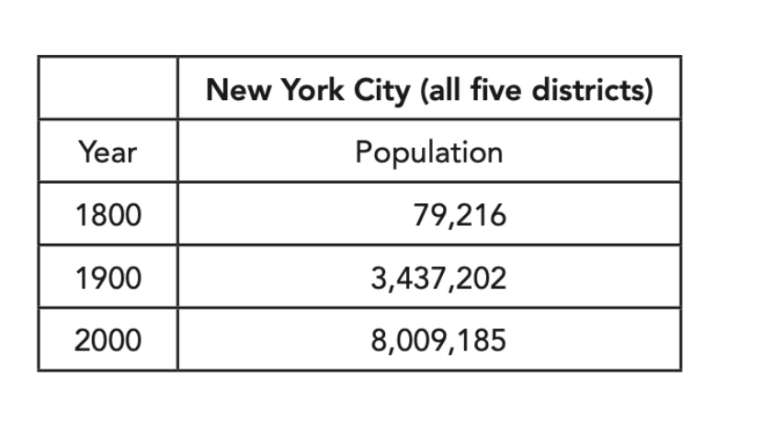
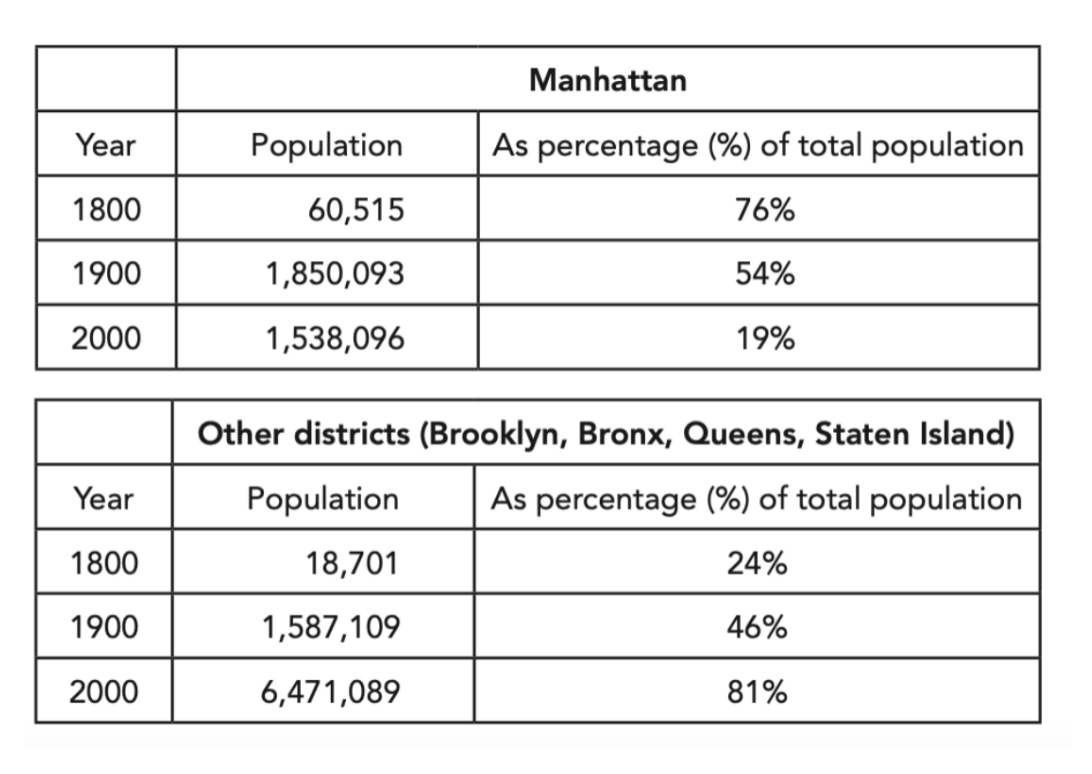
The first table below shows changes in the total population of New York City from 1800 to 2000. The second and third tables show changes in the population of the five districts of the city (Manhattan, Brooklyn, Bronx, Queens, Staten Island) over the same period.
Summarise the information by selecting and reporting the main features, and make comparisons where relevant.
Student answer (Band 5.5)
The fast table display the information about cahnges of total population in new york city from 1800 to 2000 and others shown change of popultaion in five districts on over the period
over all, number of popultaion was incresed over the period in new york city whareas in manhattan shown the different figur the proporation of total popultaion was decrised over the time
The poulation of new york city was 79216 in 1800 and over the period its become [redacted phone] in 2000. this result make a great boom over the time
in manhattan on 1800, the number of populatin was 60515 and percentage rate of changes is 76% but over the period the rate was declined and its becomed 19% though number of population was rose this period. othes districts like brooklyn ,bronx,queens,staten island change of total population and number of total popultaion both ar rose in begining the rate of total population cahnges it was 24% and 2000 its become 81%
AI examiner evaluation
| Criterion | Band |
|---|---|
| Task Achievement / Task Response | 6.0 |
| Coherence and Cohesion | 5.5 |
| Lexical Resource | 5.0 |
| Grammatical Range and Accuracy | 5.0 |
| Overall | 5.5 |
Task Achievement / Task Response: Band 6.0
You identify the main overall contrast: New York City’s population grew substantially, while Manhattan’s share of the total fell and the other districts’ share rose. You also include several accurate figures, including the 1800 city total and Manhattan’s 76% share, and you refer to all five districts collectively. However, some key information is incomplete or unclear. The city’s 1900 population is omitted, and the other districts’ population figures are not reported. More importantly, you say Manhattan’s population rose over the period, although it increased to 1,850,093 in 1900 and then fell to 1,538,096 by 2000. A clearer account of this change, alongside the other districts’ strong growth, would make the comparison more complete and precise.
Coherence and Cohesion: Band 5.5
The response has a recognisable structure: an introduction, an overview, and paragraphs describing the city and its districts. This gives the reader a basic route through the information, and phrases such as “over all” and “in manhattan” signal shifts in focus. However, progression within the body is limited: the final paragraph combines Manhattan and the other districts, and the comparison between their population trends is not clearly developed. Some linking is repetitive or unclear, particularly “over the period” and “though,” which makes relationships between figures difficult to follow. Use separate, focused paragraphs for the city total and the district comparison, and connect changes explicitly with terms such as “by contrast” and “whereas.”
Lexical Resource: Band 5.0
You use some relevant vocabulary for describing data, including “population,” “percentage,” “declined,” and “rose,” so the topic is generally understandable. However, the range is limited and several word-choice, word-form, and spelling errors make the report less clear, for example “fast table,” “great boom,” “rate of changes,” and repeated misspellings of “population.” “Great boom” is also too informal and imprecise for an academic description of a numerical increase. Aim for standard data-reporting collocations and check spelling carefully; more precise choices would help distinguish population totals from percentage shares. Avoid repeating “over the period” when a more specific phrase can describe the direction or timing of a change.
Grammatical Range and Accuracy: Band 5.0
You attempt both simple statements and longer sentences, including a contrast with “though,” but control is uneven. Errors in verb forms and sentence construction appear in examples such as “number of population was increased,” “its become,” and “the rate was declined.” Articles and agreement are also inconsistent, as in “in manhattan on 1800” and “number of population was rose.” These problems sometimes make it hard to tell whether a figure increased or decreased. Build more reliable simple comparative sentences first—for example, “Manhattan’s population rose to a peak in 1900, then fell by 2000”—and use past-tense verbs consistently. Check sentence boundaries and punctuation so that each comparison is expressed clearly.
See this exact question answered at other band scores. The same prompt compared across bands.
Browse more IELTS Writing model answers or get your own writing scored by the same AI examiner.