Band 5.5 IELTS Writing Task 1 Model Answer
Overall Band Score: 5.5 · Cambridge IELTS 20 · 2026-11-18
IELTS Writing Task 1 question
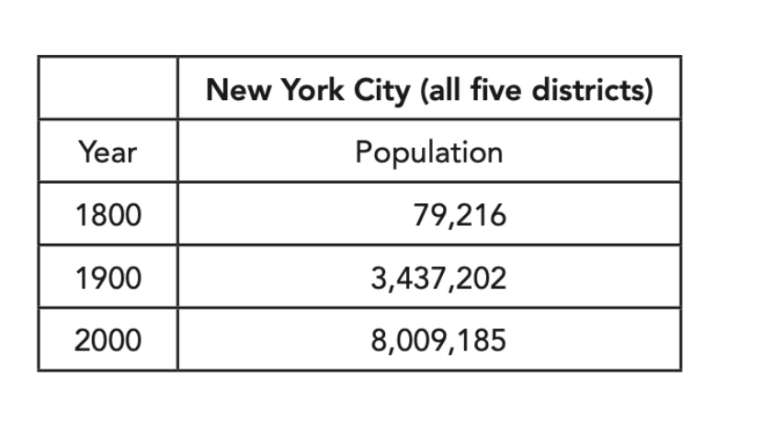
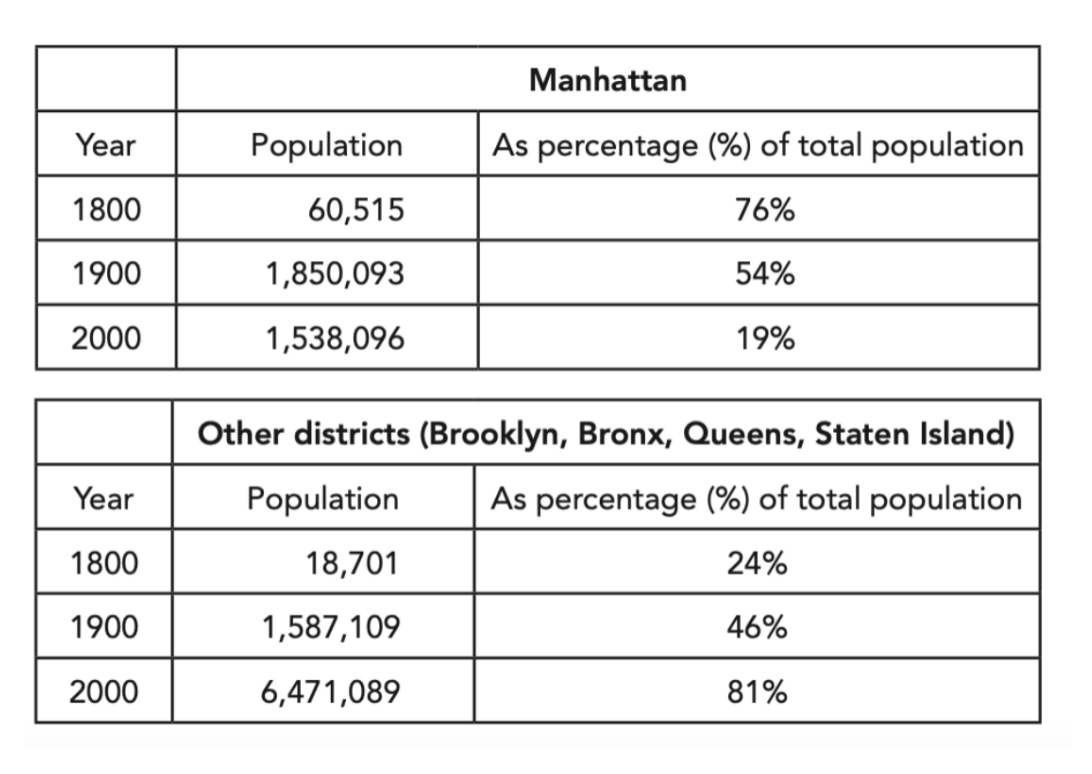
The first table below shows changes in the total population of New York City from 1800 to 2000. The second and third tables show changes in the population of the five districts of the city (Manhattan, Brooklyn, Bronx, Queens, Staten Island) over the same period.
Summarise the information by selecting and reporting the main features, and make comparisons where relevant.
Student answer (Band 5.5)
The table illustrates changes in thr total popuation of New york city from 1800 to 2000 while,second and third shows different changes in the population of five districts namely Manhattan, Brooklyn, Bronx, Queens, staten island over same period.
Overall, In year 1800 New york population (all five districts) have 79,216 people in which Manhattan holds about 76% of total population and other districts holds about 24%. The population of city has risen up to 8,009,185 till 2000. In this Manhattan has only [redacted phone] people and other districts has [redacted phone] people.
In detail., New york has abut 79,216 of people in which most of them where in Manhattan such that Manhattan has 76% of the total population of this city has other only has the 24% whereas,in 1900 population of city is 3,437,202 in which Manhattan has more than half of population and other districts has only 46%. Till 2000, populationbof the other districts combined has rose up for then the Manhattan as total number of the people in city are 8,009,185 and Manhattan has only 19% of them where as , other districts has 81%.
AI examiner evaluation
| Criterion | Band |
|---|---|
| Task Achievement / Task Response | 5.5 |
| Coherence and Cohesion | 5.5 |
| Lexical Resource | 5.0 |
| Grammatical Range and Accuracy | 5.0 |
| Overall | 5.5 |
Task Achievement / Task Response: Band 5.5
You identify the main overall pattern: New York City’s population grew substantially, while Manhattan’s share fell and the other districts’ share rose. The figures you give for 1800 and 2000, including the 76%/24% and 19%/81% shares, match the tables. However, the account is only partly developed: the important 1900 total and district figures appear, but the city’s growth across all three dates is not clearly compared, and Manhattan’s population actually peaked in 1900 before declining by 2000—a key feature that is not explicitly highlighted. Some statements are also unclear, such as saying Manhattan had “more than half” without specifying its 54% share. A clearer overview and more precise comparisons would make the summary more complete.
Coherence and Cohesion: Band 5.5
The response has an introduction, an overview, and a detail paragraph, so there is some organisation, and the reader can follow the broad movement from 1800 to 2000. However, progression is limited because the overview and detail paragraph repeat several of the same figures rather than developing a clear comparison. Linking expressions such as “Overall,” “In detail,” and “Till 2000” help signal stages, but some are used awkwardly or do not make the relationship between ideas clear; for example, “whereas” joins information without a well-formed contrast. Punctuation around transitions is also inconsistent. Group the data by the city total and the changing district shares, then use clear comparisons to guide the reader through each year.
Lexical Resource: Band 5.0
You use relevant task vocabulary, including “total population,” “districts,” “percentage,” and “combined,” and these terms help communicate the subject. However, the range is limited and several word choices or collocations are inaccurate or repetitive. Phrases such as “has risen up to,” “holds about 76%,” and “has rose up for then the Manhattan” are not natural ways to describe population data and can make the meaning difficult to follow. There are also noticeable spelling errors, including “popuation,” “abut,” and “populationbof,” as well as inconsistent capitalisation of place names. Practise standard reporting phrases such as “increased to,” “accounted for,” and “exceeded,” and proofread spelling carefully.
Grammatical Range and Accuracy: Band 5.0
The response attempts longer sentences and uses some comparison structures, but the range is limited and complex sentences are often faulty. Errors in verb forms and agreement occur in phrases such as “the population … have 79,216 people,” “other districts holds,” and “has rose.” Sentence construction also breaks down in “Manhattan has more than half of population and other districts has only 46%,” where the comparison is difficult to parse. Articles and punctuation are inconsistent, including “in year 1800” and the comma placement around “whereas.” These errors sometimes make the intended relationships unclear. Build accuracy first with clear subject–verb patterns and past-tense reporting, then combine clauses using correctly structured contrast sentences.
See this exact question answered at other band scores. The same prompt compared across bands.
Browse more IELTS Writing model answers or get your own writing scored by the same AI examiner.