Band 5.0 IELTS Writing Task 1 Model Answer
Overall Band Score: 5.0 · Cambridge IELTS 20 · 2026-11-19
IELTS Writing Task 1 question
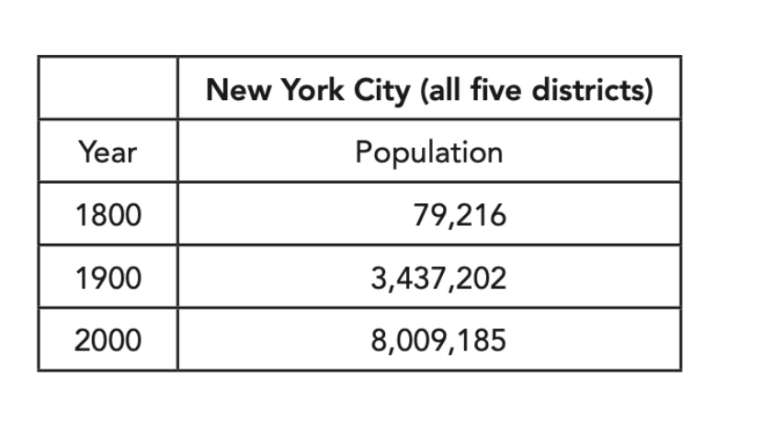
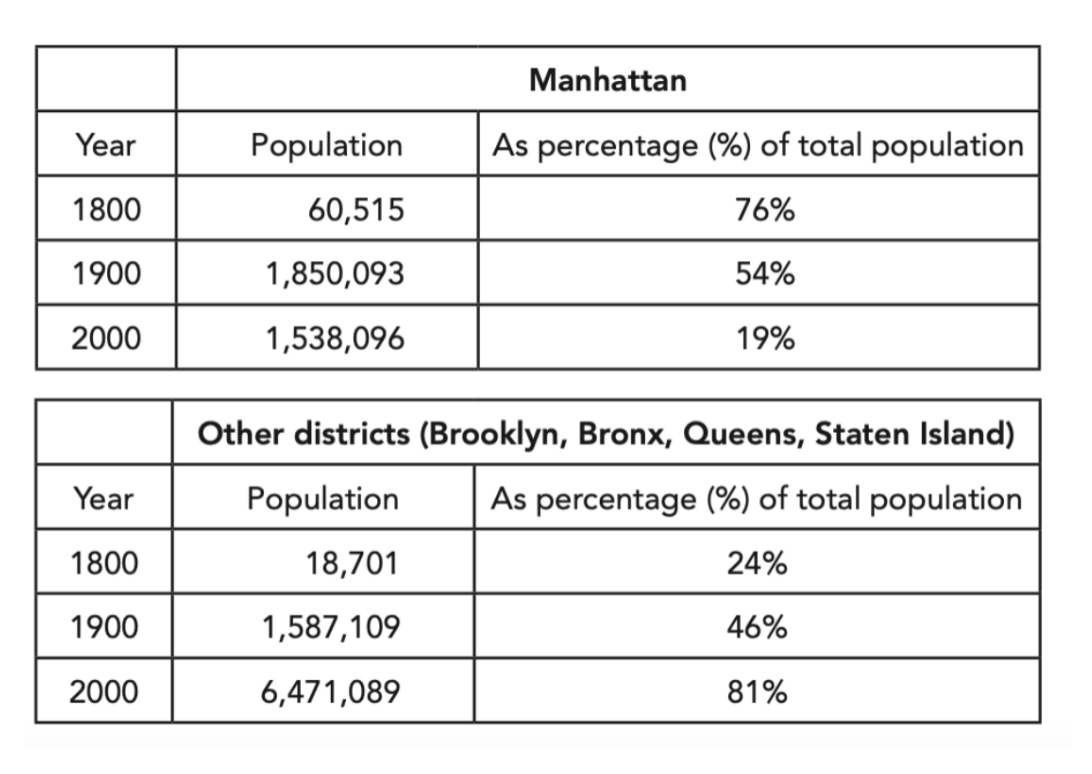
The first table below shows changes in the total population of New York City from 1800 to 2000. The second and third tables show changes in the population of the five districts of the city (Manhattan, Brooklyn, Bronx, Queens, Staten Island) over the same period.
Summarise the information by selecting and reporting the main features, and make comparisons where relevant.
Student answer (Band 5.0)
The first table illustrates the changes in the population of New york city from 1800 to till 2000. The second and third tables gives the information of the population of the five districts of the city, over the same period.
Overall, it is clear that they were significant differences in the main features shown in the given information with some aspects being more prominent than the others.
The chart shows the information about the New york city. In 1800, population is become low and they contain 79,216 and in 1900, the ratio of poulation are increase and they are 3,437,202. Last 2000, the ratio of the poulation are 8,009,185.
The second and third tables shows the percentage of the poulation. In 1800, population of the Manhattan district are 60,515 and they 76%. In 2000, the population contain 1,538,096 and total ratio is very low only 19%.
In 1800, other districts population are 18,701 and the percentage of the population are 24%. Finally, in 2000 population is very high 6,471,089 and the total percentage are 81%.
AI examiner evaluation
| Criterion | Band |
|---|---|
| Task Achievement / Task Response | 5.0 |
| Coherence and Cohesion | 5.0 |
| Lexical Resource | 5.0 |
| Grammatical Range and Accuracy | 4.5 |
| Overall | 5.0 |
Task Achievement / Task Response: Band 5.0
You report the overall city population figures accurately and include relevant comparisons for Manhattan and the other districts in 1800 and 2000. However, the response only partially covers the data: the important 1900 district figures are omitted, including Manhattan’s peak population of 1,850,093 and the other districts’ 46% share. The overview is also vague—“significant differences” does not identify the main trend that the city grew greatly while Manhattan’s share declined and the other districts became dominant. Some descriptions, such as saying the population “is become low” in 1800, are unclear. A more specific overview and coverage of all three years would make the report more complete.
Coherence and Cohesion: Band 5.0
The response has a basic paragraph structure, moving from an introduction and overview to the city total and then district figures. Time markers such as “In 1800,” “In 2000,” and “Finally” help readers follow individual details. However, there is no strong overall progression: the overview is generic, and the body paragraphs do not consistently compare the same years or groups. Repeated openings such as “In 1800” and “The chart shows” make the organisation feel list-like. Some linking is also awkward, for example, “Last 2000” and “and they 76%,” which interrupt the flow. Grouping the figures by year or by contrasting trends, and using clearer comparisons, would improve cohesion.
Lexical Resource: Band 5.0
You use some relevant task vocabulary, including “population,” “percentage,” “district,” and “significant differences,” so the topic is generally clear. However, the range is limited and several words or phrases are repeated, particularly “population” and “the information.” Some choices are inaccurate or unnatural: “the ratio of population” is not suitable for reporting population totals, and “the population contain” does not express the intended meaning. There are also spelling errors, including “New york” and “poulation.” Use precise reporting language such as “rose,” “reached,” “accounted for,” and “share,” while checking spelling and avoiding repeated generic phrases.
Grammatical Range and Accuracy: Band 4.5
The response relies mainly on simple sentence patterns, with limited evidence of controlled complex structures. Frequent errors in verb forms, agreement, and sentence construction make some statements difficult to read. For example, “The second and third tables gives” has a subject–verb agreement error, while “In 1800, population is become low” uses an incorrect verb form and tense. In “In 2000, the population contain 1,538,096 and total ratio is very low only 19%,” the clauses are not grammatically well formed. Articles and sentence punctuation are also inconsistent. Practise accurate past-tense reporting and basic comparison structures first, then combine ideas using clauses such as “while” or “whereas.”
See this exact question answered at other band scores. The same prompt compared across bands.
Browse more IELTS Writing model answers or get your own writing scored by the same AI examiner.