Band 6.0 IELTS Writing Task 1 Model Answer
Overall Band Score: 6.0 · Cambridge IELTS 20 · 2026-11-19
IELTS Writing Task 1 question
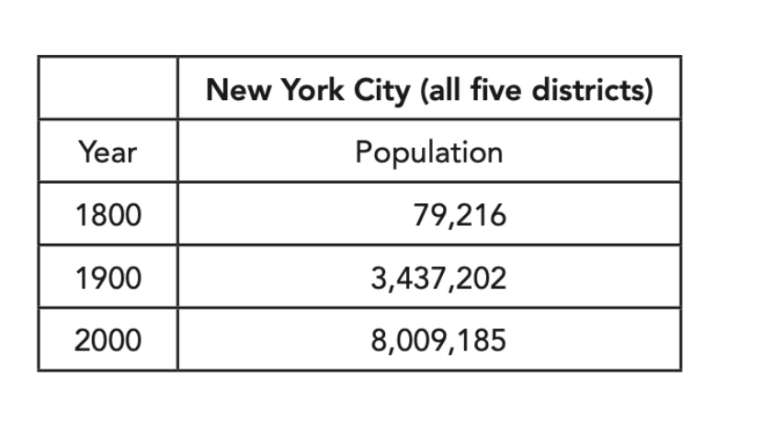
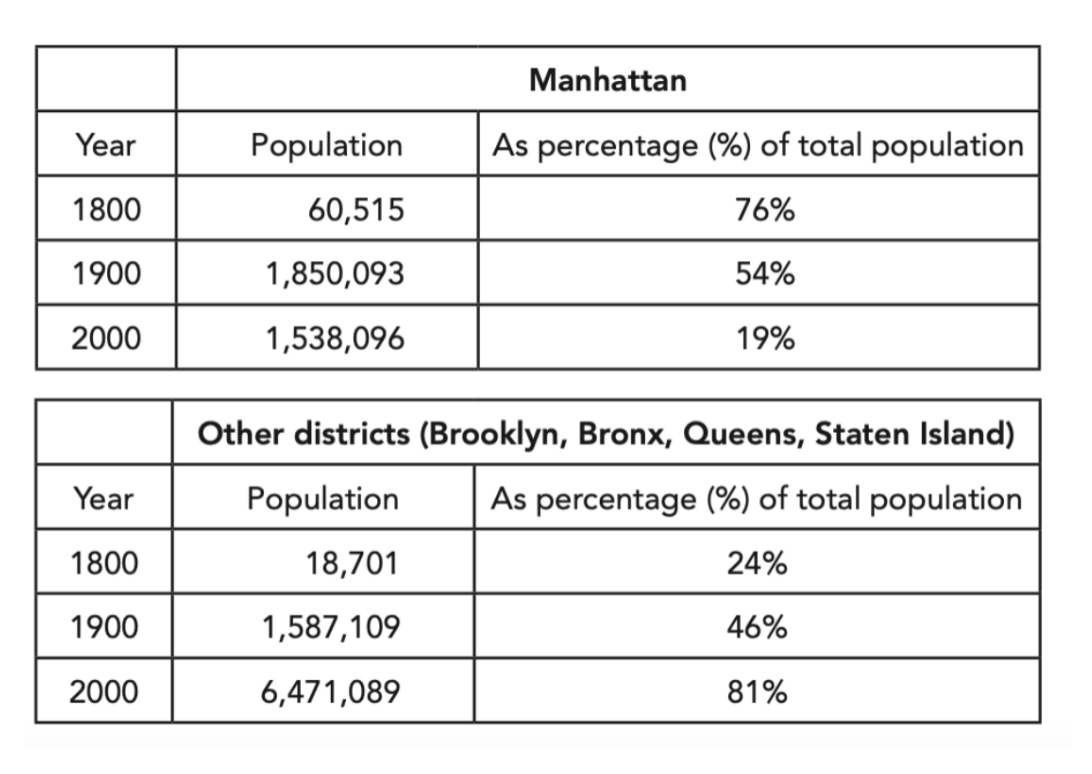
The first table below shows changes in the total population of New York City from 1800 to 2000. The second and third tables show changes in the population of the five districts of the city (Manhattan, Brooklyn, Bronx, Queens, Staten Island) over the same period.
Summarise the information by selecting and reporting the main features, and make comparisons where relevant.
Student answer (Band 6.0)
The first table illustrates variations in the total population of New York City between 1800 and 2000. The remaining two tables displays how the population of the five districts of the city changes over the same period.
Overall, the total population of all five districts shows a significant rise throught the periods. Whereas, the population of Manhattan increase then fell, while remaining districts experience a steady growth.
In terms of New York city, it begins with 79,216 population in 1800 before increasing to 3,437,202 in 1900 and reache to 8,009,185 in 2000. In case of Manhattan, it contribute with 60,515 at 76% of total population in 1800 and rise with 1850,093 in 1900 but, percentage of total population decline to 54%. Additionally, by 2000, it slightly fall to 1,538,096 and with just 19% of total population.
Regarding other districts, it started with small proportion of total population(18,701) with 24% in 1800 and after that, it showed a steady growth in population, reaching to 6,471,089 at 81% contribution to total population in 2000.
AI examiner evaluation
| Criterion | Band |
|---|---|
| Task Achievement / Task Response | 6.5 |
| Coherence and Cohesion | 6.5 |
| Lexical Resource | 6.0 |
| Grammatical Range and Accuracy | 5.5 |
| Overall | 6.0 |
Task Achievement / Task Response: Band 6.5
You cover the main changes and include accurate figures for the city total and the district groups. The overview identifies the overall rise and the contrasting pattern for Manhattan, while the body reports the key population and percentage changes. This is a relevant, reasonably clear summary. However, some features are less fully reported: Manhattan’s population peaked in 1900 and then fell by 2000, but “slightly fall” understates that decline, and the other districts’ figures for 1900 are omitted. The overview could also make the shift in population share more explicit. These limitations keep the account from being consistently precise and fully developed, although the main trends are covered.
Coherence and Cohesion: Band 6.5
The response has a clear four-part structure: introduction, overview, and separate paragraphs for the city and district figures. This gives the information a generally logical order, and transitions such as “Overall,” “In terms of,” and “Regarding” help signal the stages of the summary. Some links are less effective or mechanical, however. “Whereas” begins a sentence fragment-like contrast after a full stop, and “Additionally” does not clearly connect the final Manhattan figures to the preceding point. The paragraph on other districts also jumps from 1800 directly to 2000, leaving the middle year unintegrated. More precise linking and clearer connections between comparisons would make the progression smoother.
Lexical Resource: Band 6.0
You use an adequate range of task-related vocabulary, including “total population,” “proportion,” “steady growth,” and “decline,” and the meaning is generally clear. There are also attempts to vary reporting language, such as “illustrates,” “reaching,” and “contribution.” Some choices are inaccurate or unnatural for describing data: “contribute with” and “rise with” do not fit the intended meaning, while “it begins with … population” is awkward. “Slightly fall” also understates the change and is not the most precise description. Spelling errors such as “throught” and “reache” reduce accuracy. Aim for standard collocations such as “stood at,” “rose to,” and “accounted for,” and check spelling carefully.
Grammatical Range and Accuracy: Band 5.5
You attempt both simple and more complex sentence forms, including a contrast with “while” and clauses introduced by “before” and “reaching.” The main information remains understandable, but some grammatical errors recur. For example, “The remaining two tables displays” has subject–verb disagreement, and “the population … shows” is followed by the incorrect “increase” in the overview. The sentence beginning “Whereas” is not properly joined to the preceding sentence. There are also problems with articles and sentence construction in “it contribute with 60,515 at 76%” and “with just 19% of total population.” Greater control of verb forms, agreement, and complete sentence boundaries would improve accuracy while preserving your attempts at varied structures.
See this exact question answered at other band scores. The same prompt compared across bands.
Browse more IELTS Writing model answers or get your own writing scored by the same AI examiner.