Band 4.5 IELTS Writing Task 1 Model Answer
Overall Band Score: 4.5 · Cambridge IELTS 20 · 2026-11-19
IELTS Writing Task 1 question
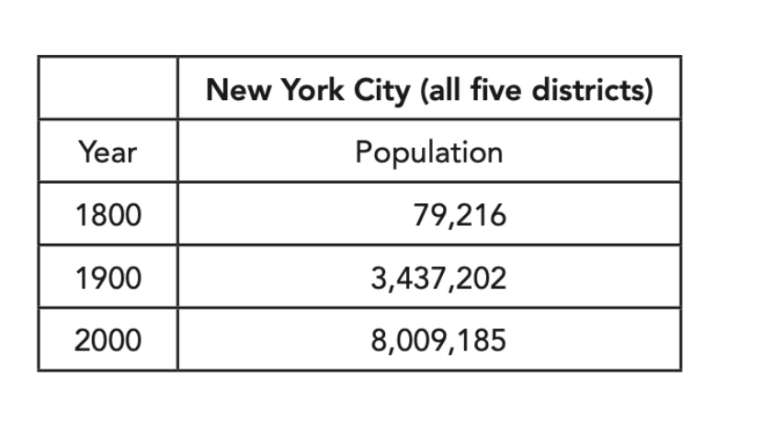
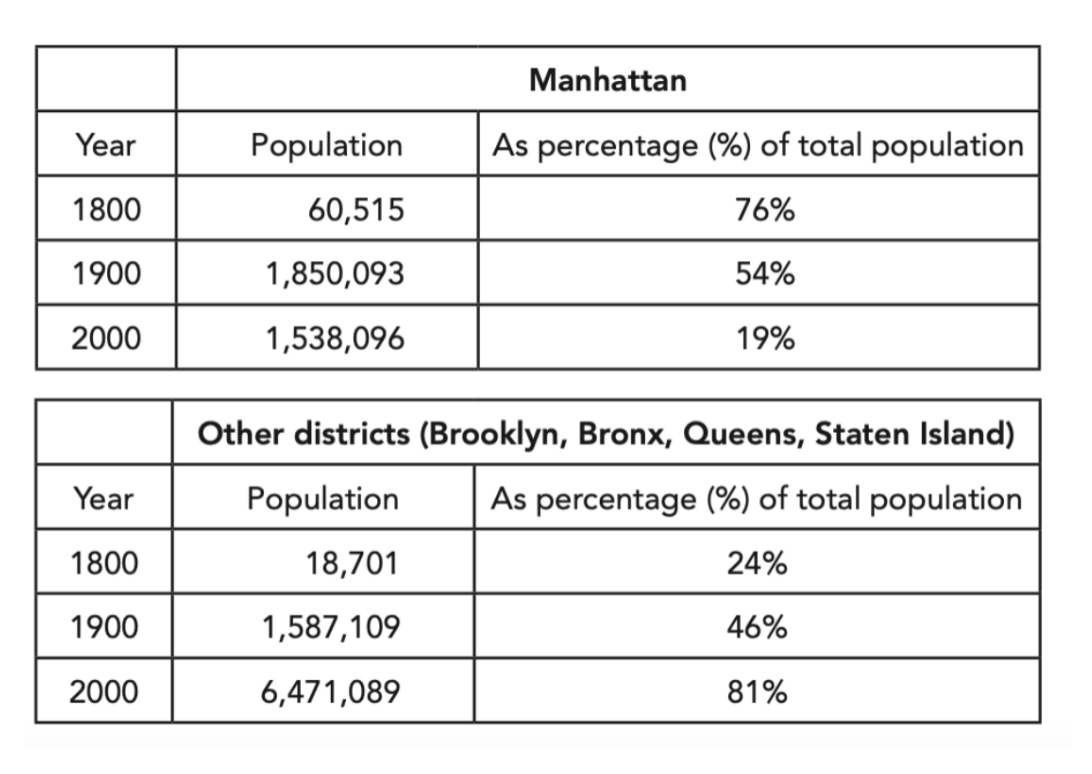
The first table below shows changes in the total population of New York City from 1800 to 2000. The second and third tables show changes in the population of the five districts of the city (Manhattan, Brooklyn, Bronx, Queens, Staten Island) over the same period.
Summarise the information by selecting and reporting the main features, and make comparisons where relevant.
Student answer (Band 4.5)
The first table below define the information regarding changes in the total inhabitants of new york city from 1800 to 2000. the second and third table demonstrates the people of the five regions of the city (Manhattan, brooklyn, Queens, state island) between the same year.
overall, Manhattan had the highest population had the start of the time period while the population had decrease from highest to the lowest
the population of mahattan population had decrease year by year which is 76% in 1800 and its population increase to [redacted phone] 54% and in year 2000 the population were drop to [redacted phone] which is 19% of all.
the population of the other districts (broooklyn, bronx, Queens, Staten island) the population of this regions were grandually increase year by year in 1800 the population of this areas 24% which is 18701 in addition the
AI examiner evaluation
| Criterion | Band |
|---|---|
| Task Achievement / Task Response | 4.5 |
| Coherence and Cohesion | 4.0 |
| Lexical Resource | 5.0 |
| Grammatical Range and Accuracy | 4.5 |
| Overall | 4.5 |
Task Achievement / Task Response: Band 4.5
You identify the broad contrast between Manhattan and the other districts, and you include several relevant figures, such as Manhattan’s 76% share in 1800 and 19% in 2000. However, the response is incomplete: it stops mid-sentence after “in addition the” and does not report the overall city population figures or explain the key change by 2000, when the other districts accounted for 81% of residents. The claim that Manhattan’s population decreased “year by year” is not supported by the tables, which show only three dates; its population rose to a peak in 1900 before falling. The response is also 21 words below the 150-word minimum, with prompt wording excluded from the count. Include a concise overview and complete the main comparisons.
Coherence and Cohesion: Band 4.0
There is a basic attempt to organise the response: an opening sentence introduces the tables, followed by an overview and separate discussion of Manhattan and the other districts. This gives the reader some sense of the intended structure. However, progression is difficult to follow because the overview is incomplete and the final paragraph breaks off mid-sentence. Connections between figures are also unclear; for example, the Manhattan sentence combines population and percentage changes without clearly distinguishing them. The repeated phrase “the population” and the unfinished “in addition the” further weaken cohesion. Use complete paragraphs, group the figures by period or district, and connect comparisons with clear, accurate linking phrases.
Lexical Resource: Band 5.0
The response uses some relevant task vocabulary, including “total,” “population,” “districts,” and “percentage,” so the topic is generally recognisable. However, the range is limited and several word choices or spellings reduce clarity: “inhabitants” is awkward in this context, “regions” is less precise than “districts,” and “grandually” is misspelled. “The population of this regions” also shows imprecise phrasing, while “had decrease” does not express the intended trend naturally. Aim for accurate, varied terms such as “residents,” “share of the total,” “rose,” and “fell,” and check spelling and collocations before submitting.
Grammatical Range and Accuracy: Band 4.5
The response attempts to communicate comparisons using time references and clauses, but sentence structures are mostly simple and frequent grammatical errors make several statements difficult to interpret. Examples include “The first table below define,” “the second and third table demonstrates,” and “the population … had decrease”; these contain subject–verb agreement, plural, and verb-form problems. The sentence beginning “overall” is also incomplete or malformed, and the final sentence is unfinished. Capitalisation and punctuation are inconsistent, including lowercase sentence openings and place names. Practise accurate simple sentences first, then combine them with controlled clauses—for example, stating that Manhattan’s population rose by 1900 but fell by 2000.
See this exact question answered at other band scores. The same prompt compared across bands.
Browse more IELTS Writing model answers or get your own writing scored by the same AI examiner.