Band 5.0 IELTS Writing Task 1 Model Answer
Overall Band Score: 5.0 · Cambridge IELTS 20 · 2026-11-19
IELTS Writing Task 1 question
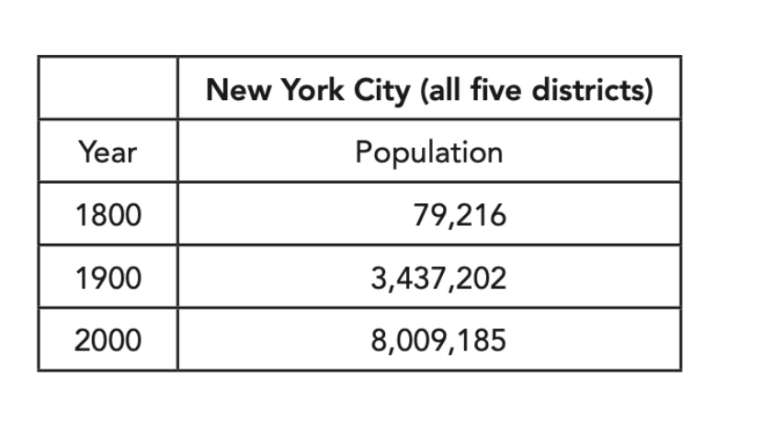
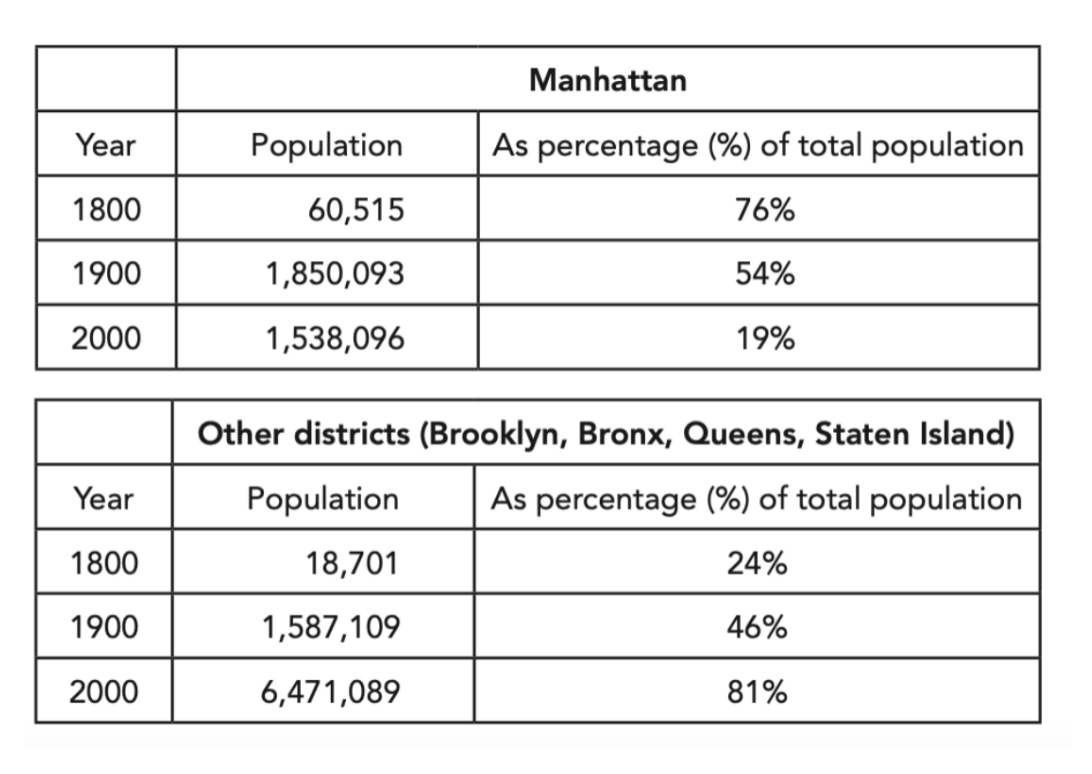
The first table below shows changes in the total population of New York City from 1800 to 2000. The second and third tables show changes in the population of the five districts of the city (Manhattan, Brooklyn, Bronx, Queens, Staten Island) over the same period.
Summarise the information by selecting and reporting the main features, and make comparisons where relevant.
Student answer (Band 5.0)
The table shows the total population of New York City of five districts from 1800 to 2000 but the remaining two tables illustrates the change in population respectivelt.
Overall, first paragraph shows the increase the population but neext two tables shows the increase/ decrease the population of five districts.
Firstly, the population in 1800 is 79,216 and it increases every year. However, in 2,000 the population is almost double that is 8,009,185. On the other hand, in 1800, Manhattan has the population of 60,515 with the population of 76%. but, it gradually increases every year but in 2000, the population is 1,538,096.
Secondly, the other four districts Brooklyn, Bronx, Queens and Staten Island has almost the same population as compared to the Manhattan district. In 2000 the population is 6,471,089 with the percentage of 81%. This percentage of total population is highest that is 81% on the comparision of both tables.
AI examiner evaluation
| Criterion | Band |
|---|---|
| Task Achievement / Task Response | 5.0 |
| Coherence and Cohesion | 5.0 |
| Lexical Resource | 5.0 |
| Grammatical Range and Accuracy | 5.0 |
| Overall | 5.0 |
Task Achievement / Task Response: Band 5.0
You identify the overall rise in New York City’s population and report several relevant figures, including the 1800 total and the 2000 populations of Manhattan and the other districts. However, the account only partially covers the main changes: it omits the 1900 city total and district figures, and does not clearly highlight that Manhattan’s population peaked in 1900 before falling by 2000, while the other districts grew substantially. The statement that the total “is almost double” in 2000 is inaccurate: 8,009,185 is more than twice the 1900 figure, not almost double the 1800 figure. The overview is also unclear about which populations increased or decreased. Select the key comparisons and describe the three dates accurately.
Coherence and Cohesion: Band 5.0
The response has a basic structure, moving from an introduction and overview to comments on Manhattan and the other districts. Sequencing words such as “Firstly” and “Secondly” help signal these sections. However, progression is limited because the overview does not clearly summarise the main contrast, and the body does not compare the figures consistently across all three dates. Some linking is confusing or repetitive: “but” appears several times, and “On the other hand” does not introduce a clear contrast. References such as “the first paragraph” and “the next two tables” are also awkward and do not help the reader follow the data. Organise the report around the overall trend, then compare Manhattan with the combined other districts using the same dates.
Lexical Resource: Band 5.0
You use some relevant task vocabulary, including “population,” “districts,” “percentage,” and “increases,” so the topic is generally understandable. However, the range is limited and several choices or forms are inaccurate, such as “change in population respectivelt,” “almost the same population,” and “on the comparision.” The phrase “increase/ decrease” is vague and does not explain the contrasting trends. Repetition of “population” and “increases” also makes the report less precise. Use more specific terms for the data, such as “accounted for,” “rose,” “declined,” and “share of the total,” and check spelling and collocations. This would make comparisons clearer without requiring unnecessarily complex vocabulary.
Grammatical Range and Accuracy: Band 5.0
The response attempts both simple and joined sentences, for example, “However, in 2,000…” and “Secondly, the other four districts…,” but complex constructions are often faulty and errors occur frequently. Examples include “the remaining two tables illustrates,” where the subject and verb do not agree, and “the population in 1800 is 79,216 and it increases every year,” which uses an unsuitable present tense for historical data and claims annual figures not shown. Articles and sentence boundaries are also problematic in “the population of 76%. but,” while “districts … has” has incorrect agreement. Use past-tense verbs consistently, check singular and plural subjects, and separate sentences with appropriate punctuation. A wider range of accurately controlled sentence patterns would improve clarity.
See this exact question answered at other band scores. The same prompt compared across bands.
Browse more IELTS Writing model answers or get your own writing scored by the same AI examiner.