Band 5.0 IELTS Writing Task 1 Model Answer
Overall Band Score: 5.0 · Cambridge IELTS 20 · 2026-11-19
IELTS Writing Task 1 question
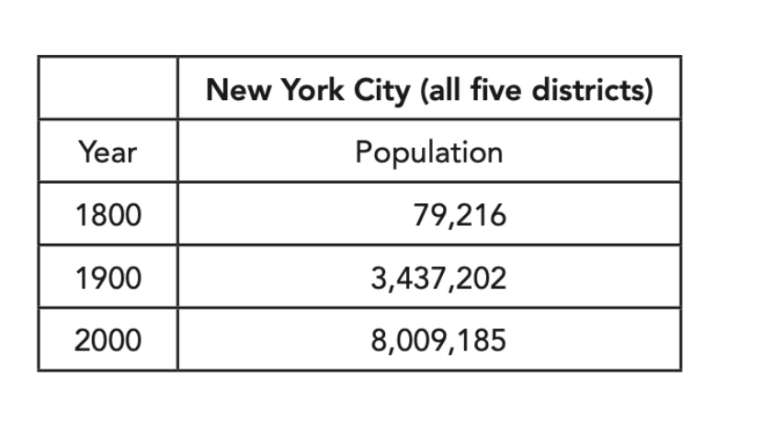
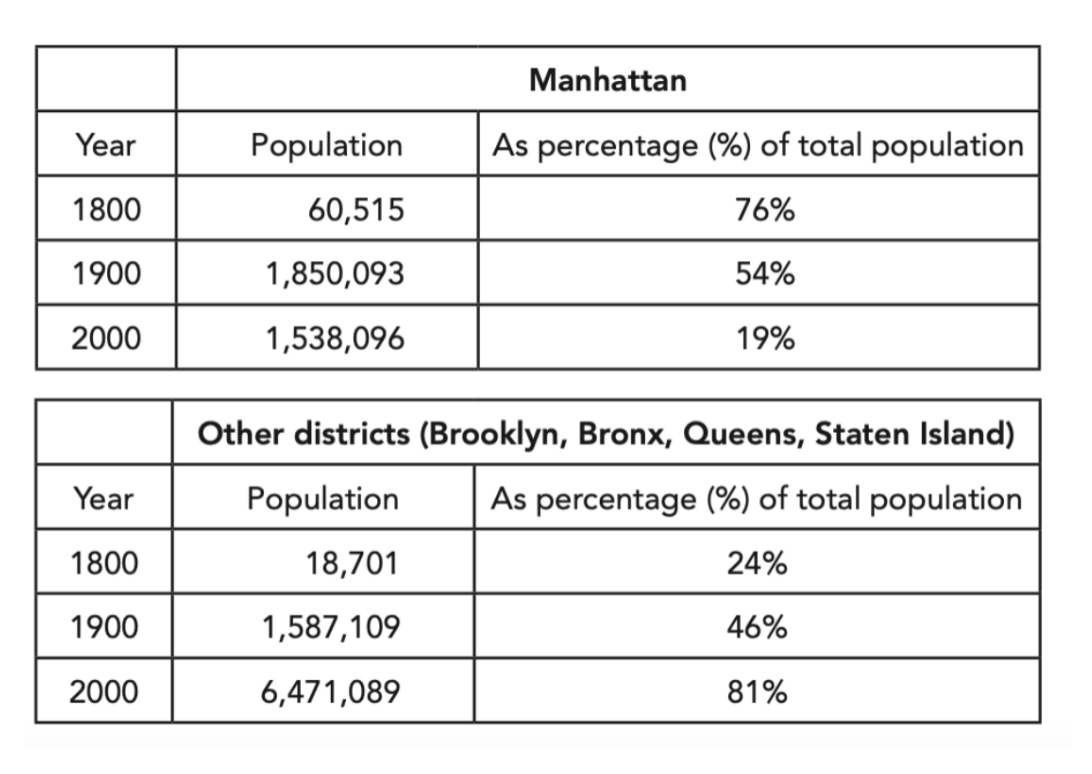
The first table below shows changes in the total population of New York City from 1800 to 2000. The second and third tables show changes in the population of the five districts of the city (Manhattan, Brooklyn, Bronx, Queens, Staten Island) over the same period.
Summarise the information by selecting and reporting the main features, and make comparisons where relevant.
Student answer (Band 5.0)
The intially chart demonstrates decrease and increase in the overall population of New York City from 1800 to 2000. The next and after the next matrix illustrates the population of the five districts of the city (Manhattan,Brooklyn,Bronx,Queens,Staten Island) within exact duration.
As we take a glance on the population of all five districts of New York City in 1800s is 79,216. Likewise it rise to 3,437,202. As well as in 2000 it increase to 8,009,185.
Looking at the others ditricts compare to manhattan is that we can see in 1800s manhattan is 76% but in the other districts the population is 18,701(24%). However, if catch a sight on manhattan in 1900s so thier percentage is 54% as compare to other districts it is lower from them. Because they are 46%. If we observe the proportion in manhattan in 2000% the ratio is 19%. (1,538,096). As we look to other five districts the population jump dramatically. the ratio is 81%(6,471,089).
AI examiner evaluation
| Criterion | Band |
|---|---|
| Task Achievement / Task Response | 5.0 |
| Coherence and Cohesion | 5.0 |
| Lexical Resource | 5.0 |
| Grammatical Range and Accuracy | 5.0 |
| Overall | 5.0 |
Task Achievement / Task Response: Band 5.0
You include relevant figures for all three years and identify the major shift from Manhattan’s 76% share in 1800 to 19% in 2000, while the other districts rise from 24% to 81%. However, the response only partially fulfils the task: it has no clear overview that summarises the main trends, and the opening incorrectly describes the city’s population as showing both a decrease and an increase, although the total rises throughout. Some comparisons are also unclear, and the 1900 Manhattan population is omitted. The response is 138 words, below the required 150, which limits the opportunity to report and compare the key features fully. Add a concise overview and explain the contrast between Manhattan’s decline after 1900 and continued growth elsewhere.
Coherence and Cohesion: Band 5.0
The response has a basic structure, moving from the total population to the district figures, and connectors such as “Likewise,” “However,” and “As well as” show an attempt to link information. Nevertheless, there is no distinct overview, and the progression within the second paragraph is difficult to follow: the discussion shifts between years, percentages and population counts without a consistent comparison pattern. Some linking phrases are inaccurate or repetitive, while “if catch a sight” and “As we look to other five districts” make relationships between ideas unclear. Organise the report into an introduction, an overview, and a paragraph comparing the district data across the three years. Use time-based sequencing and clear references to distinguish population totals from percentage shares.
Lexical Resource: Band 5.0
You use some relevant task vocabulary, including “overall population,” “percentage,” “proportion,” and “ratio,” and the reader can generally identify the figures being discussed. However, the range is limited and several word choices or collocations are inaccurate, sometimes making the meaning difficult to follow. For example, “the intially chart” and “the next and after the next matrix” do not describe the tables naturally, while “the population jump dramatically” is imprecise because the figure given is a share of the total. Spelling errors such as “ditricts” and “thier” also reduce accuracy. Choose standard terms such as “table,” “districts,” “share,” and “accounted for,” and use “population” only for the numerical totals.
Grammatical Range and Accuracy: Band 5.0
You attempt both simple and more extended sentences, including comparisons introduced by “However” and “Because,” but control is inconsistent. Errors in verb forms and sentence construction occur frequently: “it rise” and “it increase” should be “it rose” and “it increased,” while “in 1800s … is 79,216” needs a clear time reference and past-tense verb. Several clauses are incomplete or awkwardly joined, as in “Because they are 46%,” and “If we observe the proportion … the ratio is 19%.” Punctuation and spacing around names and figures are also inconsistent. Practise writing complete past-tense sentences with a clear subject and verb, and use subordinate clauses only when they form a complete sentence.
See this exact question answered at other band scores. The same prompt compared across bands.
Browse more IELTS Writing model answers or get your own writing scored by the same AI examiner.