Band 5.0 IELTS Writing Task 1 Model Answer
Overall Band Score: 5.0 · Cambridge IELTS 20 · 2026-11-19
IELTS Writing Task 1 question
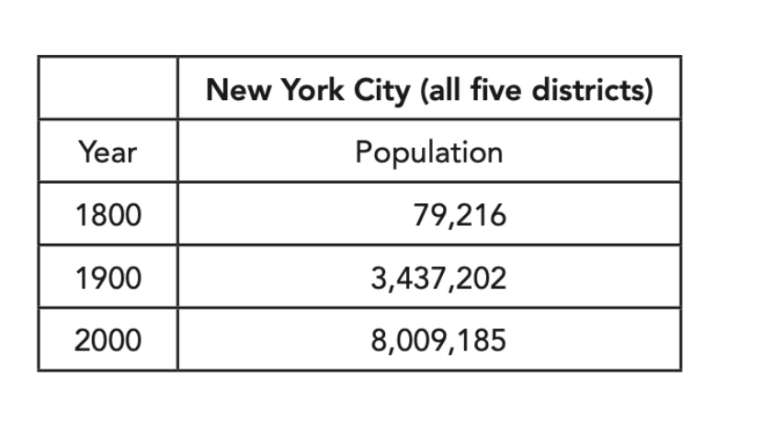
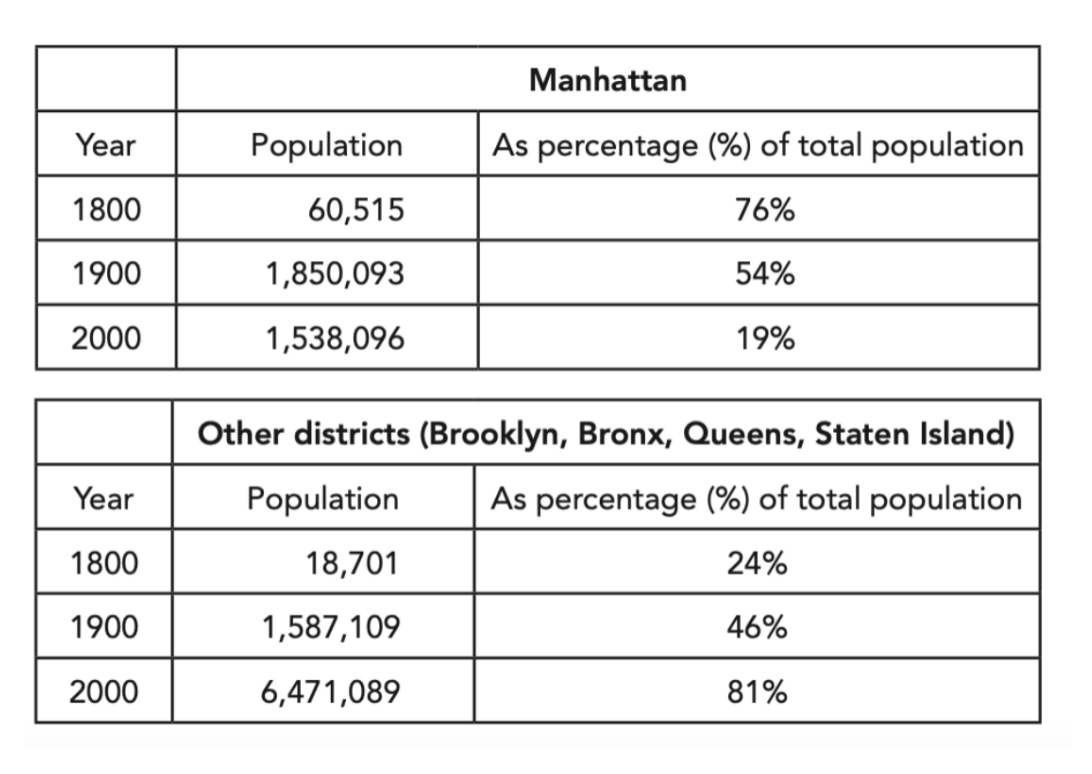
The first table below shows changes in the total population of New York City from 1800 to 2000. The second and third tables show changes in the population of the five districts of the city (Manhattan, Brooklyn, Bronx, Queens, Staten Island) over the same period.
Summarise the information by selecting and reporting the main features, and make comparisons where relevant.
Student answer (Band 5.0)
From the following information given we can see that how population have been changed overtime and from the first table we can conclude the overall population of the five districts in a overview and with second table we could clearly see how much population changed overtime exactly.
From the second table we can see clearly see that the reduction in population in Manhattan district as time changes, at the end of 18th century there were 76 percentage of population who were present within a century the population reduced to 54 percentage and at the end of 20th century further even it reduced to just 19 percentage which is bery drastic.
On the other hand, rest 4 districts drastically increased overtime which include Brooklyn, Bonx, Queens, Staten Island. Initially at the end of 18th century it was just 24 percentage and later when time changes it increased to 46 percentage in a century and even more in the next century, at the end of 20th century it was almost 3 and half times increase in population respective with 18th century. This shows people are more convenient in these districts and started to expand their livelihood more in this cities.
Conclusion:
People started to live more and more as time changes in the other 4 districts while compared to Manhattan districts.
AI examiner evaluation
| Criterion | Band |
|---|---|
| Task Achievement / Task Response | 5.5 |
| Coherence and Cohesion | 5.0 |
| Lexical Resource | 5.0 |
| Grammatical Range and Accuracy | 5.0 |
| Overall | 5.0 |
Task Achievement / Task Response: Band 5.5
You identify the main contrast: Manhattan’s share of the city population fell, while the other four districts’ share rose. The percentages you report—76%, 54%, and 19% for Manhattan, and 24%, 46%, and 81% for the other districts—match the tables. However, the response only partly summarises the task because it omits the striking growth in New York City’s total population, from 79,216 in 1800 to over 8 million in 2000, and gives no district population figures. Some interpretation is also unsupported: the claim that people found the other districts more convenient is not shown by the data. Include a concise overview and select key figures to support the comparisons.
Coherence and Cohesion: Band 5.0
There is some organisation: the response moves from an introduction to Manhattan, then the other districts, and ends with a conclusion. Contrast markers such as “On the other hand” help signal the comparison. However, the progression is not consistently clear because the opening repeats “we can see” and does not state the main trend directly, while the conclusion largely repeats the preceding point. Several sentences are overloaded with multiple time comparisons, making relationships harder to follow. The phrase “within a century” is also unclear about which period is meant. Use separate paragraphs for the overview and the key comparisons, and connect each date explicitly to its figures.
Lexical Resource: Band 5.0
The vocabulary is sufficient to communicate the broad comparison, with useful terms such as “reduction,” “increased,” and “percentage.” However, the range is limited and several choices are inaccurate or repetitive, including repeated uses of “clearly see,” “drastically,” and “overtime.” “Population” is also used where “share” or “proportion” would more accurately describe the percentages. The phrase “expand their livelihood” does not express a clear data-based idea, and “respective with” is an unsuitable collocation. Aim for precise table-description language and avoid adding speculative explanations. Check spelling as well, particularly “Bonx” and “bery,” which reduce accuracy.
Grammatical Range and Accuracy: Band 5.0
The response attempts longer sentences and some subordinate clauses, but complex structures are often faulty, and errors occur frequently enough to make parts difficult to read. For example, “how population have been changed” has problems with the article, verb form, and word order; “there were 76 percentage of population” has an incorrect construction; and “at the end of 20th century further even it reduced” has unclear word order. There are also errors in agreement and articles, as in “the population ... it was,” and punctuation is inconsistent, including extra spaces and a colon before the conclusion. Build accuracy with shorter sentences first, then add controlled comparisons using forms such as “fell from … to …”.
See this exact question answered at other band scores. The same prompt compared across bands.
Browse more IELTS Writing model answers or get your own writing scored by the same AI examiner.