Band 5.5 IELTS Writing Task 1 Model Answer
Overall Band Score: 5.5 · Cambridge IELTS 20 · 2026-11-19
IELTS Writing Task 1 question
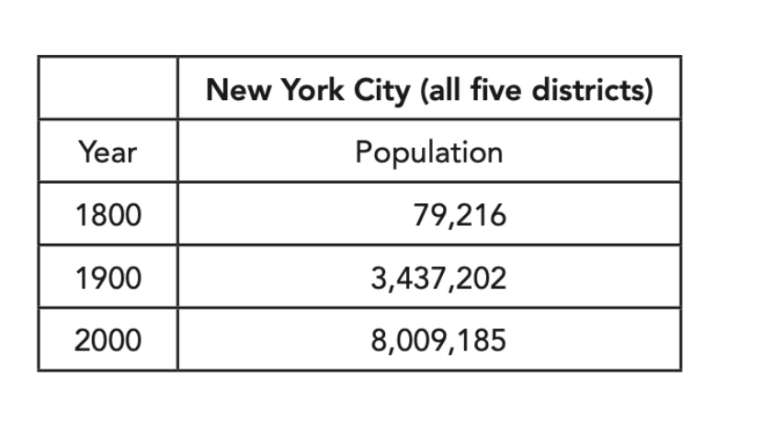
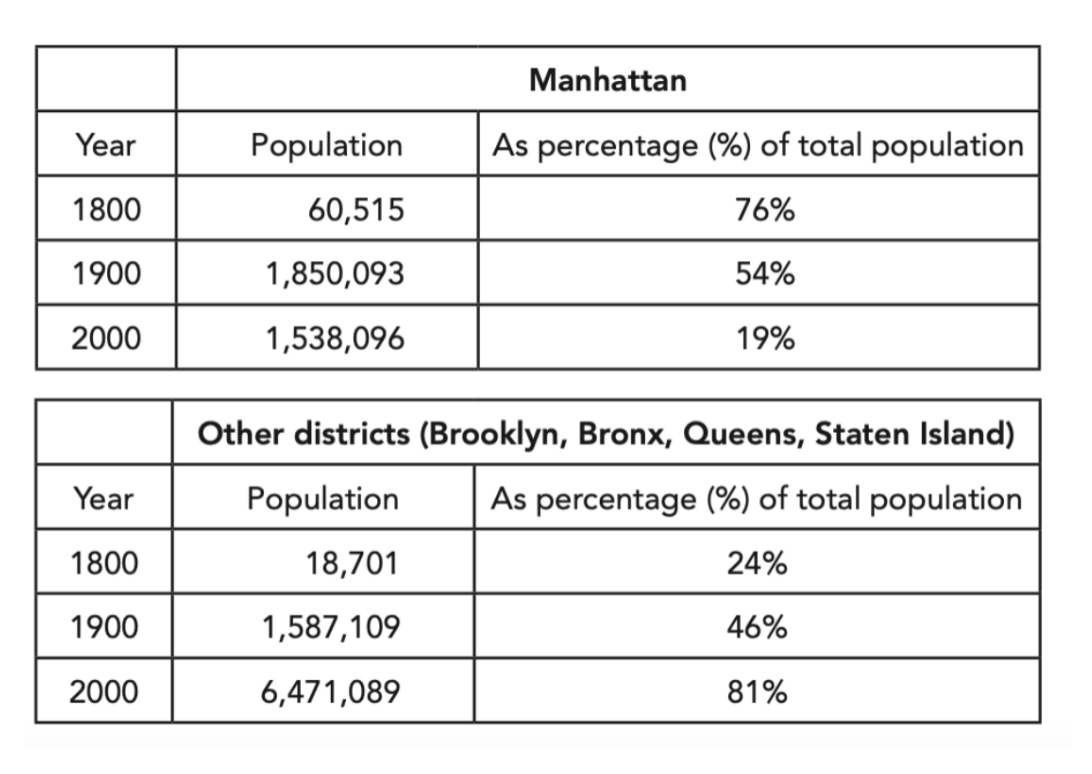
The first table below shows changes in the total population of New York City from 1800 to 2000. The second and third tables show changes in the population of the five districts of the city (Manhattan, Brooklyn, Bronx, Queens, Staten Island) over the same period.
Summarise the information by selecting and reporting the main features, and make comparisons where relevant.
Student answer (Band 5.5)
Three tables showing the total population of people living in New York City and it's district in the year 1800 to 2000 respectively.
Firstly, looking at the first table given, it shows the total number of people living in New York City as whole without separating the district. In 1800 the population was recorded as 79,216. As the years goes by in 1900 another census was taken and the population was at 3,437,202 indicating a signficant increase then in 2000 population rose to 8,009,185 precisely.
Furthermore, if you check below the first table you will see that there are two more tables there which has the population of the 5 districts in NYC. The second one has the population of individuals in Manhattan while the third and last table has the total census of people in other districts like Bronx, Queens, Brooklyn etc. In 1800 Manhattan had the population of 76% while the other district had 24%. Moving on to 1900 manhattan population dropped to 54% while that same year the other district head count increased to 46%. then in 2000 Manhattan population dropped drastically to 19% while there was a huge increase on the other district.
In conclusion, the amount of individual in Manhattan was dropping and the population of other district was increasing on the other head. which means thst individual where moving from Manhattan together district ohh
AI examiner evaluation
| Criterion | Band |
|---|---|
| Task Achievement / Task Response | 6.0 |
| Coherence and Cohesion | 6.0 |
| Lexical Resource | 5.0 |
| Grammatical Range and Accuracy | 5.0 |
| Overall | 5.5 |
Task Achievement / Task Response: Band 6.0
You cover the main population changes and identify the key contrast: Manhattan’s share fell from 76% to 19%, while the other districts’ share rose from 24% to 81%. The total-city figures are also reported accurately, and the response includes a general concluding comparison. However, some features are less fully reported: the other districts’ actual population figures are omitted, and Manhattan’s population rose to 1,850,093 in 1900 before falling to 1,538,096 in 2000, a change not captured by saying only that its population was “dropping.” The final claim that people were moving out of Manhattan is not demonstrated by the tables. A clearer overview and more precise reporting of the population counts would make the summary more complete.
Coherence and Cohesion: Band 6.0
The response has a recognisable overall structure: an introduction, discussion of the total population, a paragraph comparing Manhattan with the other districts, and a conclusion. Sequencing expressions such as “Firstly,” “Furthermore,” and “Moving on to 1900” help guide the reader through the data. However, some linking is mechanical or imprecise, and the conclusion repeats the comparison rather than synthesising the main trend. References such as “the second one” and “the third and last table” make the reader rely on table order instead of clearly naming the groups. The final sentence is difficult to follow and weakens the ending. Organise the body around the overall population trend and the changing district shares, using clear references and a concise overview.
Lexical Resource: Band 5.0
You use some relevant vocabulary for describing data, including “population,” “census,” “significant increase,” and “dropped drastically.” However, the range is limited and several expressions are repetitive or imprecise, such as “number of people living” and “population of individuals.” Some word choices and spelling errors reduce clarity, including “head count,” “thst,” and “ohh”; “other district” is also used where the plural is needed. The phrase “moving from Manhattan” introduces an unsupported interpretation rather than describing the figures. Aim for precise, varied terms such as “population,” “share,” “accounted for,” and “rose/fell,” and check spelling and collocations before submitting.
Grammatical Range and Accuracy: Band 5.0
You attempt both simple and more extended sentences, and the main figures and comparisons are generally understandable. However, there are recurring errors in agreement, tense, articles, and sentence construction. For example, “As the years goes by” should be “As the years went by,” and “the second and last table … has” needs a plural verb if referring to tables. The opening is a sentence fragment, while “In conclusion … was dropping … was increasing” shifts awkwardly between past and progressive forms. Punctuation and capitalisation are also inconsistent, particularly at the start of sentences and with “Manhattan.” Practise writing complete, controlled sentences and use the past simple consistently to report the three historical years.
See this exact question answered at other band scores. The same prompt compared across bands.
Browse more IELTS Writing model answers or get your own writing scored by the same AI examiner.