Band 5.5 IELTS Writing Task 1 Model Answer
Overall Band Score: 5.5 · Cambridge IELTS 20 · 2026-11-20
IELTS Writing Task 1 question
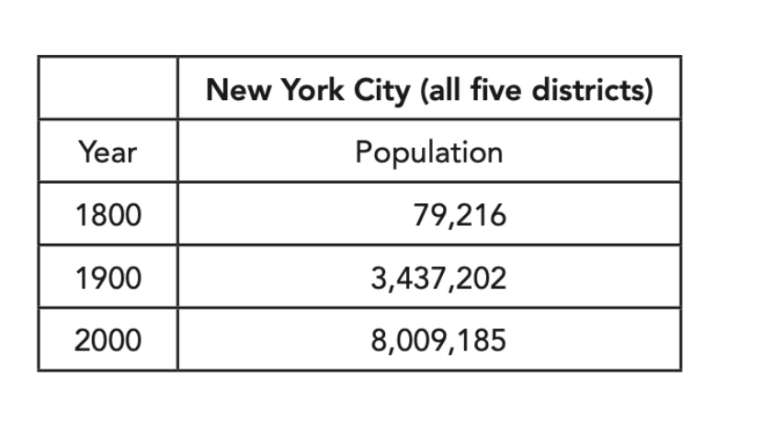
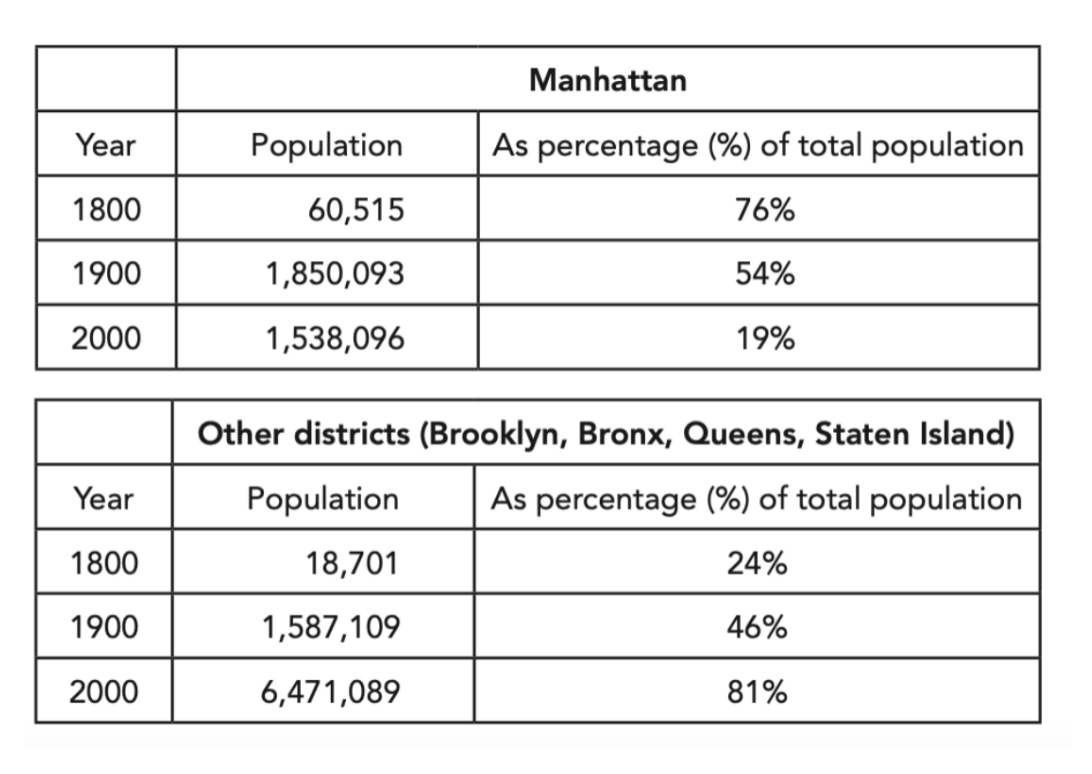
The first table below shows changes in the total population of New York City from 1800 to 2000. The second and third tables show changes in the population of the five districts of the city (Manhattan, Brooklyn, Bronx, Queens, Staten Island) over the same period.
Summarise the information by selecting and reporting the main features, and make comparisons where relevant.
Student answer (Band 5.5)
The table illustrates the changes in the overall population of New York from 1800 and 2000. It also shows the changes in population of the five districts of the city namely Manhattan, Brooklyn, Bronx, Queens and Staten Island. Overall, the population in New York City has significantly grew in numbers over the span of 3 decades. From 79,216 it grew to 3,437,202 in the 1900 and 8,009,185 in year 2000. Manhattan has the highest percentage of total population in 1800 at 76% while the other distrcits shares on the rest which is 24%. In 1900, the population of Manhattan and the other districts were almost the same by 46% and 54%. While in latest year which is 2000, the other 5 districts has overpower the Manahattan in population by 81% and 19%. We can conclude that over the years, population in New York has spread over the 5 districs.
AI examiner evaluation
| Criterion | Band |
|---|---|
| Task Achievement / Task Response | 5.5 |
| Coherence and Cohesion | 5.5 |
| Lexical Resource | 6.0 |
| Grammatical Range and Accuracy | 5.5 |
| Overall | 5.5 |
Task Achievement / Task Response: Band 5.5
You identify the main overall rise in New York City’s population and the shift in population share from Manhattan to the other districts. The figures you give for the city total and the percentages in 1800, 1900 and 2000 match the tables. However, the response is under the required 150 words, with 141 words counted (eight words copied from the prompt were excluded). It also omits the important detail that Manhattan’s population rose to 1,850,093 in 1900 before falling to 1,538,096 by 2000, even as the other districts grew substantially. The overview is relevant, but the final claim that population “spread over the 5 districts” is imprecise. Add key population figures and clarify the comparison.
Coherence and Cohesion: Band 5.5
The response follows a generally understandable order: it introduces the tables, gives an overall statement, and then compares the three years. Phrases such as “Overall” and “In 1900” help signal the stages. However, the whole report is presented as one paragraph, and the progression between details is sometimes awkward. The sentence beginning “While in latest year” is a fragment, and “We can conclude” repeats the overview rather than adding a distinct final point. Some references, such as “the other 5 districts,” are unclear because the table groups four districts together as the other districts, in contrast with Manhattan. Use separate paragraphs for the overview and details, and connect comparisons more directly.
Lexical Resource: Band 6.0
You use an adequate range of task-related vocabulary, including “overall population,” “percentage,” “significantly,” and “over the years,” so the main comparisons remain understandable. There are also attempts at more descriptive wording, such as “spread over,” although this is not a precise way to describe a changing population distribution. Several word-choice and spelling problems reduce accuracy: “overpower” does not fit the demographic comparison, “distrcits” and “Manahattan” are misspelled, and “grew in numbers” is an awkward collocation. Aim for precise terms such as “accounted for,” “share,” and “declined,” and check spelling carefully. More varied, accurate language for increases, decreases and proportions would make the report clearer.
Grammatical Range and Accuracy: Band 5.5
The report includes both simple statements and attempts at longer structures, and the main message is usually clear. However, some grammatical errors affect accuracy. In “has significantly grew,” the verb form should be “has grown”; “from 1800 and 2000” needs “from 1800 to 2000”; and “the other districts shares” has a subject–verb agreement error. The phrase “in the 1900” also uses an unnecessary article, while “While in latest year…” is not a complete sentence. These issues show that longer sentence patterns are not yet consistently controlled. Practise accurate past-tense descriptions and complete comparison sentences, for example: “By 2000, the other districts accounted for 81% of the population.”
See this exact question answered at other band scores. The same prompt compared across bands.
Browse more IELTS Writing model answers or get your own writing scored by the same AI examiner.