Band 5.5 IELTS Writing Task 1 Model Answer
Overall Band Score: 5.5 · Cambridge IELTS 20 · 2026-11-20
IELTS Writing Task 1 question
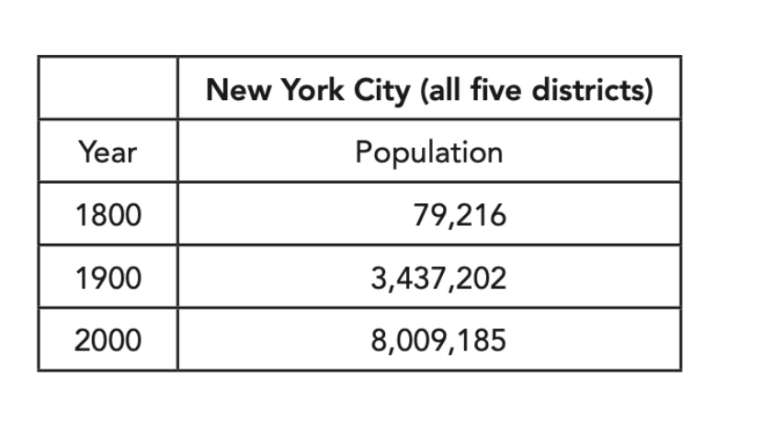
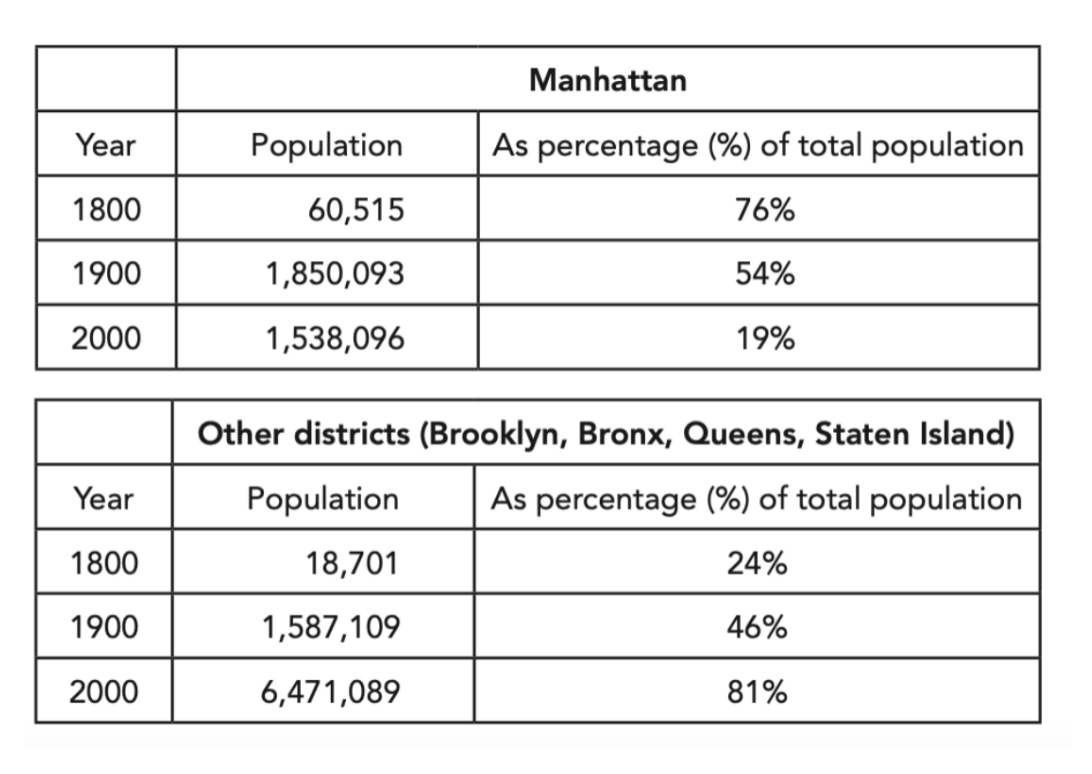
The first table below shows changes in the total population of New York City from 1800 to 2000. The second and third tables show changes in the population of the five districts of the city (Manhattan, Brooklyn, Bronx, Queens, Staten Island) over the same period.
Summarise the information by selecting and reporting the main features, and make comparisons where relevant.
Student answer (Band 5.5)
Changes in total population of New York city from 1800 to 2000 shown in first table. Second and third table illustrate the changes in the population of five districts of the New York city in same years.
Overall, the population of five districts was highest in 2000 and least in 1800. In 1900 Manhattans population was at peak and lowest in 1800.
To begin with, In the year 1800 population of all five cities were 79,216 as comparing Manhattans population was 60,515 with the percentage 76%.
As in 1900 population of all districts was 3,437,202 with comparison the population of Manhattan was 1,850,093 at 54% and other cities population were 1,587,109 with 46%.
On the other hand, in 2000 the population of all five cities were 8,009,185 as well as Manhattans population was 1,538,096 holds 19% and other cities has more neumorus than Manhattan were 6,471,089 at 81%. In 1800 the other cities poulation were least than Manhattan was 18,701 with a percentage of 24%.
AI examiner evaluation
| Criterion | Band |
|---|---|
| Task Achievement / Task Response | 5.5 |
| Coherence and Cohesion | 5.5 |
| Lexical Resource | 5.0 |
| Grammatical Range and Accuracy | 5.0 |
| Overall | 5.5 |
Task Achievement / Task Response: Band 5.5
You report the main population figures for all three years and compare Manhattan with the combined other districts, so the response is relevant and includes several accurate details. The figures for 1800, 1900 and 2000 are correctly stated, including Manhattan’s changing share and the other districts’ 81% share in 2000. However, the overview is limited: it notes that the total was highest in 2000 and Manhattan peaked in 1900, but does not clearly summarise the key contrast that Manhattan’s population fell after 1900 while the other districts grew substantially. Also, “all five cities” is inaccurate because the data concern districts. A clearer overview and more precise selection of the main trends would strengthen the report.
Coherence and Cohesion: Band 5.5
The response has a basic structure, moving from an introduction and overview to figures for 1800, 1900 and 2000. This year-by-year order makes the data reasonably easy to follow. However, progression is weakened by repetitive sentence openings such as “As in 1900” and “On the other hand, in 2000,” and the final sentence returns to 1800 after the discussion of 2000. Some linking phrases do not express a clear relationship: “On the other hand” suggests a contrast, but the sentence mainly adds information. Grouping the figures into a clearer comparison—Manhattan’s decline after 1900 versus growth elsewhere—would improve the overall flow and reduce repetition.
Lexical Resource: Band 5.0
You use relevant task vocabulary, including “population,” “percentage,” “peak” and “districts,” and the reader can generally understand the comparisons. However, the range is limited and several word choices or forms are inaccurate or awkward. “All five cities” should be “all five districts,” while “other cities” is also imprecise for the combined group. The phrase “holds 19%” is not a natural way to describe a share, and “more neumorus” appears to be a misspelling and does not fit the intended comparison. Repeated use of “population” and “as well as” also makes the report less precise. More accurate collocations and varied comparison language would improve clarity.
Grammatical Range and Accuracy: Band 5.0
The response attempts both simple and more extended sentences, and the main figures remain understandable. However, grammatical control is inconsistent, with errors in sentence formation, agreement, articles and punctuation. For example, “Changes in total population … shown in first table” lacks a finite verb and article; “population … were 79,216” has subject–verb disagreement; and “Manhattans population” needs a possessive apostrophe. The sentence beginning “As in 1900” is also incomplete in its construction, while “other cities has” has incorrect agreement. Most sentences rely on similar basic patterns, and attempts to connect clauses are not always successful. Check each sentence for a complete subject and verb, then review agreement and punctuation.
See this exact question answered at other band scores. The same prompt compared across bands.
Browse more IELTS Writing model answers or get your own writing scored by the same AI examiner.