Band 6.0 IELTS Writing Task 1 Model Answer
Overall Band Score: 6.0 · Cambridge IELTS 20 · 2026-11-20
IELTS Writing Task 1 question
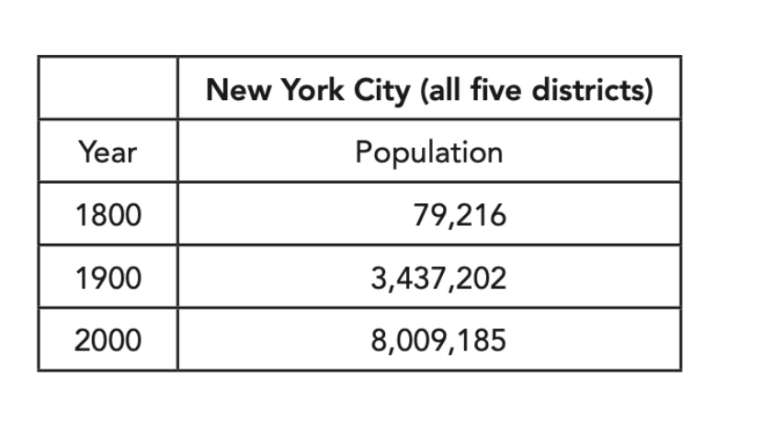
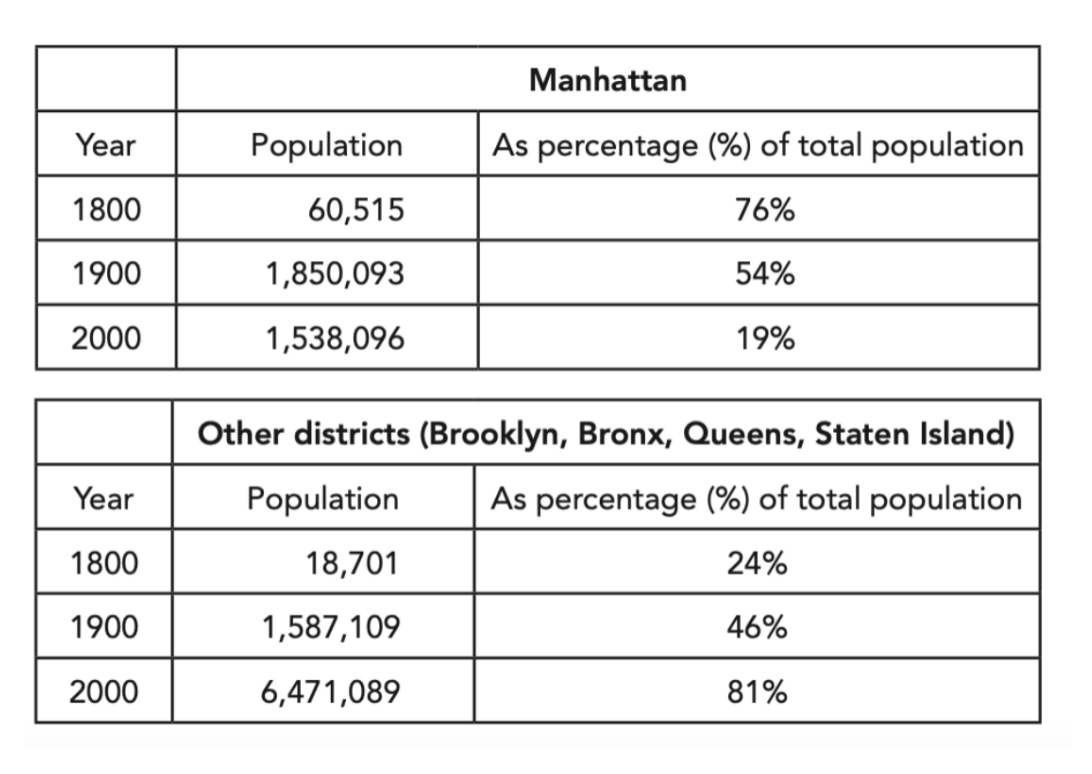
The first table below shows changes in the total population of New York City from 1800 to 2000. The second and third tables show changes in the population of the five districts of the city (Manhattan, Brooklyn, Bronx, Queens, Staten Island) over the same period.
Summarise the information by selecting and reporting the main features, and make comparisons where relevant.
Student answer (Band 6.0)
The first table illustrates the changes in the total poplution of New York city between 1800 and 2000. And the other two tables provides information about changes in the population accross five districts of the city over the same period.
Overall, there has been an increase in total population of New York city from 1800 to 2000. All the district has shown an increase in total population except for Manhattan. The population in Manhattan has decreased in the end.
In 1800, 76% of total population of New York used to reside in Manhattan. Though the total population increased in 1900 to 1,850,093 but percentage of total population in Manhattan reduced to 54 %. This figure again reduced to 19% of total population with decrease in total population in Manhattan to 1,538,096.
On the other hand, other districts accounted for 24% of total population of new york city in 1800 with only 18,701 people, which then increased to 46% of total population and by 2000, the population drastically increased to 6,471,089 accounting for 81% of total population.
AI examiner evaluation
| Criterion | Band |
|---|---|
| Task Achievement / Task Response | 6.5 |
| Coherence and Cohesion | 6.5 |
| Lexical Resource | 6.0 |
| Grammatical Range and Accuracy | 5.5 |
| Overall | 6.0 |
Task Achievement / Task Response: Band 6.5
You identify the main overall pattern: New York’s population grew substantially, while Manhattan’s share fell and the other districts’ share rose. The figures you give for Manhattan and the combined other districts are accurate, and the comparison between 1800 and 2000 is relevant. However, the overview says all districts increased except Manhattan, although the tables group the four other districts together and do not show each district separately. More importantly, the 1900 total city population of 3,437,202 is omitted, and the description of Manhattan’s 1900 population is unclear: it rose to 1,850,093, rather than the total population increasing to that figure. The response covers the key trends, but some comparisons need clearer development and more precise reporting.
Coherence and Cohesion: Band 6.5
The response has a clear four-paragraph structure, moving from an introduction and overview to Manhattan and then the other districts. This gives the reader a generally logical route through the information, and phrases such as “On the other hand” help signal the contrast between the two groups. However, some links are mechanical or unclear. In “Though the total population increased in 1900 to 1,850,093,” the reference to “total population” makes the relationship between the city total and Manhattan’s figure difficult to follow. The final paragraph also moves from the 1800 share to the 1900 share and then the 2000 population without consistently presenting both population and percentage. Clearer sequencing of each year’s figures would make the progression more controlled.
Lexical Resource: Band 6.0
You use an adequate range of task-related vocabulary, including “accounted for,” “reside,” “percentage,” and “drastically increased,” and the meaning is generally clear. There are, however, several spelling errors, including “poplution,” “accross,” and “new york,” which reduce accuracy. Some expressions are also imprecise or awkward for describing data: “the population in Manhattan has decreased in the end” is vague, while “used to reside” sounds less natural than a direct description of the proportion living there. “Drastically increased” is understandable but somewhat emphatic for a neutral report. More precise collocations for describing population changes and shares would improve the range and control of your vocabulary.
Grammatical Range and Accuracy: Band 5.5
You attempt a mix of simple and complex sentences, including a contrast clause beginning “Though” and a relative clause in “which then increased.” Most of the information remains understandable, but some grammatical errors and sentence constructions limit accuracy. For example, “the other two tables provides” has subject–verb disagreement, and “All the district has shown” has an incorrect plural form and agreement. The sentence beginning “Though” is also incomplete in its logic and incorrectly presents 1,850,093 as the total population; the intended comparison needs a clearer grammatical structure. Articles and prepositions are sometimes missing, as in “76% of total population.” Aim for consistently accurate agreement and build complex comparisons around clearly stated subjects and figures.
See this exact question answered at other band scores. The same prompt compared across bands.
Browse more IELTS Writing model answers or get your own writing scored by the same AI examiner.