Band 5.0 IELTS Writing Task 1 Model Answer
Overall Band Score: 5.0 · Cambridge IELTS 20 · 2026-11-20
IELTS Writing Task 1 question
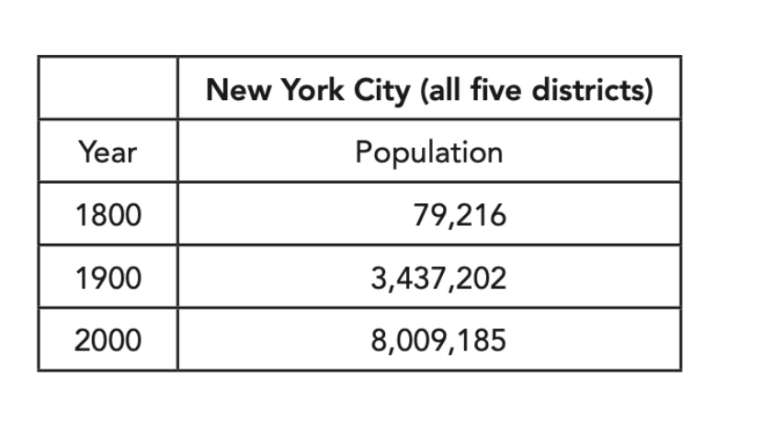
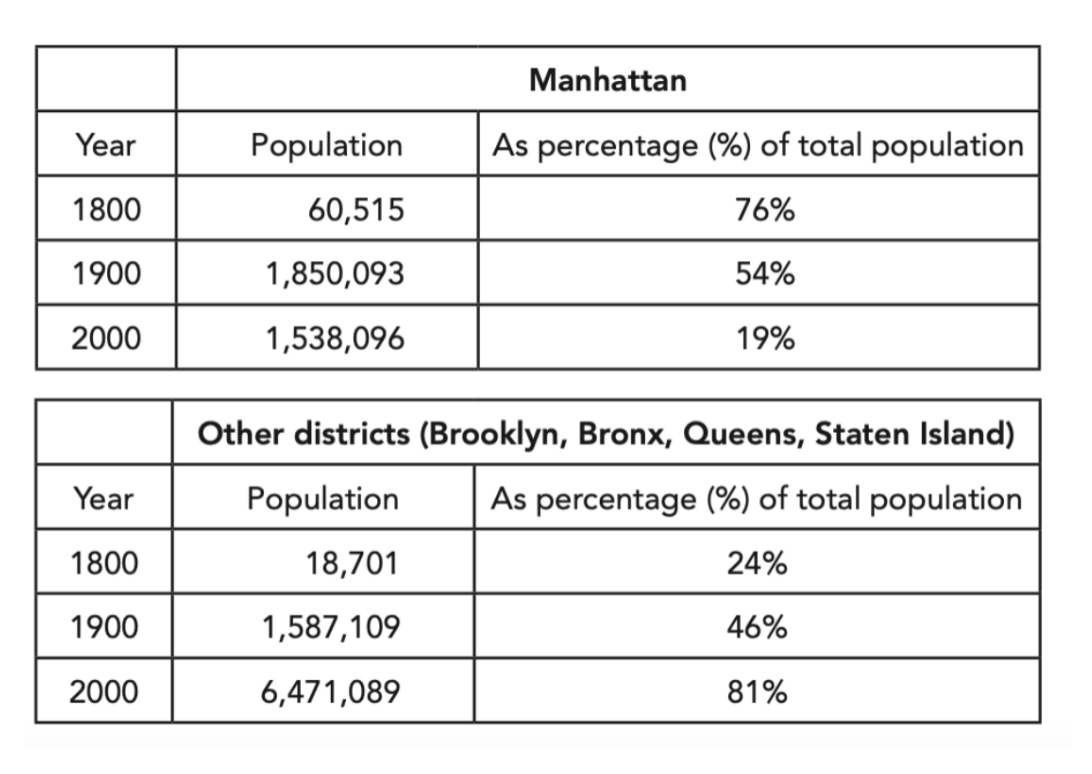
The first table below shows changes in the total population of New York City from 1800 to 2000. The second and third tables show changes in the population of the five districts of the city (Manhattan, Brooklyn, Bronx, Queens, Staten Island) over the same period.
Summarise the information by selecting and reporting the main features, and make comparisons where relevant.
Student answer (Band 5.0)
information about changes in the total population of new york city from 1800to 2000 and other information about changes in the population in manhattan ,brooklyn ,bronx ,queens,staten island .
in the first time we can see the population increased in new york city between 1800 at 2000 because in the first year in the table we see 1800 ,79216 population and in 1900 the number of population is [redacted phone] and in the last year 2000 the population is [redacted phone] this is a big increased opposite than manhattan because in manhattan the population incraesed in the first time between 1800 ,1900 with 60515 until [redacted phone] but increaed in the percentage of total population in the first time is its 76 % until 54% it huge discrased in percentage and in 2000 other huge discraesed in population and percentage with [redacted phone] population and 19% in percentage of total population
after that in the other districts like brooklyn ,bronx ,queens,staten island the number of population increased with percentage of total population with 18701 in the first year and [redacted phone] in the last years with that the incraesed of the percentage of total population .
AI examiner evaluation
| Criterion | Band |
|---|---|
| Task Achievement / Task Response | 5.0 |
| Coherence and Cohesion | 5.0 |
| Lexical Resource | 5.0 |
| Grammatical Range and Accuracy | 5.0 |
| Overall | 5.0 |
Task Achievement / Task Response: Band 5.0
You identify the broad rise in New York City’s population and the changing balance between Manhattan and the other districts, which are relevant main features. However, the report is only partially developed: it gives no clear overview and does not consistently compare the three years. There is also a significant data error: Manhattan’s population rose from 60,515 to 1,850,093 by 1900, not to 185,093. You correctly note its later fall to 1,538,096 and its declining share, but the other districts’ figures are only given for 1800 and 2000, leaving out their 1900 population and share. Add a concise overview and select accurate figures to support the key comparisons.
Coherence and Cohesion: Band 5.0
The response has some organisation: it moves from the city total to Manhattan and then to the other districts, and phrases such as “after that” signal a change of focus. However, the progression is difficult to follow because the opening is a fragment and the main discussion is packed into long, loosely connected sentences. Linking expressions such as “because,” “opposite than,” and “with that” do not clearly show the relationships between the figures. Paragraphing is also limited, and the final point does not provide a clear concluding comparison. Use separate paragraphs for the overview and the detailed comparisons, and connect each year’s figures with precise transitions such as “by 1900” and “whereas”.
Lexical Resource: Band 5.0
You use some task-relevant vocabulary, including “population,” “percentage,” “increased,” and “decreased,” so the topic is generally understandable. However, the range is limited and several words are repeated, while spelling errors such as “incraesed,” “discraesed,” and “discrased” make the writing less clear. Some combinations are also unnatural, for example “a big increased” and “opposite than Manhattan.” Choose accurate forms and collocations, such as “a substantial increase” and “in contrast to Manhattan.” You could also use “accounted for” or “share of the total” to describe the percentages, and “districts” consistently when referring to the four boroughs grouped together.
Grammatical Range and Accuracy: Band 5.0
The response attempts to connect ideas in longer sentences, but the range of sentence structures is limited and these attempts often contain errors. The opening, “information about changes…,” is not a complete sentence, and the sentence beginning “in the first time we can see” has unclear tense and clause structure. There are also problems with articles, prepositions, and punctuation, as in “between 1800 at 2000” and “in the first year in the table we see 1800.” These errors sometimes make the comparisons hard to interpret. Build clearer sentences with a subject and verb, use past-tense forms consistently, and separate the data into shorter sentences; for example, “The city’s population rose from 79,216 in 1800 to 8,009,185 in 2000.”
See this exact question answered at other band scores. The same prompt compared across bands.
Browse more IELTS Writing model answers or get your own writing scored by the same AI examiner.