Band 5.0 IELTS Writing Task 1 Model Answer
Overall Band Score: 5.0 · Cambridge IELTS 20 · 2026-11-20
IELTS Writing Task 1 question
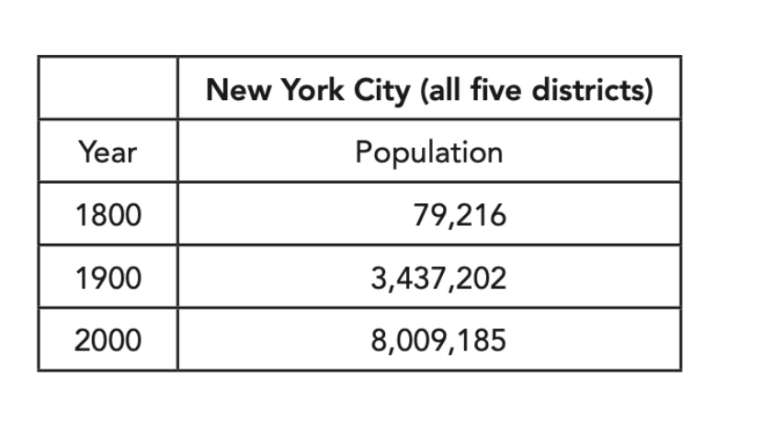
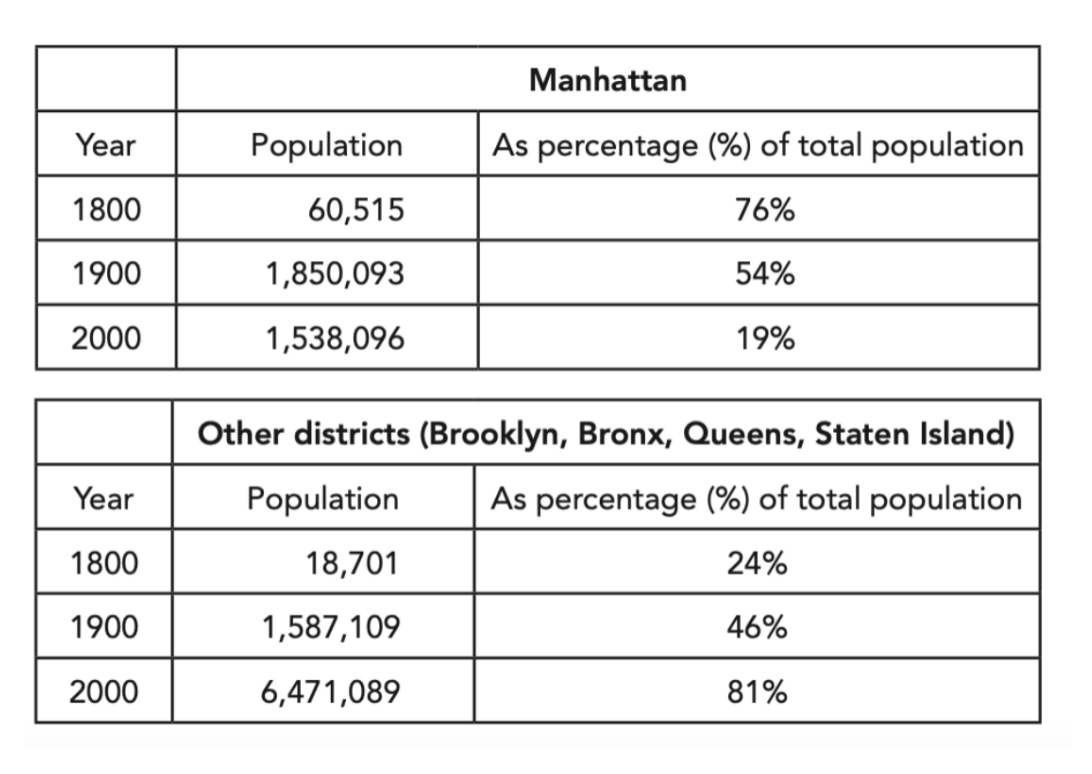
The first table below shows changes in the total population of New York City from 1800 to 2000. The second and third tables show changes in the population of the five districts of the city (Manhattan, Brooklyn, Bronx, Queens, Staten Island) over the same period.
Summarise the information by selecting and reporting the main features, and make comparisons where relevant.
Student answer (Band 5.0)
The table illustrates the changes in total population of New York city and its different districts from the year 1800 to 2000.
Overall, it is apparent that the population of New York city showed an increase trend throughout the period. There are also some fluctuations in population of New York city from the year 1800 to 2000. In beginning, the population stands for almost 79,216 residents. By the passage of time , in year 1900, it surges to 3.45million people. And eventually , it rises to 8.09 million citizens by the end of year 2000.
In addition, population of Manhattan district goes an upward direction overall. At the year 1800, it stood 60,500 locals comprising the 76% of total population. Then it boost to 1.8million people making almost 54% of total population. In the end, it reached 1.5 million making 19% of total population.
Other districts also demostrates the gradual rise in population. Brooklyn , Bronx, Queens a
AI examiner evaluation
| Criterion | Band |
|---|---|
| Task Achievement / Task Response | 5.0 |
| Coherence and Cohesion | 5.0 |
| Lexical Resource | 5.5 |
| Grammatical Range and Accuracy | 5.0 |
| Overall | 5.0 |
Task Achievement / Task Response: Band 5.0
You identify the overall rise in New York City’s population and report several relevant figures, including Manhattan’s changing share. However, the response only partially covers the tables: the final discussion of the other districts is cut off after naming them, so their substantial growth and their increase from 24% to 81% of the total are not explained. The overview also says there were “fluctuations,” although the citywide total rises at both reported intervals; Manhattan’s population, by contrast, rises to 1900 and then falls by 2000. Some figures are approximate, but the 2000 city total is given as 8.09 million rather than 8,009,185. A clearer overview and complete comparison of both groups would make the report more informative.
Coherence and Cohesion: Band 5.0
The response has a recognisable sequence: an introduction, a general statement, and discussion of the total population and Manhattan before turning to the other districts. This gives the reader some organisation. However, progression is limited because the final paragraph stops mid-sentence (“Brooklyn, Bronx, Queens a…”), leaving the comparison unfinished. Linking phrases such as “Overall,” “In addition,” and “In the end” help signal stages, but some are repetitive or do not express the relationship precisely; for example, “In addition” introduces a separate data group without developing its comparison. Group the information into a complete overview and two focused comparison paragraphs, and use links to show changes over time and contrasts between the groups.
Lexical Resource: Band 5.5
You use a reasonable range of population-related vocabulary, including “increase,” “surges,” “comprising,” and “total population,” and the main subject remains understandable. However, several choices are imprecise or unnatural for a formal data report: “citizens” and “locals” are less suitable than “residents,” while “population … goes an upward direction” is awkward. There are also noticeable spelling and form errors, such as “demostrates,” and inconsistent spacing in expressions such as “3.45million.” These do not prevent the reader from understanding the main points, but they reduce precision and fluency. Prefer standard reporting collocations such as “the population rose” and check spelling and number formatting carefully.
Grammatical Range and Accuracy: Band 5.0
You attempt both simple and more developed sentence forms, and the time references generally make the sequence understandable. However, errors are frequent, and some attempted structures are faulty. Examples include “showed an increase trend,” “In beginning,” “it stood 60,500,” and “Then it boost,” where articles, verb forms, or sentence patterns are missing or incorrect. The sentence beginning “And eventually” is also awkwardly separated from the preceding sequence, and punctuation spacing is inconsistent. Most sentences rely on similar basic patterns, so the range is limited. Practise accurate past-tense reporting and complete sentence structures—for example, “Manhattan’s population stood at 60,515 in 1800”—before adding more complex comparisons.
See this exact question answered at other band scores. The same prompt compared across bands.
Browse more IELTS Writing model answers or get your own writing scored by the same AI examiner.