Band 5.5 IELTS Writing Task 1 Model Answer
Overall Band Score: 5.5 · Cambridge IELTS 20 · 2026-11-20
IELTS Writing Task 1 question
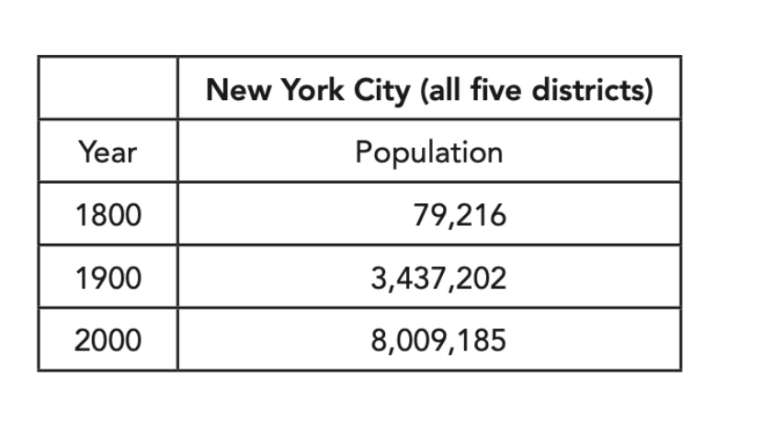
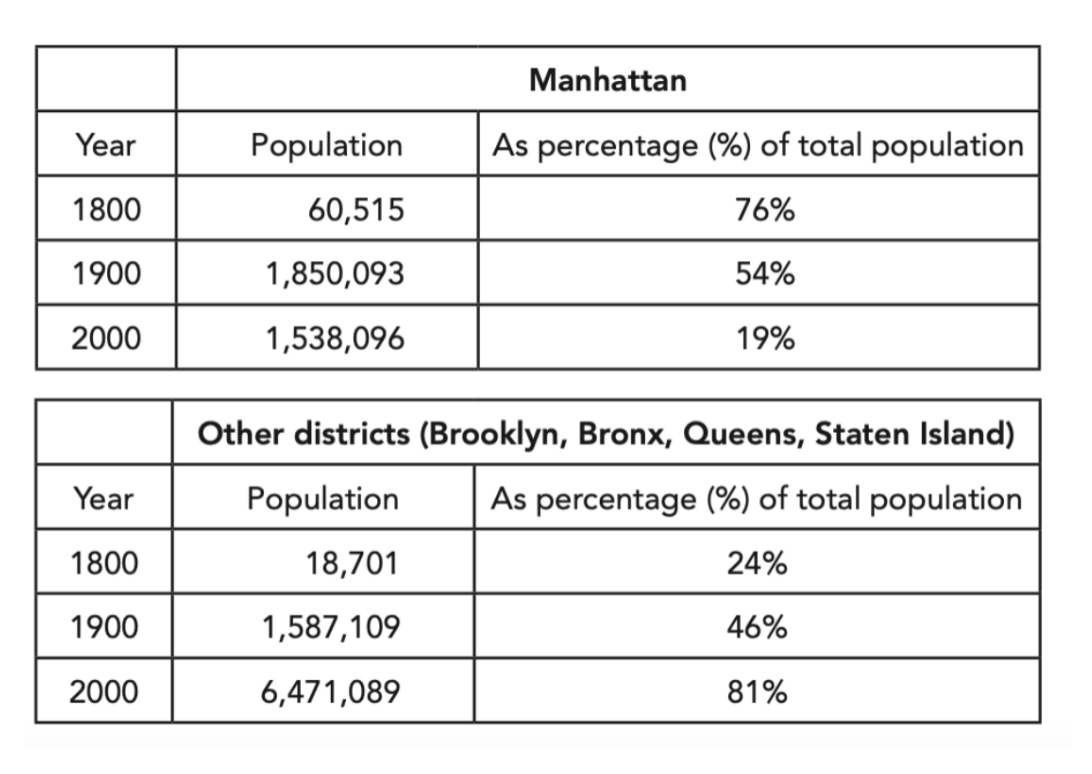
The first table below shows changes in the total population of New York City from 1800 to 2000. The second and third tables show changes in the population of the five districts of the city (Manhattan, Brooklyn, Bronx, Queens, Staten Island) over the same period.
Summarise the information by selecting and reporting the main features, and make comparisons where relevant.
Student answer (Band 5.5)
The given tables compare between the amount difference of total population of new york city and changes of population of five districts of the town between the year of 1800 and 2000.
Overall, New York has undergone huge population rise from 79,216 in 1800 to 8,009,185 in 2000. To be precise, Manhatten district became the part of large population (1,538,096 in 2000) among mentioned five districts of NewYork.
In the year of 1800, Manhatten district had 76 percent of total humankind whereas other four suburbs (Brooklyn, Bronx, Queens, Staten Island) hold into 24%. However, In the folowing two thousand years, Manhatten fell from 54% ratio to 19%. On the other hand, combinely other districts's citizen number grew up to 81% which was only 46% in 1900.
To sum up, New york population increased over the period and hugely from Manhatten though other districts also became filled time to time mankind's habitatual need.
AI examiner evaluation
| Criterion | Band |
|---|---|
| Task Achievement / Task Response | 5.5 |
| Coherence and Cohesion | 5.5 |
| Lexical Resource | 5.0 |
| Grammatical Range and Accuracy | 5.0 |
| Overall | 5.5 |
Task Achievement / Task Response: Band 5.5
You identify the broad rise in New York City’s population and the shift in population share from Manhattan to the other districts, which are central features of the tables. However, the account is only partly developed: it gives the city totals for 1800 and 2000 but omits the 1900 total, and it does not report the key district population figures that would clarify the changes. The statement that Manhattan became the district with the largest population in 2000 is inaccurate: the table groups the other four districts together and shows their combined population, not a ranking among them. The final sentence is vague rather than a clear summary of the data. Select the main comparisons accurately and support them with relevant figures.
Coherence and Cohesion: Band 5.5
The response has a recognisable structure, with an introduction, an overview, a paragraph about district shares and a concluding sentence. This gives the reader some organisation, and contrast markers such as “However” and “On the other hand” help signal comparisons. Nevertheless, progression is not consistently clear: the overview’s claim about Manhattan being the largest district conflicts with the later account of its declining share, and the final “To sum up” repeats the general rise without adding a precise conclusion. Some linking is mechanical, while references such as “the following two thousand years” make the time sequence difficult to follow. Organise the body around the city’s total growth and the changing distribution between Manhattan and the other districts, using clear year-to-year comparisons.
Lexical Resource: Band 5.0
You use some relevant topic vocabulary, including “population,” “district,” “total,” and “percentage,” and attempt more formal phrasing. However, the range is limited and several word choices or collocations are noticeably inaccurate, sometimes making the meaning difficult to interpret. Examples include “amount difference,” “total humankind,” “combinely,” and “habitatual need”; these do not express the intended demographic ideas naturally. “Manhatten” and “NewYork” are also misspelled or incorrectly spaced, and capitalisation of place names is inconsistent. Prefer precise, familiar terms such as “population change,” “share of the total,” and “combined population.” More accurate collocations and spelling would make the comparisons clearer without requiring unusually advanced vocabulary.
Grammatical Range and Accuracy: Band 5.0
You attempt a mixture of simple statements and longer sentences, including a contrast introduced by “However” and a relative clause in the opening. However, control is uneven, and errors in sentence construction, tense, articles and agreement recur. For example, “compare between” has an incorrect grammatical pattern, while “other four suburbs … hold into 24%” has problems with the verb form and construction. “Manhatten fell from 54% ratio to 19%” also lacks a clear grammatical relationship between the figures. The final sentence is difficult to parse because its clauses are joined without a clear structure. Build accurate simple sentences first, then add controlled complex forms; check verb tense, subject–verb agreement, articles and punctuation in each sentence.
See this exact question answered at other band scores. The same prompt compared across bands.
Browse more IELTS Writing model answers or get your own writing scored by the same AI examiner.