Band 5.0 IELTS Writing Task 1 Model Answer
Overall Band Score: 5.0 · Cambridge IELTS 20 · 2026-11-20
IELTS Writing Task 1 question
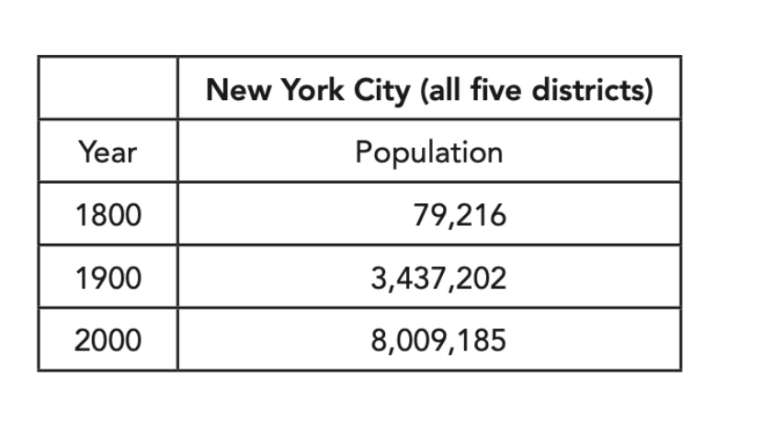
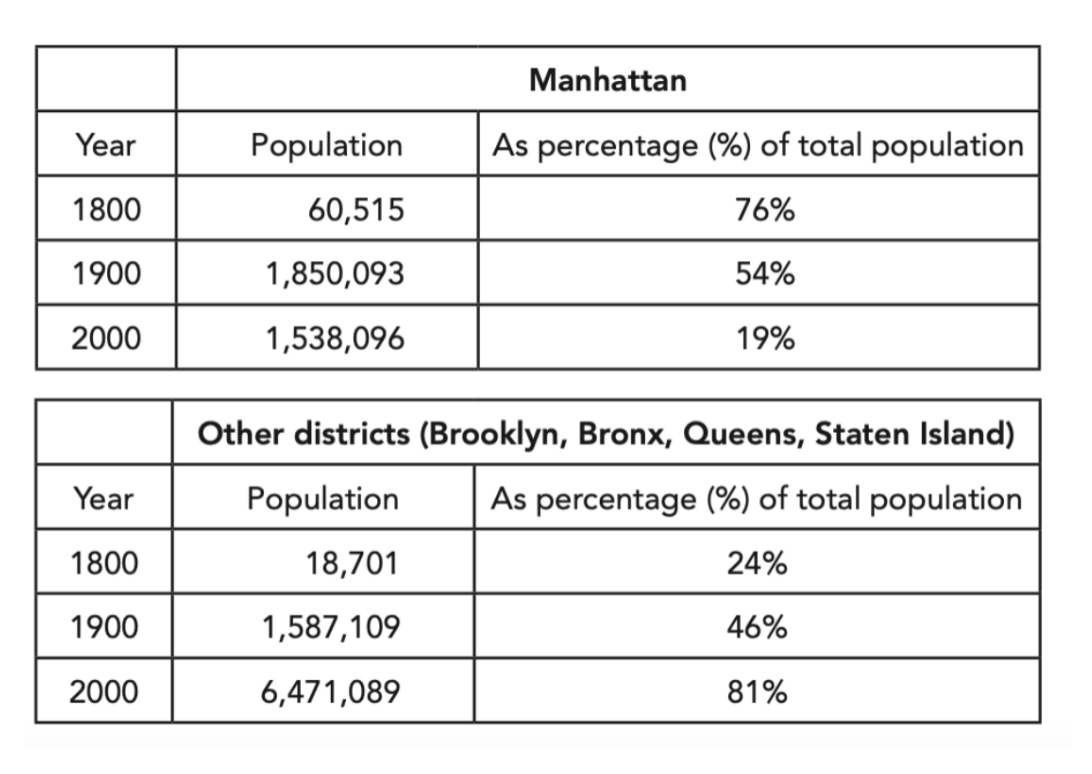
The first table below shows changes in the total population of New York City from 1800 to 2000. The second and third tables show changes in the population of the five districts of the city (Manhattan, Brooklyn, Bronx, Queens, Staten Island) over the same period.
Summarise the information by selecting and reporting the main features, and make comparisons where relevant.
Student answer (Band 5.0)
The table graph illustrates that the number of total population of new york city between 1800 and 2000. While, the table enumerates the changes of five districts population (Manhattan, Brooklyn, Bronx, Queens, Staten Island) over the same decades.
Overall, the number of population in 18s was fell down. While, in 20 century the population increased 10 times. In 1800, Manhattan district the 76% of total population then other districts. Whenever, in 2000 other districts was 81% of total population.
It is quite evident from 1800, the total popultion of new york city was 10 times declined than 2000. In 1800 Manhattan city was occupied 76% popution while in 1900, the proption of population was declined about 22%. Also, in 2000 the percentage of population was fell down and reached in 19%.
Furthermore,in 18 century the other districts was 24% of total popultion while in 1900 the propotion was rose about 22%.In 2000, the population was bomed and reached about 81% of total population.
AI examiner evaluation
| Criterion | Band |
|---|---|
| Task Achievement / Task Response | 5.5 |
| Coherence and Cohesion | 4.5 |
| Lexical Resource | 5.0 |
| Grammatical Range and Accuracy | 4.5 |
| Overall | 5.0 |
Task Achievement / Task Response: Band 5.5
You identify the broad contrast between Manhattan and the other four districts, and you report the key shares for 1800 and 2000. However, the overview is unclear and includes a major trend error: the population did not fall in the 1800s; the city grew from 79,216 in 1800 to 3,437,202 in 1900 and 8,009,185 in 2000. The claim that it increased “10 times” is also inaccurate for the full period. You do note Manhattan’s share falling from 76% to 19% and the other districts’ share rising to 81%, but the 1900 population figures and the fact that Manhattan’s absolute population later declined are omitted. Focus the overview on overall growth and the shift in population distribution, then support it with accurate comparisons.
Coherence and Cohesion: Band 4.5
The response has a basic paragraph structure, moving from an introduction to an overview and then to details about Manhattan and the other districts. This gives the reader some sense of organisation. However, progression is difficult to follow because the overview repeats or conflicts with later statements, and several linking expressions are inaccurate or awkward. For example, “While” begins a fragment in the introduction, and “Whenever” does not express the intended contrast in the overview. The final two paragraphs repeat the percentage changes rather than developing a clear sequence of comparisons. Group the information by time period or by Manhattan versus the other districts, and use straightforward links such as “By contrast” and “By 2000” to make relationships clear.
Lexical Resource: Band 5.0
You use some task-relevant vocabulary, including “total population,” “districts,” “percentage,” and “proportion,” so the topic is generally recognisable. However, the range is limited and several word choices or forms are inaccurate enough to make parts of the report unclear. Phrases such as “number of total population,” “population was bomed,” and “10 times declined” are not natural ways to describe the data. There are also spelling errors, including “popultion,” “proption,” and “proportion” misspelled as “propotion.” Aim for precise reporting verbs and collocations, such as “the population rose,” “accounted for,” and “the share fell,” and check spelling carefully.
Grammatical Range and Accuracy: Band 4.5
You attempt both simple and more complex sentence forms, including clauses introduced by “while,” but control is inconsistent and errors frequently affect clarity. Examples include “the number of population … was fell down,” where the subject and verb form do not work together, and “Manhattan district the 76%,” which lacks a complete grammatical structure. Articles and prepositions are also often missing or misplaced, as in “in 20 century” and “reached in 19%.” Sentence boundaries and punctuation need attention too, particularly where clauses are joined with “While” or “Furthermore.” Build accurate simple sentences first—for example, “Manhattan accounted for 76% of the population in 1800”—then add subordinate clauses once the basic structure is secure.
See this exact question answered at other band scores. The same prompt compared across bands.
Browse more IELTS Writing model answers or get your own writing scored by the same AI examiner.