Band 4.5 IELTS Writing Task 1 Model Answer
Overall Band Score: 4.5 · Cambridge IELTS 20 · 2026-11-20
IELTS Writing Task 1 question
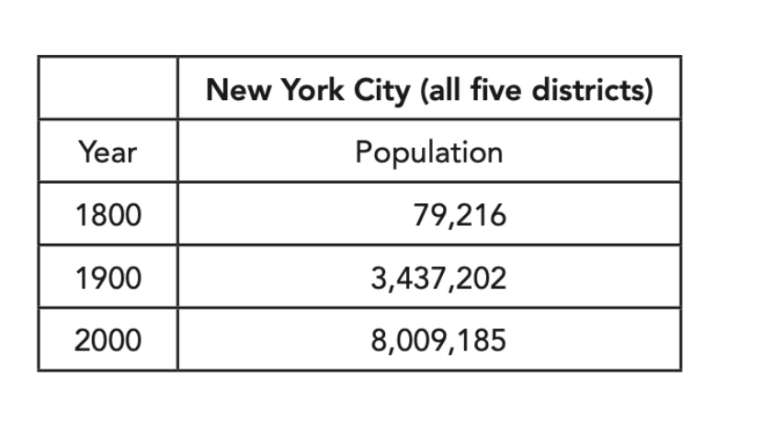
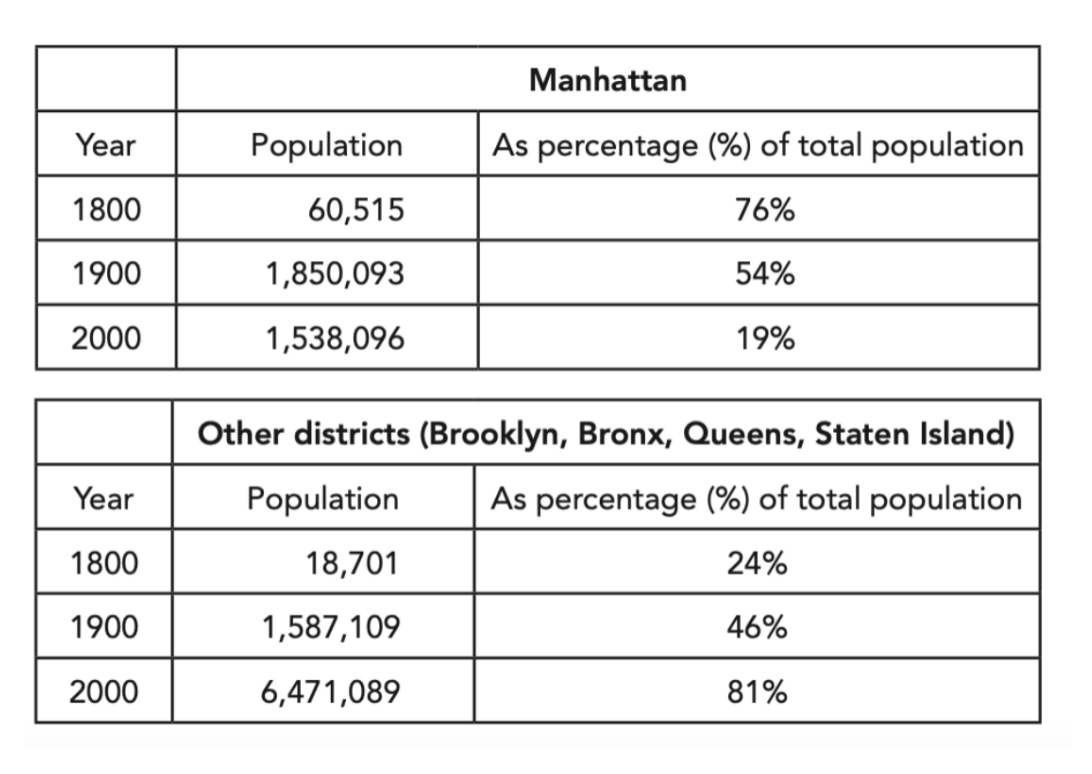
The first table below shows changes in the total population of New York City from 1800 to 2000. The second and third tables show changes in the population of the five districts of the city (Manhattan, Brooklyn, Bronx, Queens, Staten Island) over the same period.
Summarise the information by selecting and reporting the main features, and make comparisons where relevant.
Student answer (Band 4.5)
The first table illustrates changes in the total population of New York City between 1800 and 2000. The second and the third tables illustrates changes in the population of the five districts of the city (Manhattan, Brooklyn, Bronx, Queens, Staten Island) between the same period .
Overall, the first table shows the population of New York City in 3 years which were 1800/1900/2000 .The second and third table shows the population as percentage of total population in 1800/1900/2000 in Manhattan, Brooklyn, Bronx, Queens, Staten Island .
On the one hand , the higher number of population was in 2000 which was 8,009,185 .The table shows a big difference between the 3 years . In 1800 , the population was the lowest number which was 79,216 and in 1900 was 3,437,202 .
On the other hand , the last two tables shows the difference between Manhattan and other districts .The difference in population between them in 2000 was the highest number which [redacted phone]
AI examiner evaluation
| Criterion | Band |
|---|---|
| Task Achievement / Task Response | 4.0 |
| Coherence and Cohesion | 4.5 |
| Lexical Resource | 4.5 |
| Grammatical Range and Accuracy | 4.5 |
| Overall | 4.5 |
Task Achievement / Task Response: Band 4.0
You identify the topic and report the overall city population figures for all three years, correctly noting that it was lowest in 1800 and highest in 2000. However, the district comparison is not accurately or sufficiently reported: the claim that the difference between Manhattan and the other districts in 2000 was “500000” is incorrect; their populations were 1,538,096 and 6,471,089. The overview mostly describes what the tables contain rather than summarising the main trends, such as Manhattan’s share falling from 76% to 19% while the other districts’ share rose. The response also contains 136 words, below the required 150. Include accurate comparisons and develop the key trends to address the task more fully.
Coherence and Cohesion: Band 4.5
The response has a basic paragraph structure, moving from an introduction and overview to the city totals and then the district figures. The signposts “On the one hand” and “On the other hand” show an attempt to organise the information, but they do not clearly express the relationship between the points, and the final paragraph ends abruptly after one inaccurate comparison. The overview repeats that the tables show population figures rather than guiding the reader through the main changes. Improve progression by grouping the city’s growth together, then comparing Manhattan with the combined other districts, and use clear links such as “By contrast” or “Meanwhile.” More complete paragraphs and clearer references would make the report easier to follow.
Lexical Resource: Band 4.5
Your vocabulary is sufficient to identify the subject and basic comparisons, using terms such as “total population,” “difference,” and “lowest.” However, the range is limited and several phrases are repetitive or imprecise, including “the higher number of population” and “the lowest number.” “The last two tables” is also a vague way to refer to the district data. Use more precise language for trends and proportions, such as “population rose,” “accounted for,” or “share of the total.” Avoid repeating “the table shows”; varied, accurate reporting verbs would make the description more natural. The meaning is generally understandable, but the imprecise phrasing weakens clarity.
Grammatical Range and Accuracy: Band 4.5
You use some simple sentence forms and attempt longer structures, for example, “The first table illustrates changes…” and “The table shows a big difference between the 3 years.” However, errors in agreement and sentence construction occur repeatedly: “the second and the third tables illustrates” should use a plural verb, and “the last two tables shows” has the same problem. The phrase “in 1900 was 3,437,202” is missing a subject, while “which 500000” is an incomplete construction. Spacing before punctuation is also inconsistent. Practise complete comparative sentences and check subject–verb agreement, articles, and punctuation. Greater control of these basic patterns would make your meaning clearer.
See this exact question answered at other band scores. The same prompt compared across bands.
Browse more IELTS Writing model answers or get your own writing scored by the same AI examiner.