Band 5.5 IELTS Writing Task 1 Model Answer
Overall Band Score: 5.5 · Cambridge IELTS 20 · 2026-11-21
IELTS Writing Task 1 question
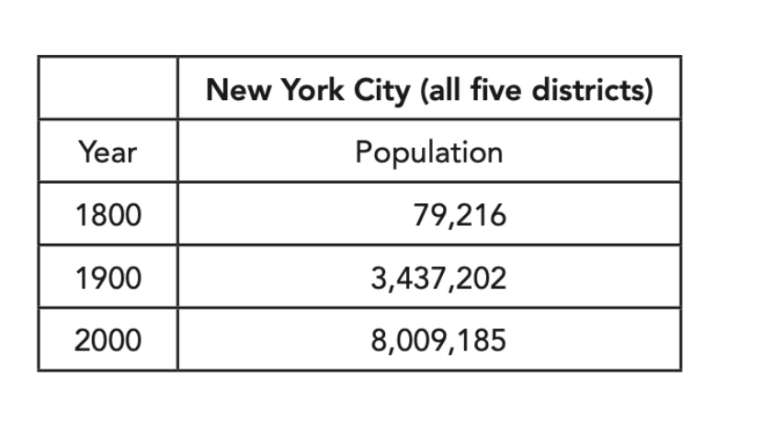
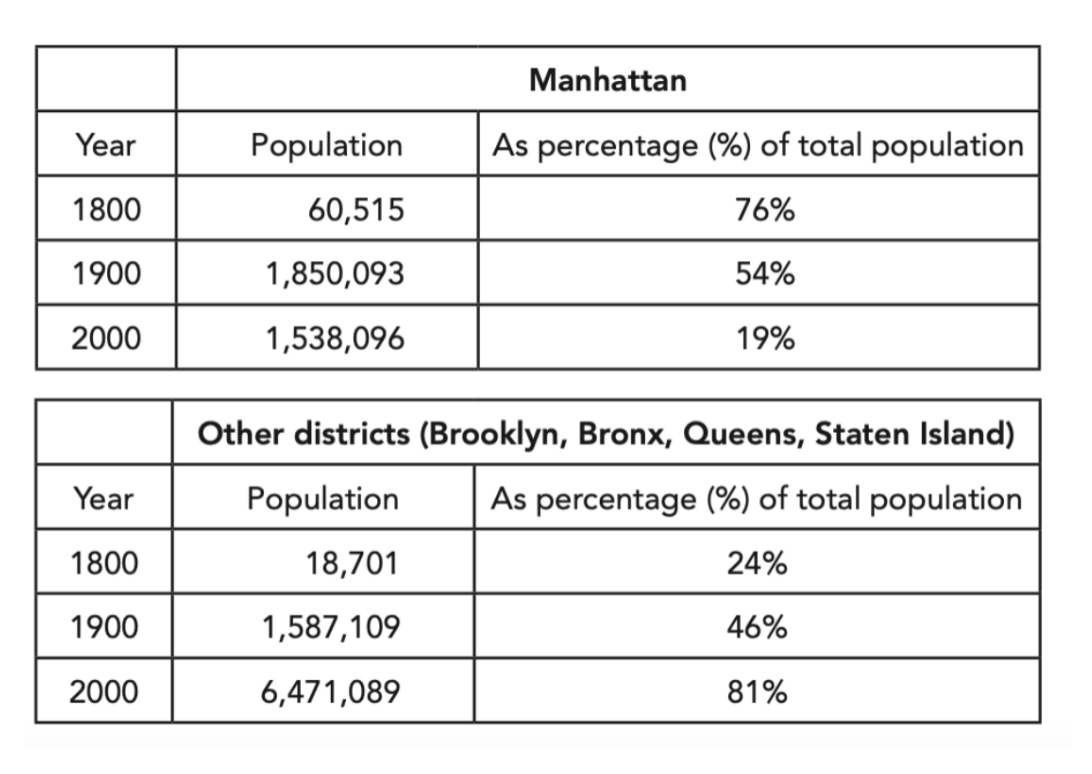
The first table below shows changes in the total population of New York City from 1800 to 2000. The second and third tables show changes in the population of the five districts of the city (Manhattan, Brooklyn, Bronx, Queens, Staten Island) over the same period.
Summarise the information by selecting and reporting the main features, and make comparisons where relevant.
Student answer (Band 5.5)
Given table shows fluctuations in the number of total population of New York City for last two centuries ([redacted phone]). Then in next two records discuss about the population changes in five districts of the same city separately for the same period of time.
The population of New York City collectively has increased dramatically from 1800 to 2000. If we talk about it's districts their population has been increased but their contribution in total population of city varies.
The number of persons in NYC has increased rapidly fromm 1800 to 2000. In the very first year of the mentioned duration it was just 79,216 but just in ten decades it became 3,437,202 which is a great increase. In next hundred years, It became more than double as it was in 1900 the exact number of persons in 2000 was 8,009,185.
Now if we discuss about the five districts obviously their population increased but their contribution was as follows, population of Manhattan had a lage number of people in it and it occupied almost 76% of total population while other four districts carried just 24%. But with the passage of time a huge reversal of percentage happened and till 2000 Manhattan had only 19% on the other hand other districts had 81% of total.
AI examiner evaluation
| Criterion | Band |
|---|---|
| Task Achievement / Task Response | 5.5 |
| Coherence and Cohesion | 5.5 |
| Lexical Resource | 5.5 |
| Grammatical Range and Accuracy | 5.5 |
| Overall | 5.5 |
Task Achievement / Task Response: Band 5.5
You identify the main overall trends: New York City’s population rose substantially, while Manhattan’s share fell and the other districts’ share grew. The total figures for all three years are accurate, and the 1800 and 2000 percentage comparisons are relevant. However, the account is only partial: it omits the important 1900 district figures and the fact that Manhattan’s population itself declined from 1,850,093 in 1900 to 1,538,096 in 2000, even as the other districts expanded. The overview also says district populations increased, which is not true of Manhattan across the full period. To develop the response more fully, report the middle-year contrast and distinguish changes in population numbers from changes in percentage share.
Coherence and Cohesion: Band 5.5
The response has a recognisable sequence: an introduction, a broad overview, total-population figures, and then district comparisons. This gives the reader a basic route through the information. However, progression is limited because the final paragraph jumps from the 1800 comparison to 2000 without explaining the 1900 stage, and several transitions are repetitive or conversational, such as “Now if we discuss” and “But with the passage of time.” The opening also repeats the task description rather than establishing a concise focus. Organise the body around the three dates or clearly separate total population from district trends, using precise links such as “By 1900” and “In contrast, by 2000.”
Lexical Resource: Band 5.5
You use some relevant vocabulary for describing change, including “increased dramatically,” “reversal,” “contribution,” and “occupied,” and the main comparisons remain understandable. However, the range is limited and several choices are inaccurate or unnatural for a formal data report: “number of persons,” “records discuss about,” and “carried just 24%.” There are also noticeable spelling errors, including “fromm” and “lage,” which reduce the overall control of vocabulary. Aim for standard chart-reporting collocations and use population terms consistently. For example, describe a share as “accounted for” a percentage, and use “districts” or “boroughs” rather than repeatedly referring to “persons.”
Grammatical Range and Accuracy: Band 5.5
You attempt both simple and more extended sentence forms, and the reader can generally understand the intended comparisons. However, complex constructions are often faulty, and errors recur in verb forms, articles, pronouns, and punctuation. Examples include “their population has been increased,” where the passive form is inappropriate, and “if we talk about it's districts,” where the possessive form is incorrect. “In next hundred years, It became” also needs an article and consistent sentence-case punctuation. Some sentences are long and joined loosely, which makes relationships between ideas less clear. Practise accurate past-tense reporting and build longer sentences around a clear main clause, checking agreement, possessives, articles, and commas.
See this exact question answered at other band scores. The same prompt compared across bands.
Browse more IELTS Writing model answers or get your own writing scored by the same AI examiner.