Band 5.0 IELTS Writing Task 1 Model Answer
Overall Band Score: 5.0 · Cambridge IELTS 20 · 2026-11-21
IELTS Writing Task 1 question
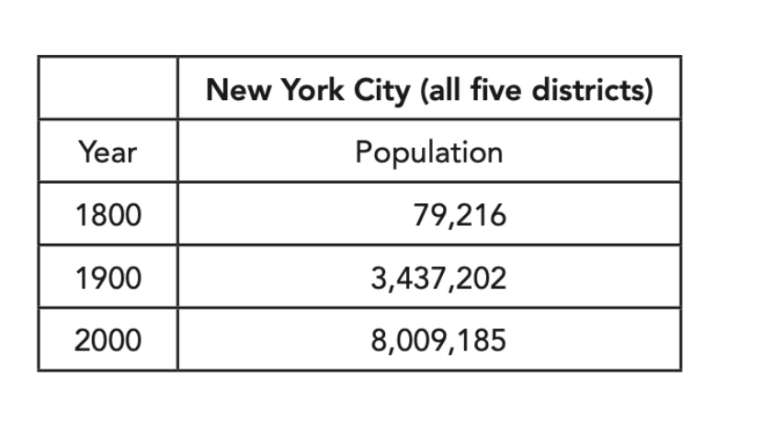
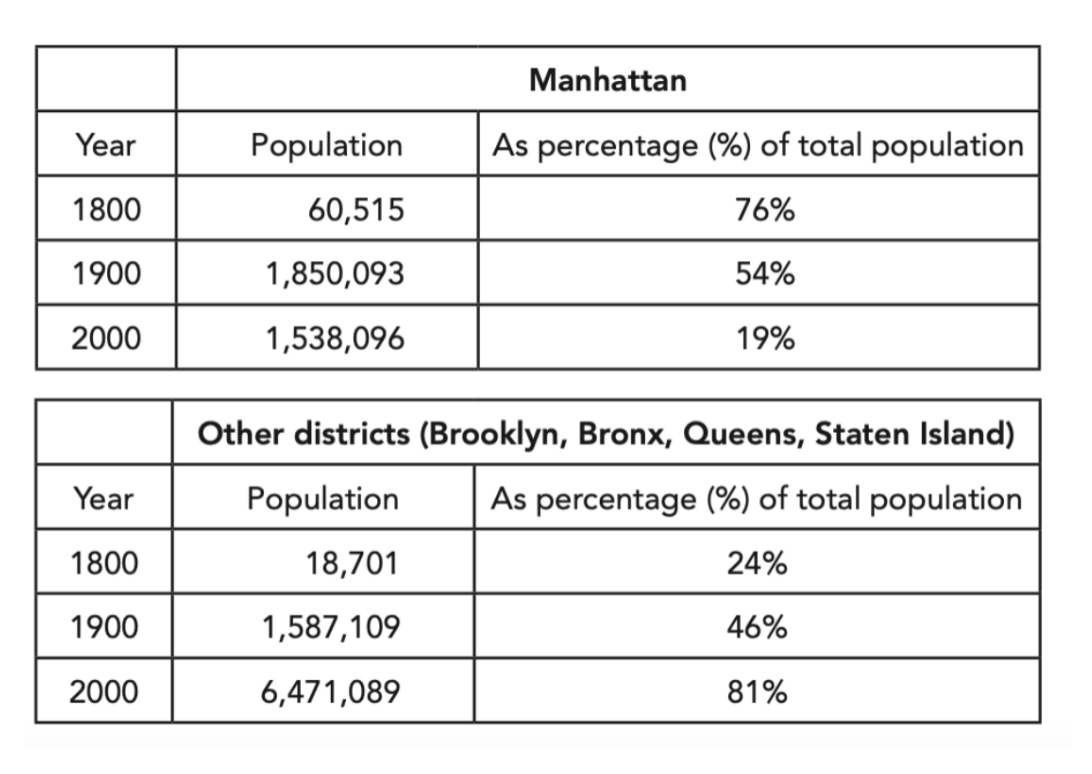
The first table below shows changes in the total population of New York City from 1800 to 2000. The second and third tables show changes in the population of the five districts of the city (Manhattan, Brooklyn, Bronx, Queens, Staten Island) over the same period.
Summarise the information by selecting and reporting the main features, and make comparisons where relevant.
Student answer (Band 5.0)
The table display changes in the population of new york city from 1800 to 2000 on the other hand secound and third tables show changes in the population of the five districts of the city over the same period.
overall,first table shows new york population 1800 to 2000 and secound chart display manhattan district population over the same year, howover third chart shows other four districts population form year 1800 to 2000,
futhermore,in the first chart shows newyork population increase significently from 1800 to 2000. in 1800 population was 79,216 and in 1900 population increased by 79.216 to 3,[redacted phone] but in 2000 it was about 8,009,185.
moreover,manhattan district decreased their population in these years in 1800 start from 76% in 2000 it was about 19% as compaire to other four districts mantattan disctrict decrease much down in these year howover, brookly,bronx,queens,staten island , these four districts increase by 24% to 81% in these years.
in conclusion,brookly,bronx,queens,and staten island these four discrticts of new york increase there population agressivly in 1800 to 2000 but manhattan district decrease there population in these years.
AI examiner evaluation
| Criterion | Band |
|---|---|
| Task Achievement / Task Response | 5.5 |
| Coherence and Cohesion | 4.5 |
| Lexical Resource | 5.0 |
| Grammatical Range and Accuracy | 4.5 |
| Overall | 5.0 |
Task Achievement / Task Response: Band 5.5
You identify the broad trends: New York City’s total population grew substantially, Manhattan’s share fell, and the other districts’ combined share rose. You also include several accurate figures, including the city totals and the 76% and 19% shares for Manhattan. However, the account is only partly developed: it does not report Manhattan’s population figures, and it describes the other districts mainly by percentages rather than their population totals. The statement that the population “increased by 79.216 to 3,437202” is unclear and inaccurate; the 1800 and 1900 totals are 79,216 and 3,437,202, not an increase of 79,216. Make the comparisons more precise and distinguish population counts from percentages.
Coherence and Cohesion: Band 4.5
The response has a basic overall shape, moving from an introduction to an overview and then to details, with a concluding statement. This gives the reader some sense of the main trends. However, progression within the paragraphs is weak: the overview largely repeats the introduction, and the final paragraph repeats the point about the districts rather than adding a useful comparison. Linking expressions such as “furthermore,” “moreover,” and “however” are frequent but do not always show a clear relationship between ideas. Some references are also difficult to follow, particularly “these years” and “these four districts.” Organise the figures by comparison and use fewer, more precise links and references.
Lexical Resource: Band 5.0
You use some relevant vocabulary for describing data, including “population,” “increased,” “decreased,” and “as compared to,” so the main subject is generally understandable. However, the range is limited and several word-choice, spelling, and collocation errors make the report less clear or less formal. Examples include “display” for a table that presents data, “increase aggressively,” and repeated use of “population” without distinguishing totals from shares. There are also frequent misspellings, such as “secound,” “significently,” and “disctrict.” Use accurate data-reporting terms and check spelling carefully; this will make your comparisons more precise and easier to read.
Grammatical Range and Accuracy: Band 4.5
You attempt both simple statements and longer sentences, but control is inconsistent, and many sentences contain errors that make relationships between figures difficult to understand. For example, “The table display changes” has a subject–verb agreement error, while “in 1800 start from 76%” lacks a clear grammatical structure. Sentence boundaries and punctuation are also unreliable, as several ideas are joined with commas or run together. The response relies heavily on basic clauses and does not yet show secure control of more varied sentence patterns. Practise forming complete sentences with a clear subject and verb, and use full stops to separate comparisons before attempting longer structures.
See this exact question answered at other band scores. The same prompt compared across bands.
Browse more IELTS Writing model answers or get your own writing scored by the same AI examiner.