Band 6.0 IELTS Writing Task 1 Model Answer
Overall Band Score: 6.0 · Cambridge IELTS 20 · 2026-11-21
IELTS Writing Task 1 question
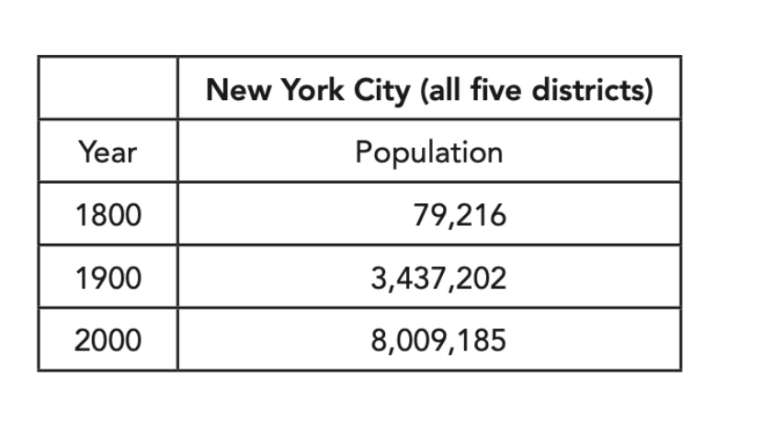
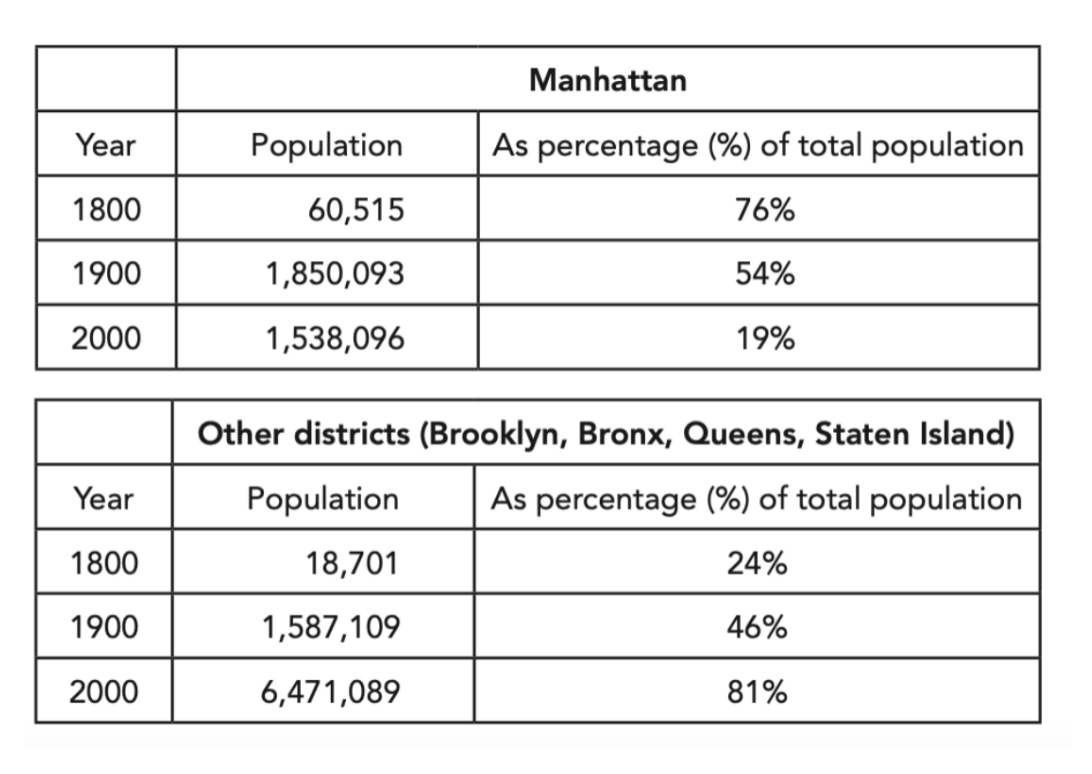
The first table below shows changes in the total population of New York City from 1800 to 2000. The second and third tables show changes in the population of the five districts of the city (Manhattan, Brooklyn, Bronx, Queens, Staten Island) over the same period.
Summarise the information by selecting and reporting the main features, and make comparisons where relevant.
Student answer (Band 6.0)
The first table presents the changes in the total population of newyork City for two centuries starting from the year 1800 to 2000. The second and third table compares the changes in the population at Manhatten city by other four city (Brooklyn, Bronx, Queens, Staten Island) combined.
Overall, it is clear that New York city population is increased over the period of time where in the begining Manhattan had the highest proportion of citizens lived in there but other cities combined got most popular at the end of the period.
In 1800, New York City population was about 79,216 people and grew by 3,437,202 in the year 1900. However, it became more than double in population by the end which is the year 2000.
In contrast, Mahnattan was the most popular for people to stay their from the begining of the period whereas less than a quarter of total people prefered other four cities combined. In 1900, Manhattan city had decreased trend in proportion hence other four cities has be increase in percentage, almost double in number. By 2000, more than three quarter of the total population prefer to live in other four districts rather than Manhattan which is only 19% of total population.
AI examiner evaluation
| Criterion | Band |
|---|---|
| Task Achievement / Task Response | 6.5 |
| Coherence and Cohesion | 6.5 |
| Lexical Resource | 5.5 |
| Grammatical Range and Accuracy | 5.5 |
| Overall | 6.0 |
Task Achievement / Task Response: Band 6.5
You identify the main overall changes: the city’s population rose substantially, while Manhattan’s share fell and the other four districts’ share increased. The overview is relevant, and you include several accurate figures, such as 79,216 in 1800 and Manhattan’s 19% share in 2000. However, some comparisons are underdeveloped or imprecise. The total population in 2000 is not stated, and “grew by 3,437,202” incorrectly presents the 1900 population as the amount of growth; it was the total population that year. The statement that the population “became more than double” is also unclear, since the total rose from about 3.4 million to 8 million. More precise reporting of the key figures and changes would make the summary more complete.
Coherence and Cohesion: Band 6.5
The response has a clear four-paragraph structure, moving from an introduction and overview to details about the total population and district shares. This gives the reader a generally coherent route through the information. You also use basic linking expressions such as “Overall,” “In contrast,” and “By 2000.” However, some connections are awkward or unclear: “In 1900, Manhattan city had decreased trend in proportion hence…” does not clearly explain the comparison, and “grew by 3,437,202” makes the relationship between the years difficult to follow. The final paragraph combines several comparisons without consistently distinguishing population numbers from percentages. Use clearer references and organise the details by year or by population measure to improve progression.
Lexical Resource: Band 5.5
You use some relevant task vocabulary, including “total population,” “proportion,” and “combined,” and the reader can generally understand the comparisons you intend to make. However, word choice and collocation are often imprecise, which limits clarity. For example, “most popular” suggests preference or popularity rather than population size, while “prefered to live” introduces an unsupported idea about residents’ choices. Phrases such as “Manhattan city” and “other four city” are also not natural descriptions of the districts. Spelling errors, including “newyork,” “Manhatten,” “Mahnattan,” and “begining,” further reduce accuracy. Aim for precise terms such as “population,” “accounted for,” and “districts,” and check spelling and word forms carefully.
Grammatical Range and Accuracy: Band 5.5
You attempt a mix of simple and more complex sentences, including a relative clause in “where in the begining Manhattan had…” and a contrastive sentence beginning “In contrast.” The main message is usually recoverable, but some grammatical errors make relationships between ideas unclear. For example, “New York city population is increased” has an incorrect verb form, and “other four cities has be increase” has problems with agreement and verb construction. Articles and sentence patterns also need attention in “the second and third table compares” and “Manhattan city had decreased trend.” Several sentences would be clearer if divided or rebuilt with a straightforward subject and verb. More consistent control of tense, agreement, and sentence structure would strengthen the response.
See this exact question answered at other band scores. The same prompt compared across bands.
Browse more IELTS Writing model answers or get your own writing scored by the same AI examiner.