Band 6.0 IELTS Writing Task 1 Model Answer
Overall Band Score: 6.0 · Cambridge IELTS 20 · 2026-11-21
IELTS Writing Task 1 question
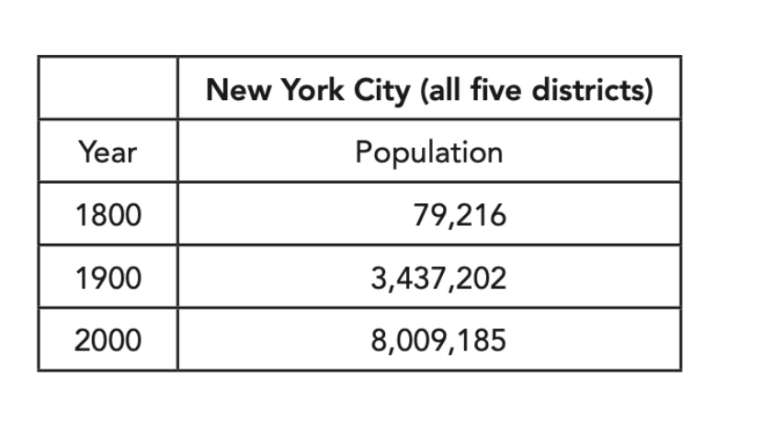
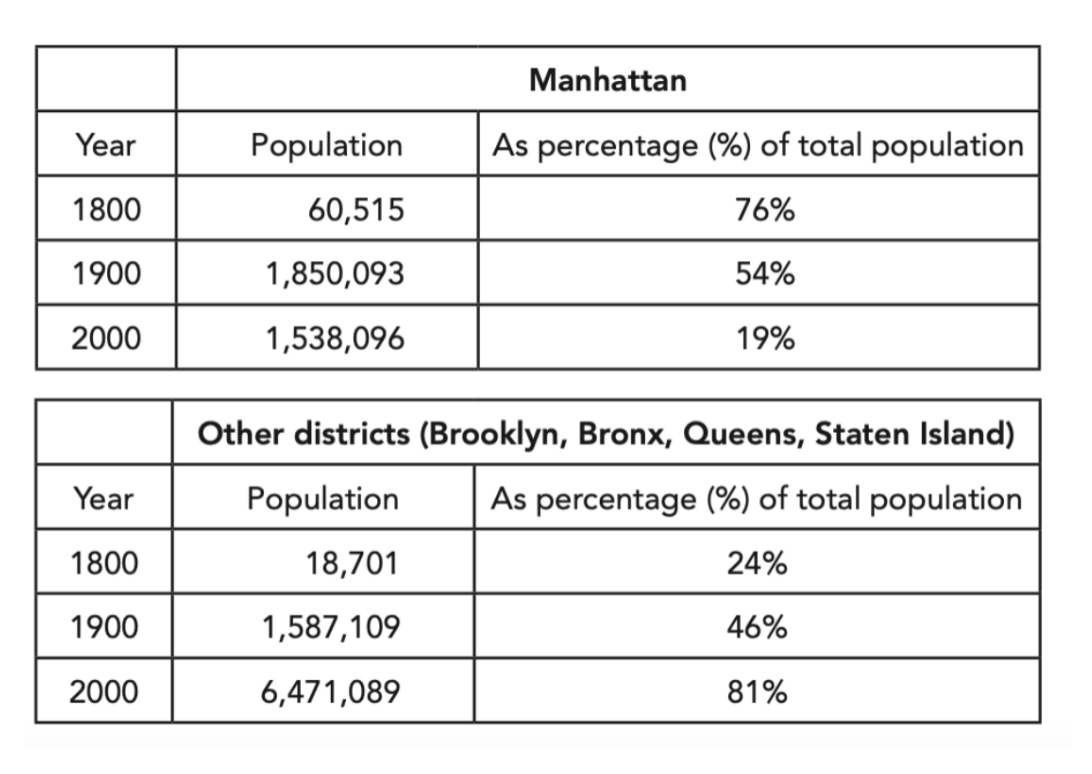
The first table below shows changes in the total population of New York City from 1800 to 2000. The second and third tables show changes in the population of the five districts of the city (Manhattan, Brooklyn, Bronx, Queens, Staten Island) over the same period.
Summarise the information by selecting and reporting the main features, and make comparisons where relevant.
Student answer (Band 6.0)
The tables compare the population of New york city and its five districts in 1800, 1900 and 2000.
Overall the city population Rises dramtically in all over the period. Manhattan District also cantains most of its population as compare to other districts in second century and In the last century, The other four districts population increases substantially.
Population of New york city's recorded 79216 in 1800, In which Manhattan ranked as most populated district, with 60515 Inhabitants accounted for 76% of total. The other four dictricts polpulation remained only 18701, Which accounted for 24%. The city's population increased significantly in 1900. When it reached at [redacted phone] inhabitants .Manhattan population also reached at [redacted phone], Which was 54% of total. The other four districts populations rose up dramatically, when it noticed [redacted phone], which was 46% of total.
In the last century some big changes noticed in population, Whereas total population of new york had Risen to [redacted phone], When the Manhattan population slightly declined and finished at [redacted phone] accounted for 19% of total. The other districts population got a huge jump and finished at [redacted phone] accounted for 81% of total population of city.
AI examiner evaluation
| Criterion | Band |
|---|---|
| Task Achievement / Task Response | 6.5 |
| Coherence and Cohesion | 6.0 |
| Lexical Resource | 5.5 |
| Grammatical Range and Accuracy | 5.0 |
| Overall | 6.0 |
Task Achievement / Task Response: Band 6.5
You cover the main comparisons and report the key figures accurately: the city grows from 79,216 to 8,009,185, while Manhattan’s share falls from 76% to 19% and the other districts’ share rises to 81%. Your overview identifies these central trends, and the response addresses all three years. This is a strong account of the data, with some of the detail and comparison expected at a higher level already present. However, the overview’s claim that Manhattan “contains most of its population” is unclear and conflicts with the later figures: Manhattan has a majority only in 1800 and 1900, not in 2000. Make the overview more precise by stating that Manhattan’s population peaks in 1900 before declining, while the other districts drive the later growth.
Coherence and Cohesion: Band 6.0
The response has a clear overall structure: an introduction, an overview, and two body paragraphs that move from the earlier years to 2000. This makes the main progression easy to follow. You also use time markers such as “In 1900” and “In the last century” to guide the reader. However, some links are mechanical or unclear, and several sentences are joined with full stops or commas in ways that interrupt the flow—for example, “The city's population increased significantly in 1900. When it reached…” and “In the last century some big changes noticed… Whereas…”. The repeated use of “which” also makes references less precise. Connect related information within complete sentences and use clearer contrasts, such as “By contrast” or “Meanwhile,” to improve cohesion.
Lexical Resource: Band 5.5
You use a reasonable range of vocabulary for describing change, including “increased significantly,” “declined,” “accounted for,” and “huge jump.” These choices help communicate the broad trends, and the data remains understandable. However, several spelling errors and awkward or imprecise collocations limit the range and naturalness of the language: “dramtically,” “cantains,” “dictricts,” and “polpulation” are examples. Phrases such as “got a huge jump” and “ranked as most populated district” are also not idiomatic in this context. Aim for accurate, formal reporting language and check spelling carefully; more precise verbs such as “rose,” “peaked,” and “fell” would make comparisons clearer without relying on repeated general intensifiers.
Grammatical Range and Accuracy: Band 5.0
You attempt both simple and more complex sentence forms, including clauses introduced by “whereas” and “when,” and the overall meaning can usually be understood. However, control is inconsistent, particularly in sentence boundaries, verb forms, and articles. For example, “When it reached at 3437202 inhabitants” is a fragment, while “some big changes noticed” lacks the passive auxiliary (“were noticed”) and “Manhattan population” needs a possessive form. Commas also create run-on sentences, as in “Population of New york city's recorded 79216 in 1800, In which…”. Practise building complete sentences around each comparison, and check subject–verb structure, articles, and punctuation. More accurate control of these patterns would make your varied sentence attempts easier to follow.
See this exact question answered at other band scores. The same prompt compared across bands.
Browse more IELTS Writing model answers or get your own writing scored by the same AI examiner.