Band 5.5 IELTS Writing Task 1 Model Answer
Overall Band Score: 5.5 · Cambridge IELTS 20 · 2026-11-22
IELTS Writing Task 1 question
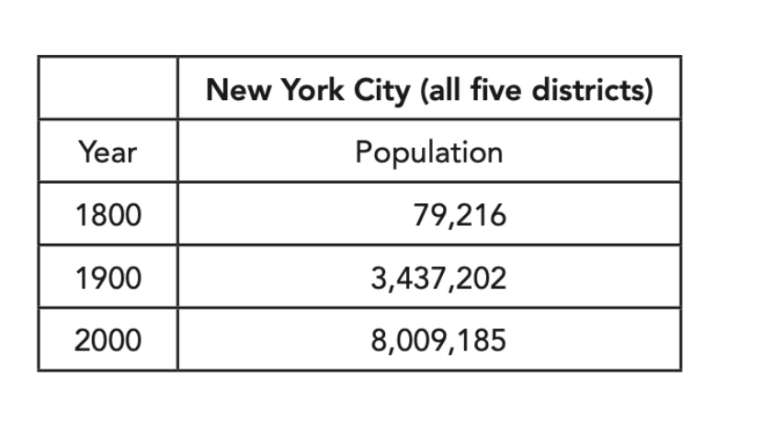
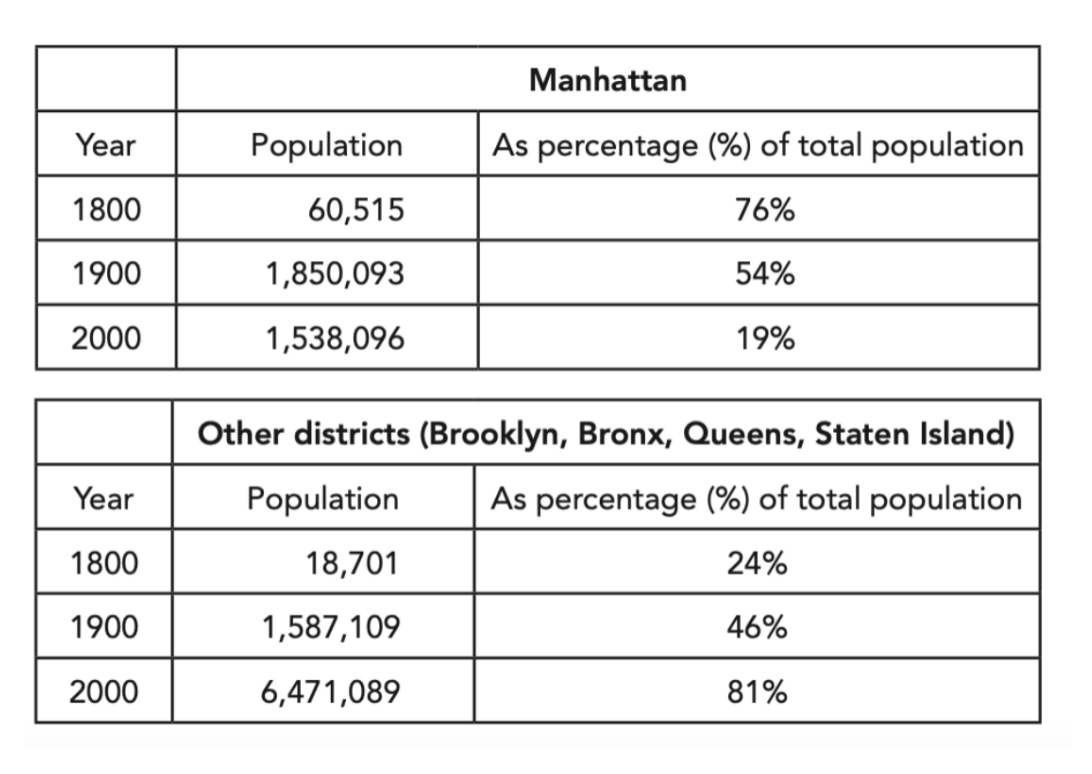
The first table below shows changes in the total population of New York City from 1800 to 2000. The second and third tables show changes in the population of the five districts of the city (Manhattan, Brooklyn, Bronx, Queens, Staten Island) over the same period.
Summarise the information by selecting and reporting the main features, and make comparisons where relevant.
Student answer (Band 5.5)
The tabular information illustrates the proportion of population for New York City, Manhattan and other 5 districts between 1800 to 2000.
Overall, although population of mentioned cities had an increasing trend, Manhattan showed a downward trend as compared to others.
To begin with, the population of New York City including 5 districts witnessed an upward trend. In 1800, the population was 79,216 which rose up to 3,437,202 in 1900 and reached to 8,009,185 till the year 2000.
Furthermore, Manhattan had the population of 60,515 with 76% in the year 1800. Though population had increased over years, the percentage were less, 54% and 19% in 1900 and 2000 subsequently. Moreover, the population of other districts namely Brooklyn, Bronx, Queens, Staten, Island
had went up over years.
Finally, it is evident that from the year 1800 to 2000 the population growth in all the mentioned dictricts was high except in Manhattan, whose population dived off from 1800 to 2000.
AI examiner evaluation
| Criterion | Band |
|---|---|
| Task Achievement / Task Response | 6.0 |
| Coherence and Cohesion | 5.5 |
| Lexical Resource | 5.5 |
| Grammatical Range and Accuracy | 5.5 |
| Overall | 5.5 |
Task Achievement / Task Response: Band 6.0
You identify the main overall contrast: New York City’s total population rose substantially, while Manhattan’s share of the city population declined. The total figures for 1800, 1900 and 2000 are accurate, and you report Manhattan’s population and percentages correctly. However, the overview is imprecise when it says the population of “mentioned cities” increased: Manhattan’s population itself rose to 1,850,093 in 1900 before falling to 1,538,096 in 2000. The other districts’ combined population and share grew strongly, but this is asserted without figures, and the final claim that growth was high in all districts is not supported by the tables, which give only a combined figure for those districts. Clarifying these distinctions and developing the comparison would make the summary more complete.
Coherence and Cohesion: Band 5.5
The response has a recognisable structure, with an overview followed by paragraphs on the total population and district figures. Sequencing expressions such as “To begin with,” “Furthermore” and “Finally” help signal movement between points. However, the progression is not fully controlled: the final paragraph repeats the overview rather than adding a distinct comparison, and the Manhattan paragraph shifts between population and percentage without clearly explaining their different trends. Some linking is mechanical, particularly the repeated use of “Moreover” and “Finally.” Grouping the figures into a clear comparison—total population, then Manhattan versus the other districts—and using references such as “its share” more precisely would improve the flow and cohesion.
Lexical Resource: Band 5.5
You use relevant vocabulary for describing data, including “proportion,” “upward trend,” “percentage” and “population growth,” so the topic is generally clear. There are also attempts at more varied phrasing, such as “witnessed an upward trend.” However, several choices are inaccurate or unnatural: “population of mentioned cities” is unclear, “reached to” is not the appropriate collocation, and “dived off” is unsuitable for describing a population decline. “Other 5 districts” also misrepresents the grouping, since Manhattan is one of the five districts and the table combines the other four. Aim for precise terms such as “the city’s population,” “rose to,” “fell” and “the other four districts.” Check spelling, including “districts” and “Staten Island.”
Grammatical Range and Accuracy: Band 5.5
You attempt a mix of simple and more complex sentences, including a concessive structure beginning “Though population had increased over years.” Most sentences communicate the intended trend, but some grammatical errors remain. In “between 1800 to 2000,” the time expression should be “between 1800 and 2000”; “the percentage were less” has a subject–verb agreement error; and “had went up” uses an incorrect past participle. Articles and noun forms also need attention, as in “although population” and “the population of mentioned cities.” The sentence beginning “Though” is difficult to follow because it contrasts an increase in population with a decrease in percentage without making the distinction explicit. More accurate agreement, verb forms and sentence framing would strengthen control.
See this exact question answered at other band scores. The same prompt compared across bands.
Browse more IELTS Writing model answers or get your own writing scored by the same AI examiner.