Band 4.0 IELTS Writing Task 1 Model Answer
Overall Band Score: 4.0 · Cambridge IELTS 20 · 2026-11-22
IELTS Writing Task 1 question
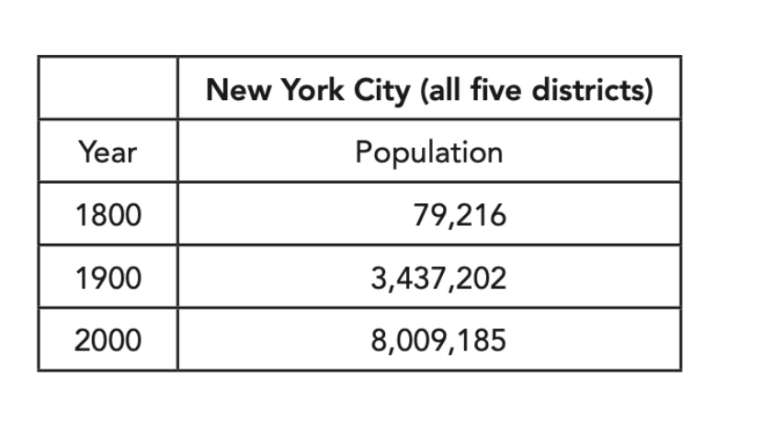
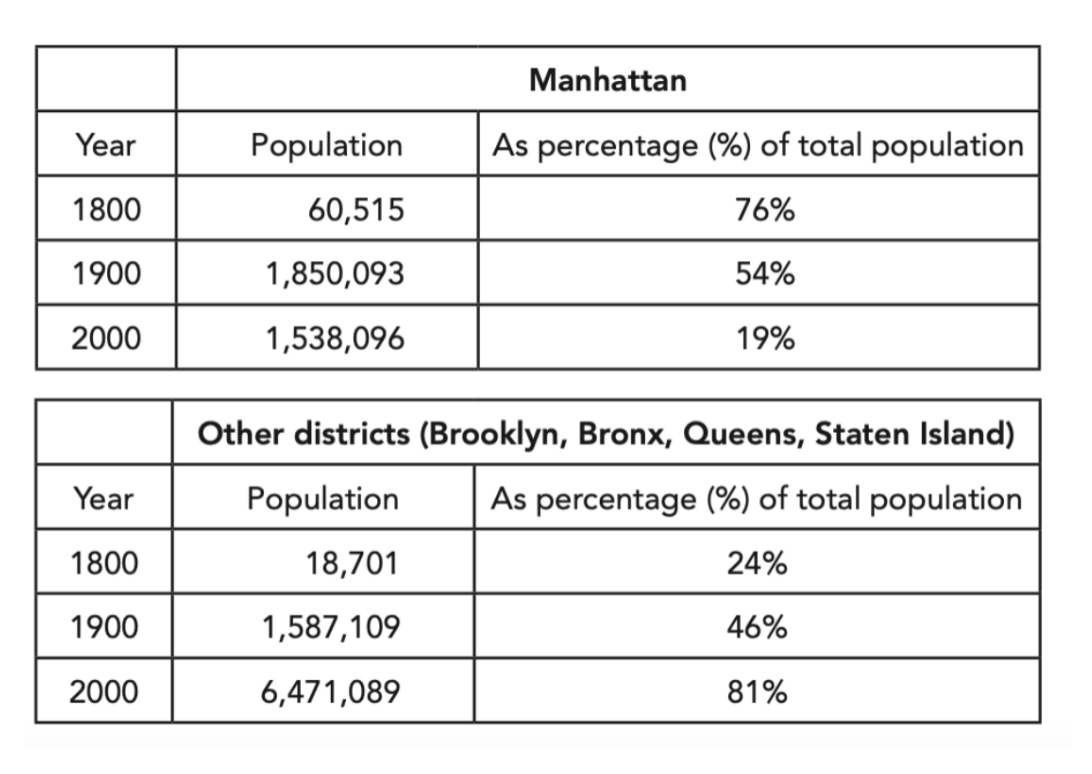
The first table below shows changes in the total population of New York City from 1800 to 2000. The second and third tables show changes in the population of the five districts of the city (Manhattan, Brooklyn, Bronx, Queens, Staten Island) over the same period.
Summarise the information by selecting and reporting the main features, and make comparisons where relevant.
Student answer (Band 4.0)
This table shows that total populatin of aanew ayork acity fom 1800 to 2000 as it also increase in Manhattan ,Brookklyn,Queens and Staten Island over th same period.
Overall as percntage of total population is gradually increase 76% in 1800. As it decrease as 54% in 1900 and eventually 19% in 2000.As compared to other cities it goes as 24% in 1800 and 46% in 1900. As result above it went 81% in 2000.As the stats says it goves from top to bottom in froom 1800 to 2000 that shows the decreese of population in new york and all other cites like brooklyn, Bronx etc.
Concalusions says that according to stats the popullation of all cites decrease with passage of time.
AI examiner evaluation
| Criterion | Band |
|---|---|
| Task Achievement / Task Response | 3.0 |
| Coherence and Cohesion | 4.0 |
| Lexical Resource | 4.5 |
| Grammatical Range and Accuracy | 4.5 |
| Overall | 4.0 |
Task Achievement / Task Response: Band 3.0
The response identifies the broad topic and reports several percentage figures, including Manhattan’s shares of 76%, 54% and 19%, and the other districts’ shares of 24%, 46% and 81%. However, the overview is inaccurate: it says populations decreased, whereas New York City’s total population rose sharply, and the combined population of the other districts also increased. Manhattan’s population rose to 1,850,093 by 1900 before falling to 1,538,096 in 2000, a key contrast that is not reported. The response also confuses the districts with “other cities” and does not give the total population figures. It is 29 words below the required minimum. To improve, select the main trends accurately and support them with relevant figures.
Coherence and Cohesion: Band 4.0
There is a basic attempt to organise the response: an opening sentence is followed by comments on the percentages and a concluding statement. Some linking expressions, such as “Overall,” “As compared to” and “As result,” show an effort to connect ideas. However, the progression is difficult to follow because the discussion shifts between Manhattan, the other districts and the city as a whole without clear distinctions. The conclusion repeats the inaccurate claim that populations decreased, rather than summarising the main comparison. Several sentences are joined or punctuated in ways that make relationships unclear. Use separate paragraphs for an overview and key details, and connect each figure explicitly to the group and year it describes.
Lexical Resource: Band 4.5
The response uses some task-related vocabulary, including “percentage,” “population,” “stats” and “decrease,” and attempts phrases such as “over the same period.” This gives the reader a general sense of the subject. However, spelling errors are frequent, including “populatin,” “percntage,” “Concalusions” and “decreese,” and some word choices are inaccurate or imprecise. “Other cities” does not correctly describe the other districts, while “goes from top to bottom” is unclear for describing a trend. “Stats” is also informal for an academic report. Build a more precise range for describing tables, such as “the total population,” “accounted for,” “rose” and “declined,” and check spelling carefully.
Grammatical Range and Accuracy: Band 4.5
The response attempts both simple and more extended sentence forms, including “As compared to other cities it goes as 24% in 1800 and 46% in 1900.” However, sentence construction is often incomplete or difficult to interpret. For example, “Overall as percentage of total population is gradually increase” lacks a clear subject and has an incorrect verb form, while “As result above it went 81% in 2000” does not clearly identify what “it” refers to. Tense and agreement are also inconsistent, and punctuation is often missing after year figures. These problems make some relationships between ideas unclear. Practise complete subject–verb sentences, accurate past-tense reporting, and clear references, for example: “The other districts’ share rose to 81% by 2000.”
See this exact question answered at other band scores. The same prompt compared across bands.
Browse more IELTS Writing model answers or get your own writing scored by the same AI examiner.