Band 5.5 IELTS Writing Task 1 Model Answer
Overall Band Score: 5.5 · Cambridge IELTS 20 · 2026-11-22
IELTS Writing Task 1 question
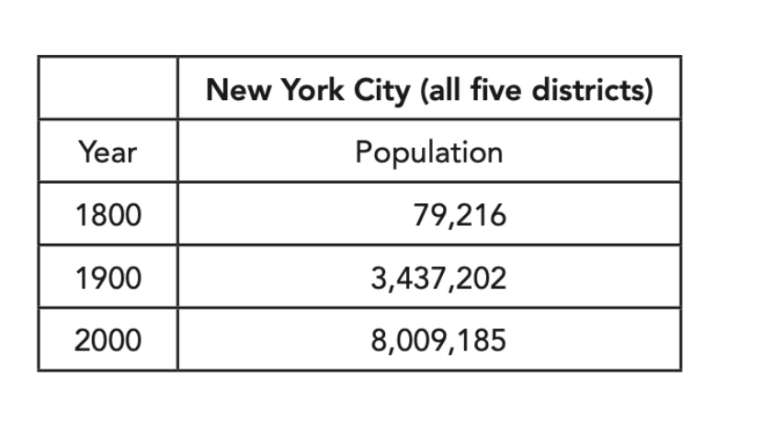
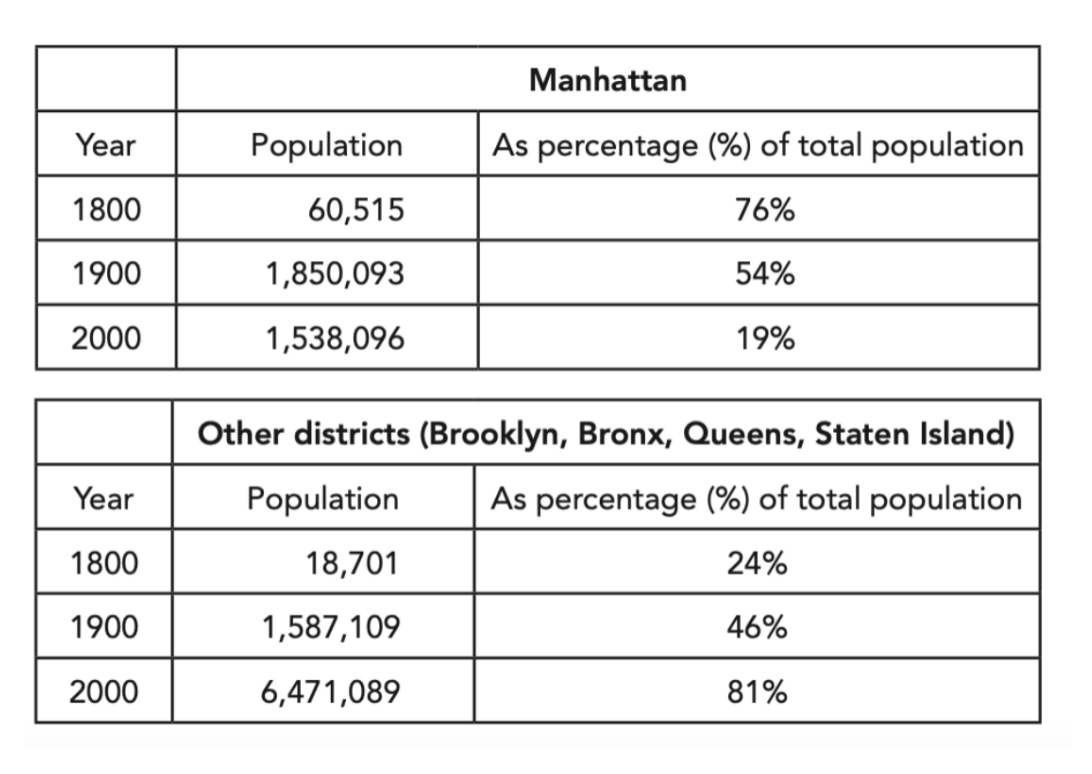
The first table below shows changes in the total population of New York City from 1800 to 2000. The second and third tables show changes in the population of the five districts of the city (Manhattan, Brooklyn, Bronx, Queens, Staten Island) over the same period.
Summarise the information by selecting and reporting the main features, and make comparisons where relevant.
Student answer (Band 5.5)
The table illustrates the total head count in New york city from the years 1800 to 2000. Other two tables, gives information seperately for manhattan and four districts in propotion.
Overall, in all the five districts, the population has doubled it's equation throught out the years.
Firstly, in 1800's the population of entire new york city is 79,216. By the next century, it goes to a huge number 3,437,202. Afterthat, by early 20's it hits a massive number of more than 8 lakh people. Subsequently, when itcomes to Manhattan, the population is increasing and total percentage is decreasing. At the starting stage, it has a share of 76 percent, it falls to 19 at the end.
However, remaining 4 districts are different from Mahattan. Because, it has a downfall in total calculation. But, the percentages are raisen here. Moreover, to the upcoming centuries, the bothpeople's count and the percentage also growing well.
AI examiner evaluation
| Criterion | Band |
|---|---|
| Task Achievement / Task Response | 5.5 |
| Coherence and Cohesion | 5.5 |
| Lexical Resource | 5.0 |
| Grammatical Range and Accuracy | 5.0 |
| Overall | 5.5 |
Task Achievement / Task Response: Band 5.5
You identify the broad growth in New York City’s population and note the contrasting percentage trends for Manhattan and the other districts. However, the overview is unclear and includes a major factual error: the city’s population did not double throughout; it rose from 79,216 to 8,009,185. You also say the final figure was “more than 8 lakh,” which is far below the actual 8 million, and describe the other districts’ population as having a “downfall,” although it increased substantially, reaching 6,471,089. The response reports some relevant figures but omits the key comparison that Manhattan’s population peaked in 1900 and then fell, while the other districts grew strongly. Select accurate headline trends and support them with correct figures.
Coherence and Cohesion: Band 5.5
The response has separate introductory, overview and detail paragraphs, and words such as “Firstly,” “However” and “Moreover” show an attempt to connect ideas. Nevertheless, the progression is difficult to follow because the overview is inaccurate and the later comparisons are not clearly organised. For example, “However, remaining 4 districts are different from Mahattan” does not specify the contrast, while “Because, it has a downfall” leaves the reader unsure which population is meant. The final sentence is also vague rather than completing the comparison. Group the information by the overall city trend, then Manhattan, then the other districts, and use clear references such as “their population” or “their share” to make each comparison explicit.
Lexical Resource: Band 5.0
You attempt a range of descriptive language, including “huge number,” “massive number” and “downfall,” but several choices are informal, imprecise or unsuitable for describing statistical data. “Head count” is not a natural term here, and “population has doubled it’s equation” does not communicate a clear trend. There are also noticeable spelling and word-form errors, including “New york,” “seperately,” “propotion,” “Mahattan” and “raisen.” These choices sometimes make the intended meaning difficult to understand. Use standard data-reporting vocabulary consistently, such as “population,” “rose,” “declined,” “accounted for” and “proportion,” and check spelling and collocations before submitting.
Grammatical Range and Accuracy: Band 5.0
You attempt both simple and more extended sentences, but control is inconsistent, and errors frequently affect clarity. For example, “Other two tables, gives information” has an incorrect determiner and subject–verb agreement, while “the population has doubled it's equation” has an unclear grammatical construction. In “Because, it has a downfall in total calculation,” the sentence fragment and unclear pronoun make the relationship difficult to follow. Tense and sentence patterns also shift awkwardly in “By the next century, it goes to” and “the bothpeople's count … also growing.” Practise complete sentences with a clear subject and verb, maintain past tense when reporting historical figures, and check agreement, articles and punctuation.
See this exact question answered at other band scores. The same prompt compared across bands.
Browse more IELTS Writing model answers or get your own writing scored by the same AI examiner.