Band 6.0 IELTS Writing Task 1 Model Answer
Overall Band Score: 6.0 · Cambridge IELTS 20 · 2026-11-22
IELTS Writing Task 1 question
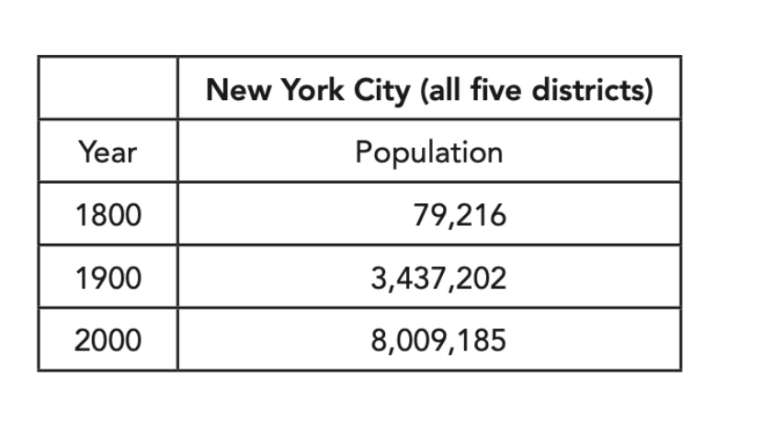
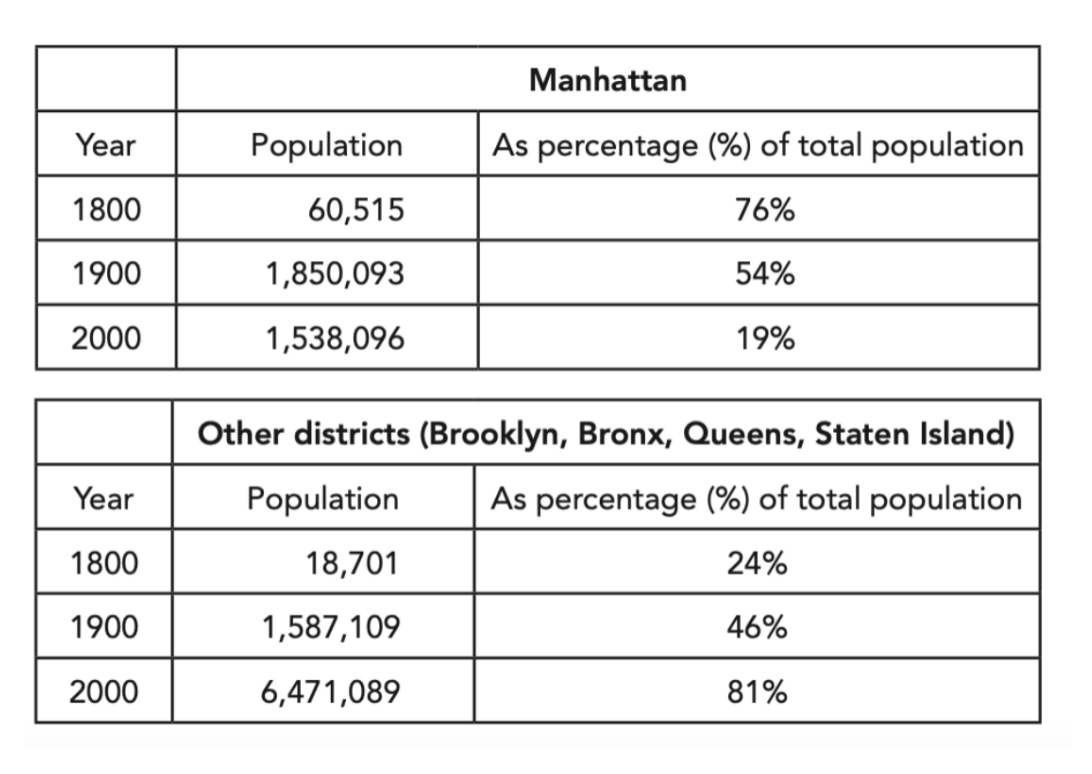
The first table below shows changes in the total population of New York City from 1800 to 2000. The second and third tables show changes in the population of the five districts of the city (Manhattan, Brooklyn, Bronx, Queens, Staten Island) over the same period.
Summarise the information by selecting and reporting the main features, and make comparisons where relevant.
Student answer (Band 6.0)
The table illustrates the population changes in New York from 1800 to 2000 along with specific changes in different districts including Manhattan, Brooklyn, Bronx, Queens and Staten Island.
The population in New York almost triples in year 1900 in comparison with 1800 and almost doubles in year 2000 from 1900. The comparison of population changes in different districts shows 76% population in Manhattan and remaining 24% in other districts in year 1800. In 1900 Manhattan comprises 54% of total population and other districts including Brooklyn, Bronx, Queens, Staten Island comprises 46%. But dramatic decrease shows in year 2000 in Manhattan which shows only 19% of total population and major 81% of population in other districts. Overall the New York City population increases from year 1800 to 2000, the Manhattan shows decline in population from 1800 to 2000, but other distrcits shows a good amount of increase in population from 1800 to 2000.
AI examiner evaluation
| Criterion | Band |
|---|---|
| Task Achievement / Task Response | 6.0 |
| Coherence and Cohesion | 6.0 |
| Lexical Resource | 5.5 |
| Grammatical Range and Accuracy | 5.5 |
| Overall | 6.0 |
Task Achievement / Task Response: Band 6.0
You identify the main overall pattern: New York’s population grew substantially, while Manhattan’s share fell and the other districts’ share rose. The percentages for all three years are reported accurately, and the concluding overview is relevant. However, the description of the citywide totals is inaccurate: the population did not almost triple by 1900 or almost double by 2000; it rose from 79,216 to 3,437,202 and then to 8,009,185. Also, saying Manhattan “shows decline in population from 1800 to 2000” overlooks that its population first increased sharply before falling by 2000. To strengthen the response, report the key totals accurately and distinguish changes in population numbers from changes in percentage share.
Coherence and Cohesion: Band 6.0
The response has a clear general sequence: it introduces the tables, compares the district shares across the three years, and ends with an overall summary. Time markers such as “in 1800,” “In 1900,” and “in year 2000” help readers follow the comparisons, while “But” signals a contrast. However, the information is presented as one continuous block, and the overview comes only at the end rather than being clearly separated from the detailed comparisons. Some linking is mechanical, especially the repeated use of “shows,” and the relationship between Manhattan’s population and its share is not always clearly signposted. Use distinct overview and detail paragraphs, and connect comparisons more precisely.
Lexical Resource: Band 5.5
You use relevant vocabulary for describing tables and proportions, including “population,” “total population,” “comprises,” “dramatic decrease,” and “increase.” This gives you enough range to communicate the main comparisons. However, several choices are imprecise or unnatural: “almost triples” and “almost doubles” misrepresent the figures, “major 81%” is not a natural way to describe a proportion, and “a good amount of increase” is vague. There is also a spelling error in “distrcits.” Aim for precise trend language and natural collocations, such as “rose sharply,” “accounted for,” and “the remaining share.”
Grammatical Range and Accuracy: Band 5.5
You attempt both simple and more complex sentence forms, including the comparison beginning “The comparison of population changes in different districts shows…” and the concluding sentence contrasting the city and its districts. The main meaning is generally understandable, but some grammatical errors remain. For example, “The population in New York almost triples in year 1900” shifts into the present tense and omits an article before “year”; “other districts … comprises” has subject–verb disagreement; and the final sentence has unclear parallel structure (“the Manhattan shows …, but other districts shows…”). Use past-tense verbs consistently for historical data, check singular and plural agreement, and divide long comparisons into controlled sentences.
See this exact question answered at other band scores. The same prompt compared across bands.
Browse more IELTS Writing model answers or get your own writing scored by the same AI examiner.