Band 5.5 IELTS Writing Task 1 Model Answer
Overall Band Score: 5.5 · Cambridge IELTS 20 · 2026-11-22
IELTS Writing Task 1 question
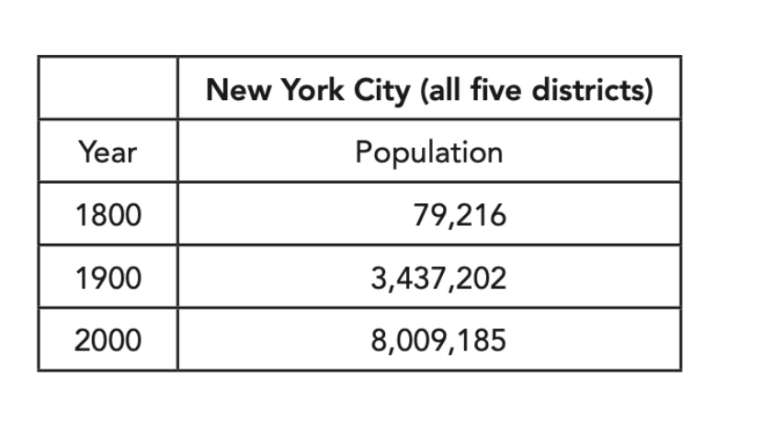
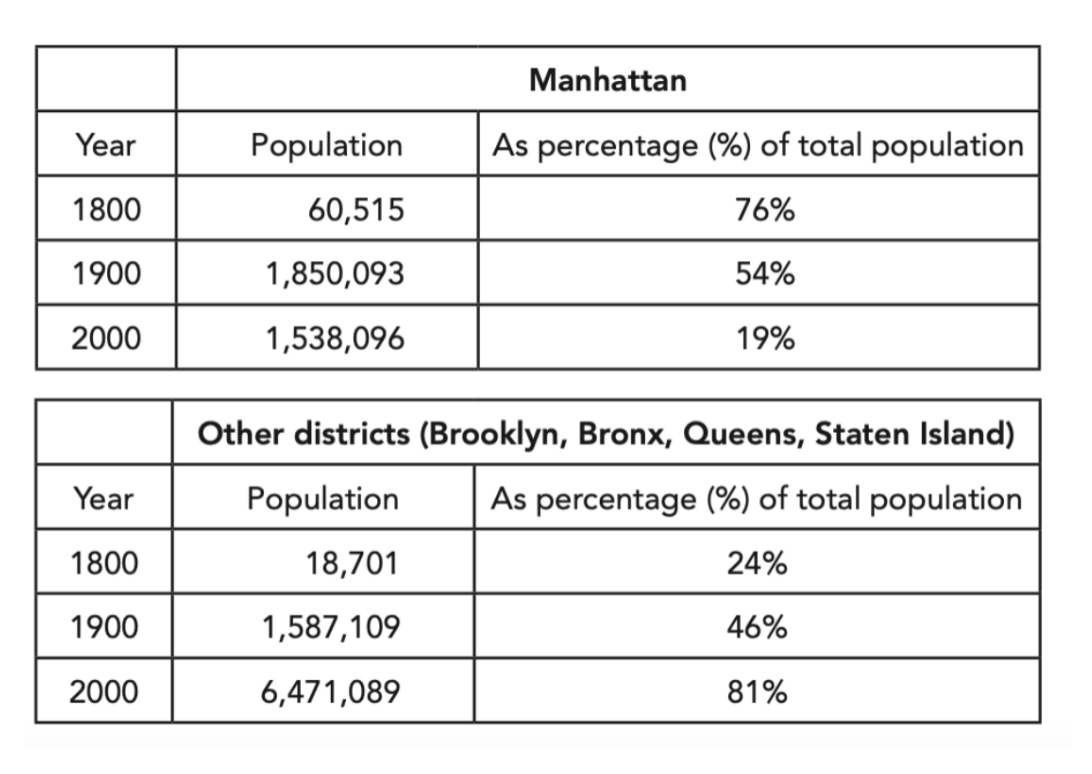
The first table below shows changes in the total population of New York City from 1800 to 2000. The second and third tables show changes in the population of the five districts of the city (Manhattan, Brooklyn, Bronx, Queens, Staten Island) over the same period.
Summarise the information by selecting and reporting the main features, and make comparisons where relevant.
Student answer (Band 5.5)
The first table shows changes in total population of New York city between 1800 and 2000. While, the second shows the changes in the population in Manhattan in the same years and the third in the other four remaining districts of New York city.
Overall, There is a significant increase in New York population from the year 1800 to 2000 with more than 100 percent. When the percentage of the total population decreased in Manhattan and increased in the other districts throughout the two centuries.
New York has witnessed a big rise in it's population number from almost 80 thousnd in 1800 to 3.43 million in 1900, then a another significant increase to 8 million in 2000.
For Manhattan, an increase of population has happened frompthe year 1800 to 2000 to reach almost 1.5 million, but a big decrease in population percentage from 76 percent in 1800 to 19 percent in 2000, which conclure that most of citizens are avoiding to live in this distric. However, the mosy of people are heading toward the other distincts (Brooklyn, Bronx, Queens and Staten Island) which it obvoiously clear from the stats. From just 24 percent in 1800 to more than 80 percent in 2000.
AI examiner evaluation
| Criterion | Band |
|---|---|
| Task Achievement / Task Response | 6.0 |
| Coherence and Cohesion | 5.5 |
| Lexical Resource | 5.0 |
| Grammatical Range and Accuracy | 5.0 |
| Overall | 5.5 |
Task Achievement / Task Response: Band 6.0
You identify the main overall pattern: New York’s population grew substantially, while Manhattan’s share fell and the other districts’ share rose. Several figures are reported accurately, including the approximate city totals and the change from 24% to over 80% for the other districts. However, the overview says the city grew by “more than 100 percent,” which greatly understates the increase, and the Manhattan account does not clearly report that its population peaked at 1,850,093 in 1900 before falling to 1,538,096 in 2000. The claim that residents are “avoiding” Manhattan or “heading toward” other districts is not demonstrated by these tables. Covering the 1900 turning point and avoiding unsupported explanations would make the summary more complete and precise.
Coherence and Cohesion: Band 5.5
The response has a recognisable structure: an introduction, an overview, and separate discussion of the city total and district patterns. This helps the reader follow the broad comparison. However, progression is uneven because the final paragraph combines Manhattan’s population, its percentage share, and an explanation about residents’ choices without clearly separating these points. Some linking is awkward or incomplete: “While” begins a sentence fragment, and “However” does not introduce a clear contrast after the preceding claim. References such as “the second” and “the third” are understandable, but the relationships between figures could be signposted more precisely. Organise the body around the city total and then the contrasting district trends, using clear comparisons across all three years.
Lexical Resource: Band 5.0
You use some relevant vocabulary for describing change, including “significant increase,” “decreased,” “increased,” and “rise.” However, the range is limited and several choices are inaccurate or informal for an academic data summary. “Population number” is an awkward collocation, while “big rise” and “big decrease” are imprecise. The phrases “avoiding to live” and “heading toward” introduce unsupported interpretations rather than neutral descriptions of the data. Spelling errors such as “thousnd,” “conclure,” “distric,” “mosy,” and “obvoiously” are noticeable and reduce clarity. Aim for precise terms such as “population,” “share,” “accounted for,” and “declined,” and check spelling carefully.
Grammatical Range and Accuracy: Band 5.0
You attempt both simple and more complex forms, including a contrast with “While” and a sentence using “which,” but control is inconsistent. “While, the second shows…” is not a complete sentence, and “When the percentage … decreased” is also a dependent clause presented as a sentence. There are errors in articles and verb forms in “a another significant increase” and “an increase of population has happened.” The sentence beginning “For Manhattan” is overloaded, making the relationship between the population figures and percentages difficult to follow. Punctuation and capitalisation are also inconsistent, as in “Overall, There.” Use complete sentences, keep each comparison focused, and check agreement, articles, and sentence boundaries.
See this exact question answered at other band scores. The same prompt compared across bands.
Browse more IELTS Writing model answers or get your own writing scored by the same AI examiner.