Band 5.5 IELTS Writing Task 1 Model Answer
Overall Band Score: 5.5 · Cambridge IELTS 20 · 2026-11-22
IELTS Writing Task 1 question
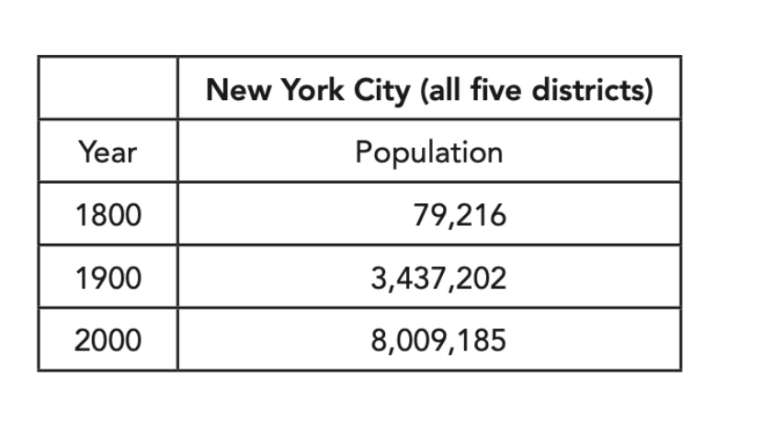
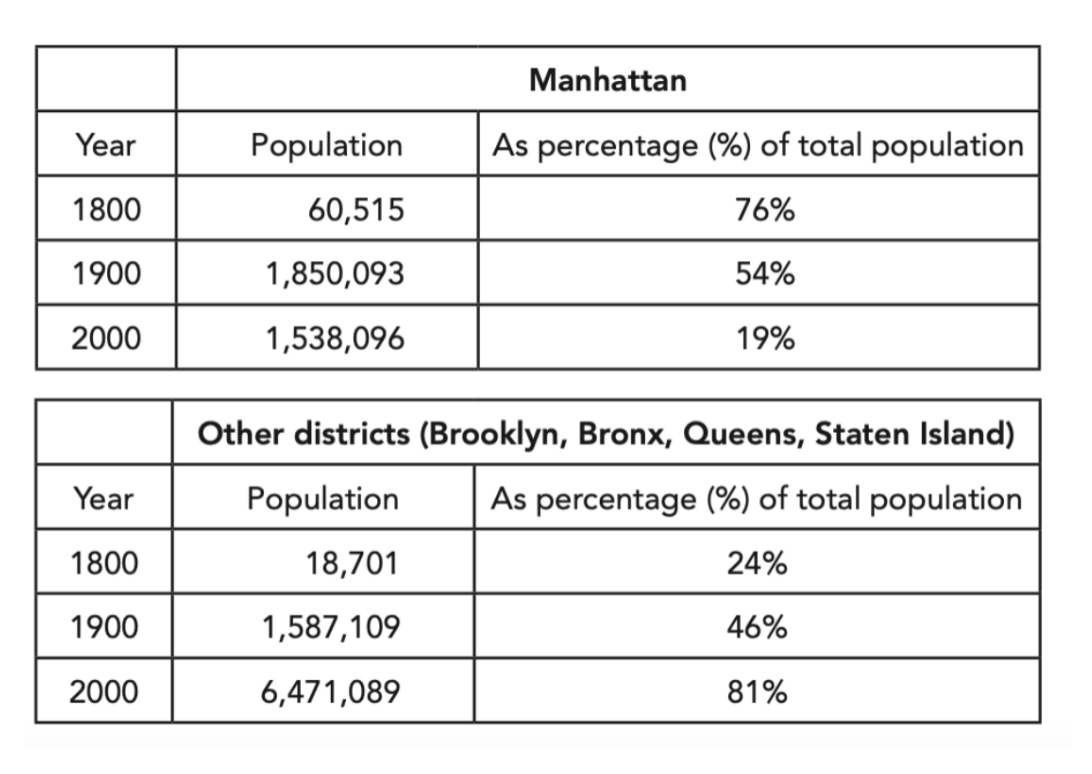
The first table below shows changes in the total population of New York City from 1800 to 2000. The second and third tables show changes in the population of the five districts of the city (Manhattan, Brooklyn, Bronx, Queens, Staten Island) over the same period.
Summarise the information by selecting and reporting the main features, and make comparisons where relevant.
Student answer (Band 5.5)
In this table we are given a population chart from 1800 to 2000. as the tamie passed the number of people were also increased. as in the whole NewYork city there is a massive increase in growth. In year of 1800 there were79,216 people while in 1900 there were growth of population jumped to 3,437,202 while in 2000 the number of people were 8,009,185 which was great in population increase.
and If compare this chart to city wise we noticed that the percentage of people increased in Manhattan with the rest of cities like Brooklyn, Bronx, Qewwns, Staten Islnad. The increment of population in 1800 was 76% and in other cities it was 0nly24%. in 1900 there were 54% more population while in other disticts it was only 46% and in 2000 the increment of population was only 19% in contrast of other cities it was 81%. which shows us the growth rate of the cities in ancient time.
AI examiner evaluation
| Criterion | Band |
|---|---|
| Task Achievement / Task Response | 5.5 |
| Coherence and Cohesion | 5.5 |
| Lexical Resource | 5.0 |
| Grammatical Range and Accuracy | 5.0 |
| Overall | 5.5 |
Task Achievement / Task Response: Band 5.5
You identify the main overall pattern: New York City’s population rose substantially, while Manhattan’s share fell and the other districts’ share increased. The figures for the citywide totals and the percentage shares are generally accurate. However, the comparison is incomplete because you do not report the actual population figures for Manhattan and the other districts, including Manhattan’s decline from 1,850,093 in 1900 to 1,538,096 in 2000. The phrase “the increment of population” also confuses population totals with percentages, and the final claim about “growth rate” is not clearly supported by the tables. Select the key changes more precisely and give a clear overview of the contrasting trends.
Coherence and Cohesion: Band 5.5
There is some organisation: the response first discusses the citywide totals and then turns to Manhattan and the other districts. This gives the reader a basic route through the information. However, the progression within each section is not consistently clear, and the long second paragraph combines several comparisons without clear sentence boundaries. Repeated openings such as “in 1800,” “in 1900,” and “in 2000” make the account feel list-like, while “and If compare this chart to city wise” does not provide a clear transition. Use separate paragraphs for the overview and details, and group the figures by trend—for example, Manhattan’s falling share versus the other districts’ rising share—to make the comparisons easier to follow.
Lexical Resource: Band 5.0
You use some relevant vocabulary, including “population,” “percentage,” “increase,” and “in contrast,” so the topic is usually understandable. However, the range is limited and several choices are inaccurate or repetitive. “The increment of population” is used for percentage shares, and “growth rate” is not an accurate description of the figures presented. Phrases such as “great in population increase” and “more population” are also unnatural in this context. Spelling errors, including “Qewwns” and “Islnad,” further reduce precision. Aim for standard data-reporting expressions such as “the population rose to,” “accounted for,” and “the share declined,” and check the spelling of district names.
Grammatical Range and Accuracy: Band 5.0
The response attempts to connect ideas in longer sentences, but control is inconsistent, and errors sometimes make relationships between figures difficult to interpret. Examples include “as the tamie passed the number of people were also increased,” where the tense and verb construction are faulty, and “If compare this chart to city wise,” which lacks a correctly formed clause. There are also problems with articles, agreement, and sentence boundaries, as in “in year of 1800 there were79,216 people” and the run-on comparison beginning “in 1900 there were 54% more population.” Most sentences rely on basic patterns, with limited accurate variety. Practise forming clear comparative sentences and use consistent past-tense structures, such as “The population increased from X to Y.”
See this exact question answered at other band scores. The same prompt compared across bands.
Browse more IELTS Writing model answers or get your own writing scored by the same AI examiner.