Band 5.5 IELTS Writing Task 1 Model Answer
Overall Band Score: 5.5 · Cambridge IELTS 20 · 2026-11-23
IELTS Writing Task 1 question
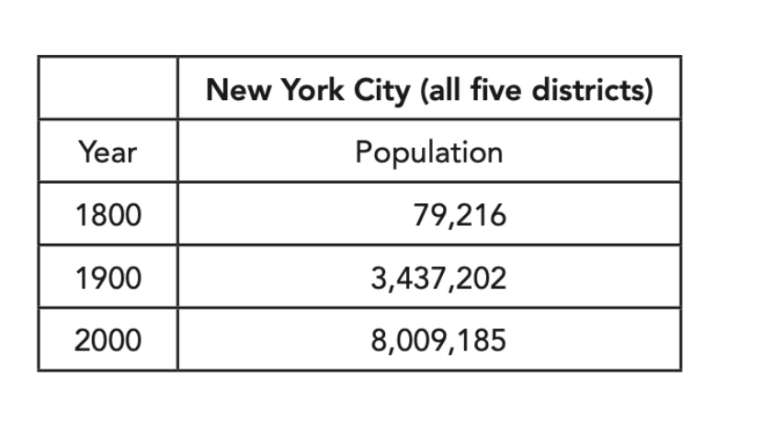
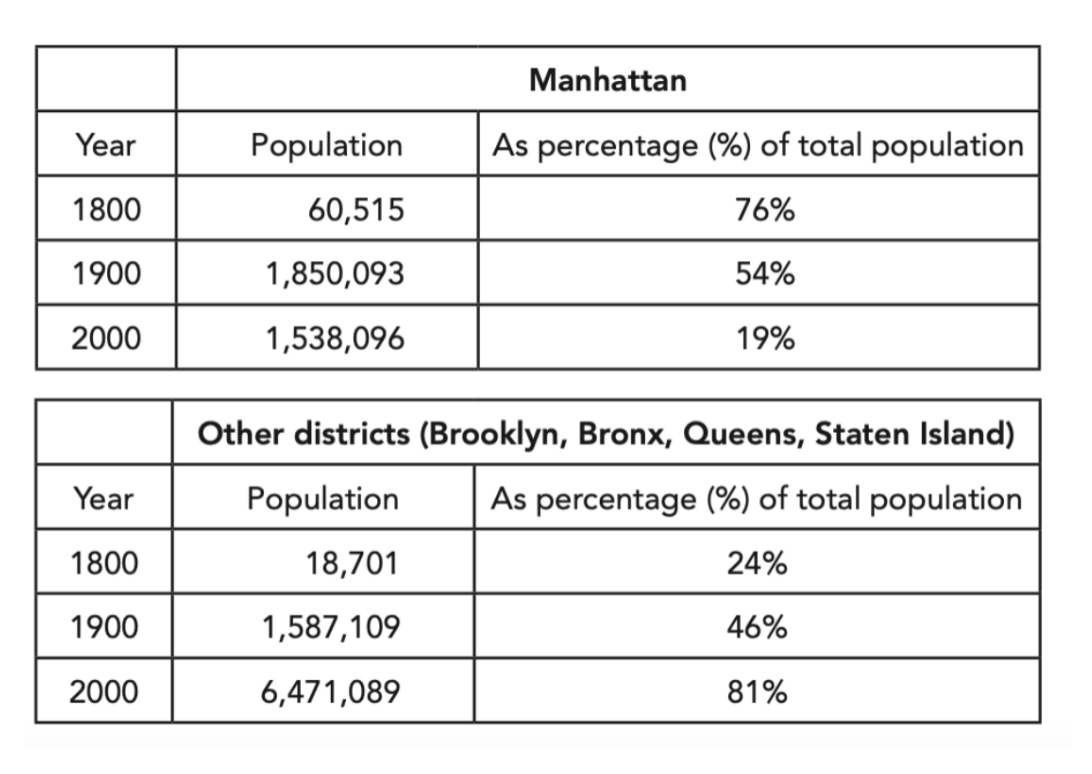
The first table below shows changes in the total population of New York City from 1800 to 2000. The second and third tables show changes in the population of the five districts of the city (Manhattan, Brooklyn, Bronx, Queens, Staten Island) over the same period.
Summarise the information by selecting and reporting the main features, and make comparisons where relevant.
Student answer (Band 5.5)
The first tables provide the information about the changes in the total human population of New york City from 200 years.While, the second and third tables illustrate the differences in the population of five districts cities over the same period.
Overall, New York City population increase gradually then Manhattan population was declined steadily and other four districts population was rose significantly.
Firstly, New York City in 2000 year the highest population was 8,009,185. While, In 1900 year the population was 3,437,202.Then the lowest population was 79,216 in 1800.In contrast, Manhattan highest population was 76% in the year of 1800.Similarly, In 1900 the population was 54% and the lowest population was 2000 year and was population 19%.
secondly, Other districts(Brooklyn, Bronx, Queens, Staten Island) was population decreased in 1800 year and the percentage was 24%.While, the highest percentage of population in 2000 and was 81% and similarly average percentage of population was 46% in the year of 1900.
AI examiner evaluation
| Criterion | Band |
|---|---|
| Task Achievement / Task Response | 6.0 |
| Coherence and Cohesion | 5.5 |
| Lexical Resource | 5.0 |
| Grammatical Range and Accuracy | 5.0 |
| Overall | 5.5 |
Task Achievement / Task Response: Band 6.0
You identify the main overall contrast: the city’s total population grew, while Manhattan’s share fell and the other districts’ share rose. You also include several accurate figures, such as the city totals and the district percentages. However, some key information is unclear or misreported. Manhattan’s population did not decline steadily across the whole period: it rose from 60,515 in 1800 to 1,850,093 in 1900, then fell to 1,538,096 in 2000. The other districts’ population did not decrease in 1800; 18,701 is their population at that date. The overview also says the city increased “gradually,” although the figures show a very large rise. More precise reporting of population counts alongside percentages would make the summary more complete and clear.
Coherence and Cohesion: Band 5.5
The response has a recognisable structure, with an introduction, an overview and two detail paragraphs, and it groups the city total separately from the district figures. This gives the reader a basic route through the information. However, progression within the paragraphs is sometimes awkward: the first detail paragraph moves from 2000 to 1900 to 1800, then shifts to Manhattan, while the second begins with a confusing statement about a decrease. Connectors such as “While,” “Similarly” and “In contrast” are often used mechanically or do not express the relationship accurately. Try organising the figures chronologically and using clear links to show comparisons, rather than relying on repeated transition words.
Lexical Resource: Band 5.0
You use some relevant task vocabulary, including “population,” “percentage,” “highest” and “declined,” so the topic is generally understandable. However, the range is limited and several word choices or combinations are inaccurate, which sometimes makes the meaning difficult to follow. For example, “total human population” is unnecessarily broad, “population was rose” is not a natural expression, and “average percentage” does not describe the 1900 figure. Repeated use of “population” and “year” also makes the report sound repetitive. Aim for precise terms such as “population total,” “accounted for,” and “share,” and check spelling and capitalisation, including “New York” and sentence-initial “Secondly.”
Grammatical Range and Accuracy: Band 5.0
You attempt both simple statements and longer sentences, and the reader can usually identify the figures being discussed. However, the range is limited, and errors in verb forms, agreement, articles and sentence boundaries are frequent enough to make some sentences difficult to interpret. Examples include “population increase gradually,” “population was declined steadily,” and “other four districts population was rose significantly.” The sentence beginning “Firstly, New York City in 2000 year…” also has an unclear structure, while several full stops are missing or followed by an incorrectly capitalised connector. Practise forming direct comparison sentences with a clear subject and verb, for example: “The city’s population rose from X to Y,” and proofread punctuation and tense consistency.
See this exact question answered at other band scores. The same prompt compared across bands.
Browse more IELTS Writing model answers or get your own writing scored by the same AI examiner.