Band 6.0 IELTS Writing Task 1 Model Answer
Overall Band Score: 6.0 · Cambridge IELTS 20 · 2026-11-23
IELTS Writing Task 1 question
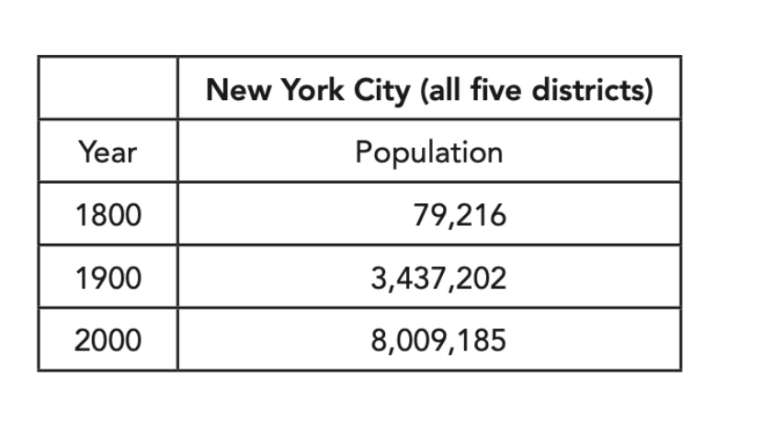
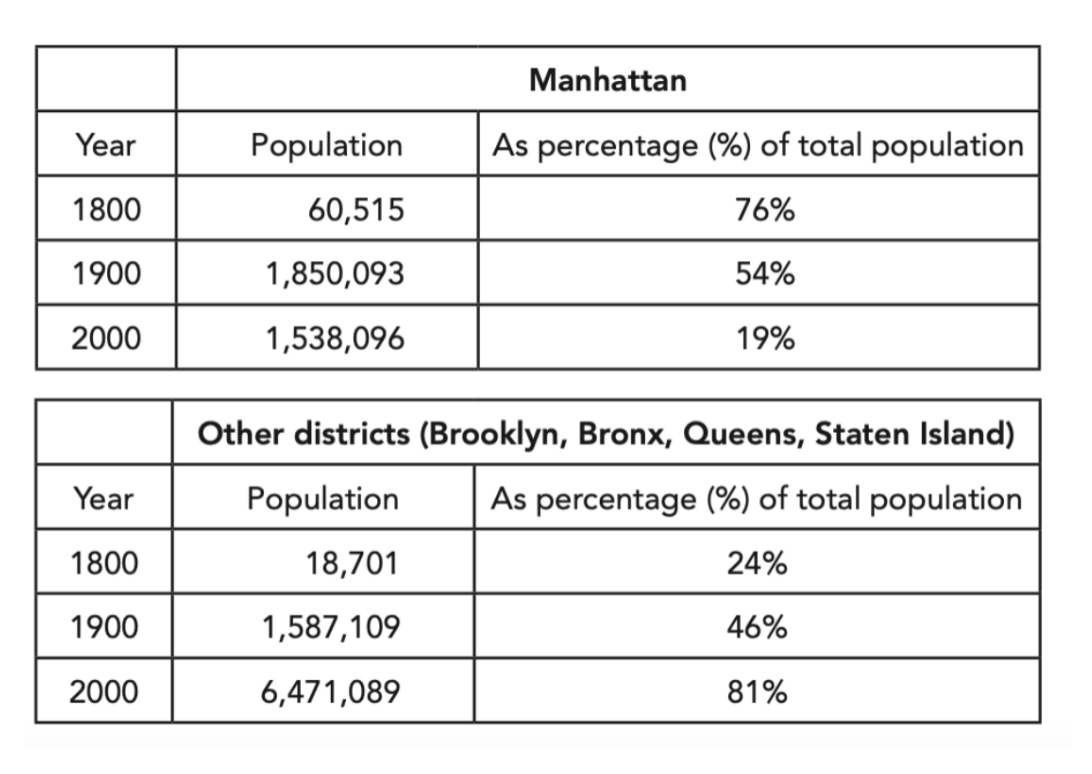
The first table below shows changes in the total population of New York City from 1800 to 2000. The second and third tables show changes in the population of the five districts of the city (Manhattan, Brooklyn, Bronx, Queens, Staten Island) over the same period.
Summarise the information by selecting and reporting the main features, and make comparisons where relevant.
Student answer (Band 6.0)
The first table demonstrates the changes in the total population in all five districts of New York City between 1800 and 2000. The second and third tables give information about the changes in the population of those five specific districts namely Manhattan, Brooklyn, Bronx, Queens, and Staten Island over the same same period.
Overall, the number of people in New York City dramatically increased over the period. Manhattan district had the highest percentage of total population of New York City among all the districts but the figures gradually decreased throughout the period. Meanwhile, the proportion of total population in other four districts had rise significantly.
In 1800, New York City had only around 80,000 people, where Manhattan's population was three quarters of the total population and rest was in the other four districts. The total population increased dramatically in the next 100 year, reaching almost 3.5 Millions. In this century, Manhattan districts population also increased significantly but the percentage had dropped by occupying only 54% of the total population. While, other four districts population was slightly above 1.5 millions.
In 2000, total population reached 8 millions, where Brooklyn, Bronx, Queens, and Staten Islands population was 81% of the total people, with almost 6.5 Millions of people. In contrast, Manhattan districts population experienced a sharp decline and only sharing 19% of the total population.
AI examiner evaluation
| Criterion | Band |
|---|---|
| Task Achievement / Task Response | 6.0 |
| Coherence and Cohesion | 6.5 |
| Lexical Resource | 6.0 |
| Grammatical Range and Accuracy | 5.5 |
| Overall | 6.0 |
Task Achievement / Task Response: Band 6.0
You identify the main trends accurately: the city’s population rose substantially, while Manhattan’s share fell and the other districts’ combined share grew. The overview is relevant, and the response includes useful comparisons for all three years, such as Manhattan’s 76% share in 1800 and 19% in 2000. However, some details are less fully developed. In particular, you say Manhattan’s population “experienced a sharp decline” in 2000, but this needs to be distinguished from its earlier rise: it increased from 60,515 to 1,850,093 by 1900, then fell to 1,538,096. The 1900 comparison could also be clearer by reporting the other districts’ 46% share alongside their population. More precise coverage of these changes would strengthen the summary.
Coherence and Cohesion: Band 6.5
The response has a clear overall structure: an introduction, an overview, and chronological paragraphs covering 1800–1900 and 2000. This makes the main progression easy to follow, and linking expressions such as “Overall,” “Meanwhile,” and “In contrast” help signal comparisons. The organisation is coherent, though some connections are mechanical or unclear. For example, “While, other four districts population…” is not smoothly attached to the preceding sentence, and “where” is used repeatedly to introduce information rather than to express a clear relationship. The overview also groups the districts effectively, but the body could connect the population figures more explicitly to the changing percentages. Use complete comparison sentences and clearer referencing to make the cohesion more flexible.
Lexical Resource: Band 6.0
You use an adequate range of vocabulary for describing trends, including “dramatically increased,” “gradually decreased,” “proportion,” and “sharp decline.” These choices communicate the broad patterns, and the repeated use of population-related terms is appropriate to the task. Some word choices and collocations are less natural or precise, however: “the figures gradually decreased” is vague about which figures, while “had rise significantly” and “only sharing 19%” are not idiomatic. There are also inconsistent forms such as “Millions” and “Staten Islands.” Aim for precise terms such as “population share,” “combined population,” and “accounted for,” and use standard lowercase forms for units and place names. This would make the data description more fluent and exact.
Grammatical Range and Accuracy: Band 5.5
You attempt a mix of simple and complex sentences, including contrast structures such as “In contrast” and clauses beginning with “where.” The overall meaning remains clear, but some grammatical errors recur. For example, “the proportion … had rise” needs the past participle “risen,” and “Manhattan districts population” requires a possessive form or a rephrasing such as “Manhattan’s population.” The sentence beginning “While, other four districts…” is a fragment, and “the next 100 year” and “the total population increased … in this century” show problems with number and time reference. There is also an unnecessary comma after “While.” Check verb forms, possessives, articles, and sentence boundaries, while retaining your attempts at complex structures.
See this exact question answered at other band scores. The same prompt compared across bands.
Browse more IELTS Writing model answers or get your own writing scored by the same AI examiner.