Band 5.0 IELTS Writing Task 1 Model Answer
Overall Band Score: 5.0 · Cambridge IELTS 20 · 2026-11-23
IELTS Writing Task 1 question
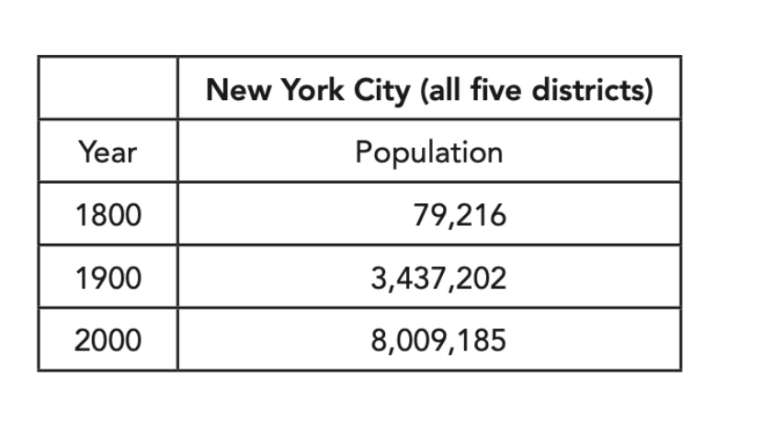
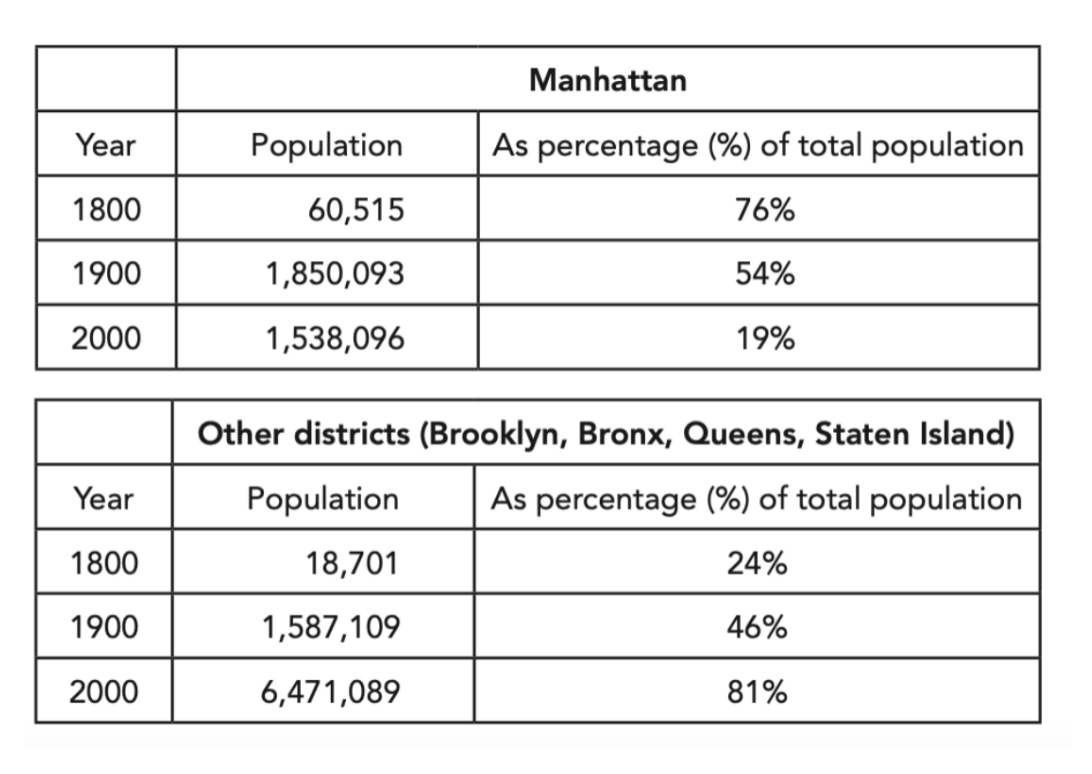
The first table below shows changes in the total population of New York City from 1800 to 2000. The second and third tables show changes in the population of the five districts of the city (Manhattan, Brooklyn, Bronx, Queens, Staten Island) over the same period.
Summarise the information by selecting and reporting the main features, and make comparisons where relevant.
Student answer (Band 5.0)
Entire population changes in the New York City had showed in the first table while the other tables showed pouplation change in the other five districts in three different years.
Population changes in the NweYork and other five districts of the same city has showed in the tables accordingly over the same period of time as in 1800, 1900 and 2000.
In 1800 the entire population of New York all five districts was 79,216 which experienced a great spike and in 1900 it was 3,437,202 aound 3,350,000 and that population increased about more than double and was 8,009,185 in 2000. These stats showed that New York became very populated in just 200 years.
In 1800 the population of district Manhattan of newyork was 60,515 which was 76% of the total population of city. While in 1900 about 1,850,093 people were living in that district which was about 54% of total population and in 2000 only 19% of the total population of city was in that district. percentage of population in other four districts was about 24% of total city population in 1800 which increase rapidly and was about 46% of entire public in 1900 and moreover in 2000 that percentage became double of the entire population in 1900 which was 81% of entire.
AI examiner evaluation
| Criterion | Band |
|---|---|
| Task Achievement / Task Response | 5.5 |
| Coherence and Cohesion | 5.0 |
| Lexical Resource | 5.0 |
| Grammatical Range and Accuracy | 5.0 |
| Overall | 5.0 |
Task Achievement / Task Response: Band 5.5
You report the main overall rise in New York City’s population and the shift in population share from Manhattan to the other districts. The figures for the city total and Manhattan’s 1800 and 1900 populations are accurate, and the percentages show a relevant comparison. However, the overview is not clearly separated or fully stated, and some key information is missing: Manhattan’s population actually fell to 1,538,096 by 2000, while the other districts reached 6,471,089. The claim that their share “became double” is also imprecise: it rose from 46% to 81%, not to twice that figure. Select the main trends more clearly and report the 2000 population figures accurately.
Coherence and Cohesion: Band 5.0
The response follows a broadly sensible order, moving from the city total to Manhattan and then the other districts, so the reader can identify the main topics. However, the opening repeats the same point in two sentences, and there is no distinct overview to guide the reader through the most important changes. Connections between ideas are sometimes mechanical or unclear: “While” begins a fragment-like contrast, and “moreover” does not express a clear relationship in the final sentence. The long final paragraph also combines several comparisons without clear separation. Use a concise introduction, a clear overview, and separate body paragraphs, with linking words that accurately show contrast or change.
Lexical Resource: Band 5.0
You use some relevant task vocabulary, including “population,” “total population,” “percentage,” and “increased,” which helps communicate the subject. However, the range is limited and several word choices or collocations are inaccurate, making parts of the report awkward: “experienced a great spike” does not naturally describe the population figure, and “entire public” is not an appropriate substitute for population. There are also noticeable spelling errors, such as “pouplation,” “NweYork,” and “aound.” Aim for precise, neutral language commonly used to describe tables, and check spelling carefully. Avoid repeating “population” where a clear reference such as “the city’s share” would be more natural.
Grammatical Range and Accuracy: Band 5.0
The response attempts longer sentences and uses time references and relative clauses, for example, “which was 76% of the total population.” However, complex sentences are often faulty, and errors occur frequently enough to make some relationships harder to follow. Examples include “had showed” and “has showed,” where the verb form is incorrect, and “percentage … which increase rapidly,” where the tense and agreement do not fit the past data. Articles and sentence boundaries are also inconsistent, as in “in 1800 the entire population of New York all five districts.” Practise accurate past-tense reporting and build comparisons in shorter, complete sentences before combining them into more complex structures.
See this exact question answered at other band scores. The same prompt compared across bands.
Browse more IELTS Writing model answers or get your own writing scored by the same AI examiner.