Band 5.5 IELTS Writing Task 1 Model Answer
Overall Band Score: 5.5 · Cambridge IELTS 20 · 2026-11-23
IELTS Writing Task 1 question
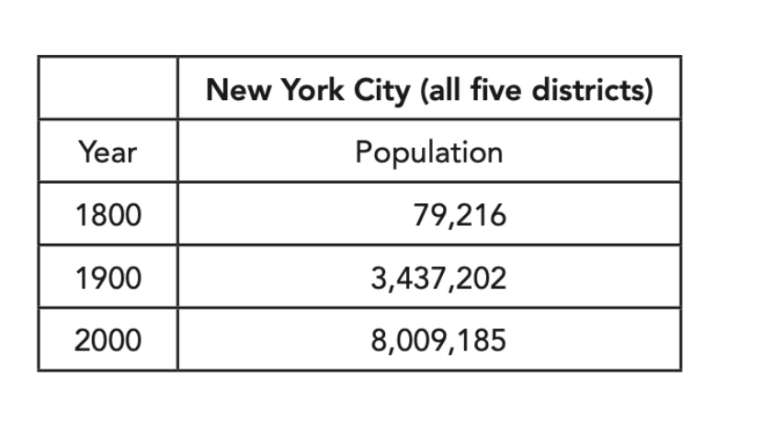
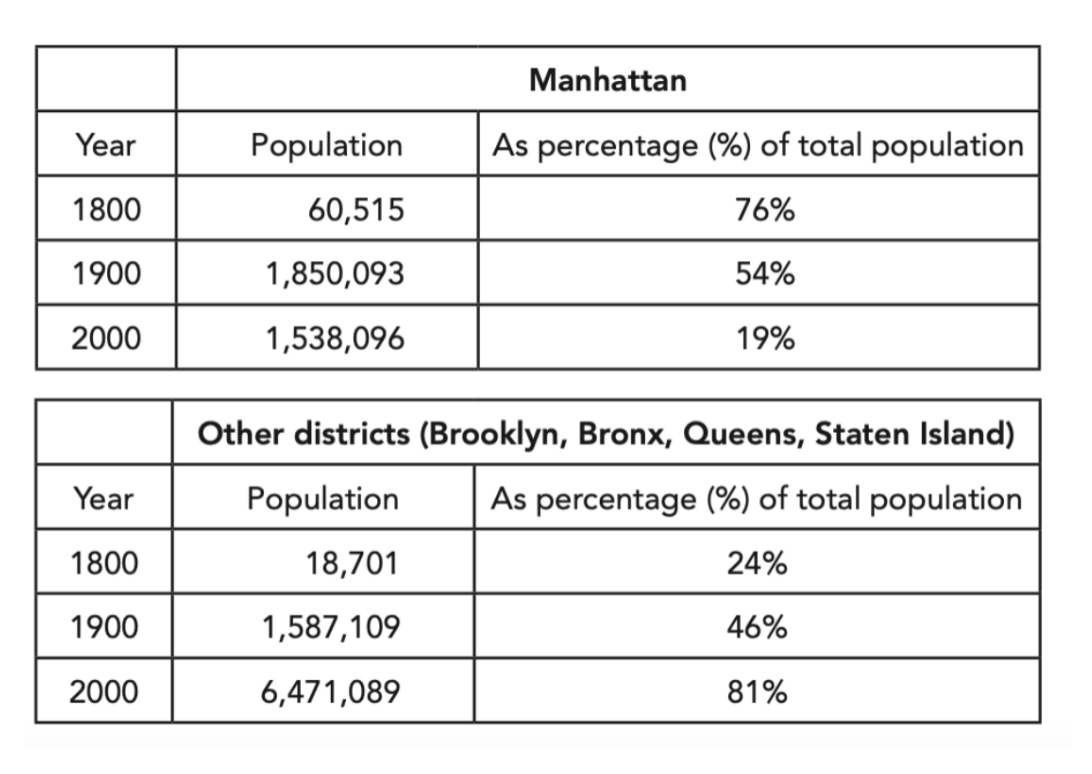
The first table below shows changes in the total population of New York City from 1800 to 2000. The second and third tables show changes in the population of the five districts of the city (Manhattan, Brooklyn, Bronx, Queens, Staten Island) over the same period.
Summarise the information by selecting and reporting the main features, and make comparisons where relevant.
Student answer (Band 5.5)
The table illustrates changes in the population of New York City in two decades, including changes in the population of it's five districts i.e, Manhattan, Brooklyn, Bronx, Queens, Staten Island over same years.
Overall, there is dramatic increase in population of New York City in two decades, Manhattan constitutes most of it's population in early years. Brooklyn and Bronx shows increase in population in 1900, while Queens and Staten Island shows little increase over same years.
In 1800, the population of New York was only 79,216. The population shows dramatic increase in 1900 to 3.4 million due to immigration and then 8 million in 2000. There is huge increase in population in 2 decades.
Manhattan comprises 76% of total population of New york in early year but there is suprising decrease in 1900 which further reduces to 19% in 2000. Brooklyn and Bronx comprises lower population in early years but increases to 81% in 2000.
AI examiner evaluation
| Criterion | Band |
|---|---|
| Task Achievement / Task Response | 5.5 |
| Coherence and Cohesion | 6.0 |
| Lexical Resource | 5.5 |
| Grammatical Range and Accuracy | 5.0 |
| Overall | 5.5 |
Task Achievement / Task Response: Band 5.5
You identify the broad rise in New York City’s population and the shift in Manhattan’s share, which are central features. However, some reporting is incomplete or inaccurate: the tables cover 1800, 1900 and 2000, not “two decades,” and the claim that Brooklyn and the Bronx increased in 1900 while Queens and Staten Island showed little increase is not supported by the combined figures provided. The other districts’ share rose from 24% to 81% by 2000, but the response does not clearly distinguish this combined group from the individual boroughs. The overview also says Manhattan made up most of the population in the “early years,” although it was below half by 2000. Select the main comparisons accurately and avoid unsupported explanations such as immigration being the cause of growth.
Coherence and Cohesion: Band 6.0
The response has a recognisable structure: an introduction, an overview and two paragraphs of details. This gives the reader a coherent overall route through the information, and time markers such as “In 1800” and “in 1900” help establish sequence. However, progression is weakened by repeated references to a “dramatic increase” and “huge increase,” and the overview’s borough-level claims are not clearly connected to the figures later reported. Some references are also imprecise: “same years” and “early years” do not specify the relevant dates. Group the total-population trend together, then compare Manhattan with the other districts, using clear links between each claim and its data.
Lexical Resource: Band 5.5
You use some relevant task vocabulary, including “population,” “constitutes,” “percentage” and “decrease,” and the main trends are generally understandable. However, the range is limited and several phrases are repeated, particularly “dramatic increase” and “population.” Some word choices are imprecise for describing the tables: “in two decades” mislabels the three dates, while “little increase” is unsupported and vague. There are also spelling and form errors, such as “suprisingly” and “it's” where the possessive “its” is needed. Aim for precise trend language and vary your descriptions—for example, distinguish a rise in the total population from a decline in Manhattan’s share.
Grammatical Range and Accuracy: Band 5.0
You attempt both simple and more developed sentence forms, and most of the intended meaning can be followed. However, errors occur across the response and sometimes make relationships between ideas unclear. Examples include “there is dramatic increase,” which needs an article, and “Brooklyn and Bronx shows” / “Queens and Staten Island shows,” where plural subjects require plural verbs. The opening sentence also has an awkwardly constructed list, and “over same years” is missing an article. Punctuation around “i.e.” is not controlled, and the final paragraph combines several comparisons without clear grammatical framing. Practise accurate subject–verb agreement, articles and sentence boundaries, then proofread each sentence for a clear subject and verb.
See this exact question answered at other band scores. The same prompt compared across bands.
Browse more IELTS Writing model answers or get your own writing scored by the same AI examiner.