Band 5.0 IELTS Writing Task 1 Model Answer
Overall Band Score: 5.0 · Cambridge IELTS 20 · 2026-11-24
IELTS Writing Task 1 question
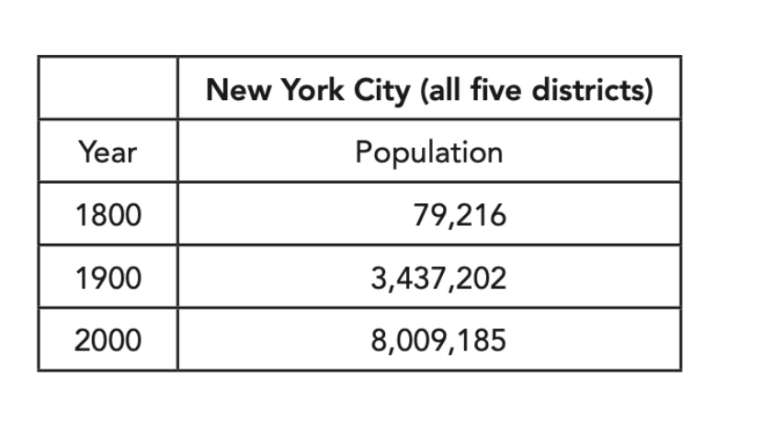
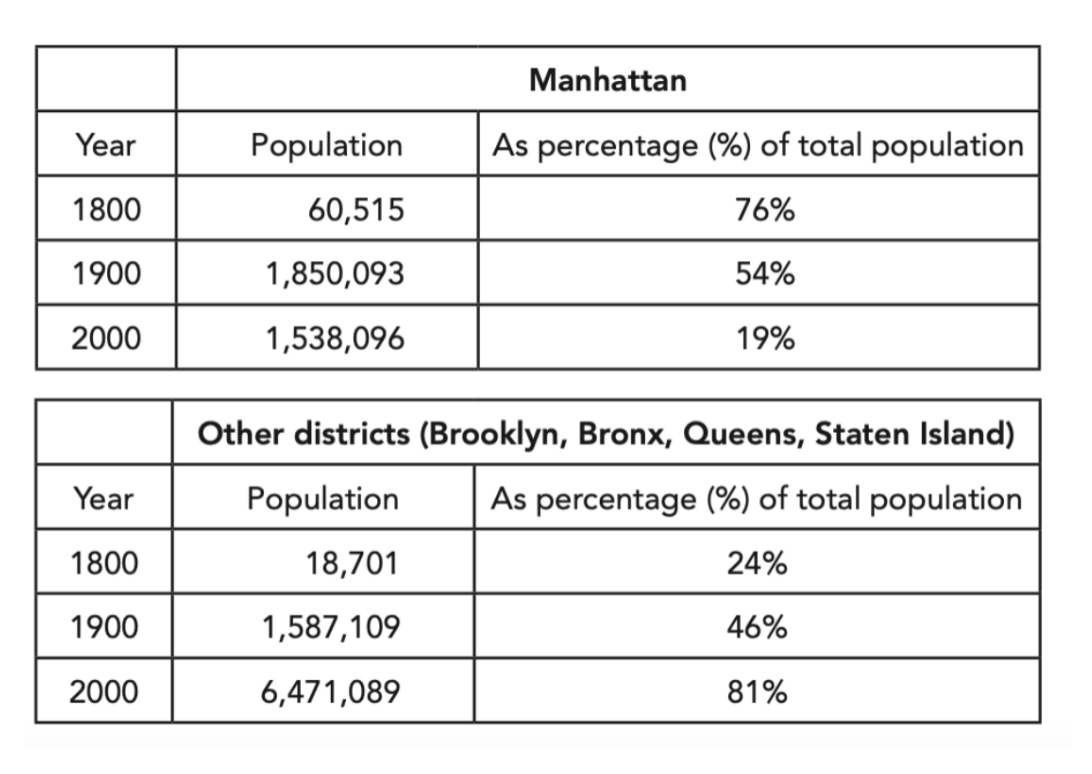
The first table below shows changes in the total population of New York City from 1800 to 2000. The second and third tables show changes in the population of the five districts of the city (Manhattan, Brooklyn, Bronx, Queens, Staten Island) over the same period.
Summarise the information by selecting and reporting the main features, and make comparisons where relevant.
Student answer (Band 5.0)
Today ill write about the comparision between New York City and Manhattan as we look for in 1800 century the population was about 79,216 in Nwe York and in Manhattan the population was round about 60.515 comaparitly low to New York , as we look for more centries in2900 it reached to 3,437,202 and in 2000 its about 8,009,185 which is rapidly growing . As now we look for Manhattan in1900 it was like 1,850,093 which is 54% and in 2000 its 1,538,096 like round about 19% . When we compare other countries whiit both of them like Brooklyn , Bronx ,Queens, Staten Island we compare it with over all world percentage in 1800 their population was like about 18,701 which is 24% as of total population ,in 1900 it was about 1,587,109 which is round about 46% and in2000 it was like 6,471,089 round about of 81% so we see clearly that population is growing rapidly.
AI examiner evaluation
| Criterion | Band |
|---|---|
| Task Achievement / Task Response | 5.5 |
| Coherence and Cohesion | 4.5 |
| Lexical Resource | 5.0 |
| Grammatical Range and Accuracy | 5.0 |
| Overall | 5.0 |
Task Achievement / Task Response: Band 5.5
You include figures from all three years and cover both Manhattan and the combined other districts, so the response is relevant and several key comparisons are present. For example, you correctly report New York City's rise from 79,216 to 8,009,185 and Manhattan's share falling from 76% to 19%. However, the overview is limited to saying that the population is “growing rapidly”; it does not clearly highlight the contrasting pattern that Manhattan's population peaked in 1900 and then declined, while the other districts grew substantially. The phrase “compare it with over all world percentage” also misrepresents the comparison: the percentages are shares of New York City's total population, not the world population. Select and summarise these main trends more clearly to make the response more complete.
Coherence and Cohesion: Band 4.5
The response follows a broadly chronological order, moving from 1800 to 1900 and then 2000, and it groups Manhattan and the other districts as separate topics. This gives the reader some basis for following the data. However, the whole answer is presented as one long paragraph, and repeated transitions such as “as we look for” and “as now we look for” make the progression mechanical rather than clear. Several ideas are joined in long strings with commas, so it is difficult to see where one comparison ends and another begins. Use distinct paragraphs for the overview and the detailed comparisons, and organise each paragraph around a clear trend. More precise linking between the city total, Manhattan, and the other districts would improve the flow.
Lexical Resource: Band 5.0
You use some relevant vocabulary, including “population,” “percentage,” “compare,” and “growing rapidly,” which helps communicate the subject. However, the range is limited and several expressions are informal or inaccurately chosen for an academic data summary. “Like round about” is repeated, while “other countries” is incorrect for the boroughs listed; “overall world percentage” also gives the wrong meaning. There are noticeable spelling errors, including “comparision,” “Nwe,” and “comaparitly,” which reduce clarity and control. Aim for concise, precise reporting language and check spelling carefully. Using terms such as “accounted for,” “rose,” “declined,” and “the remaining districts” would make the comparisons more natural and accurate.
Grammatical Range and Accuracy: Band 5.0
You attempt to connect several pieces of information in longer sentences, but the structures are often difficult to control. For example, “Today ill write about the comparision between New York City and Manhattan as we look for in 1800 century” has an unclear clause structure, and “as we look for more centries in2900 it reached” does not form a clear grammatical comparison. Tense and sentence boundaries are also inconsistent: the response shifts between “was,” “its,” and “we see,” while commas frequently join complete ideas without clear punctuation. Most sentences therefore require the reader to work out the intended relationships. Practise writing shorter, complete sentences with consistent past-tense reporting, then add a few controlled comparison clauses.
See this exact question answered at other band scores. The same prompt compared across bands.
Browse more IELTS Writing model answers or get your own writing scored by the same AI examiner.