Band 6.0 IELTS Writing Task 1 Model Answer
Overall Band Score: 6.0 · Cambridge IELTS 20 · 2026-11-24
IELTS Writing Task 1 question
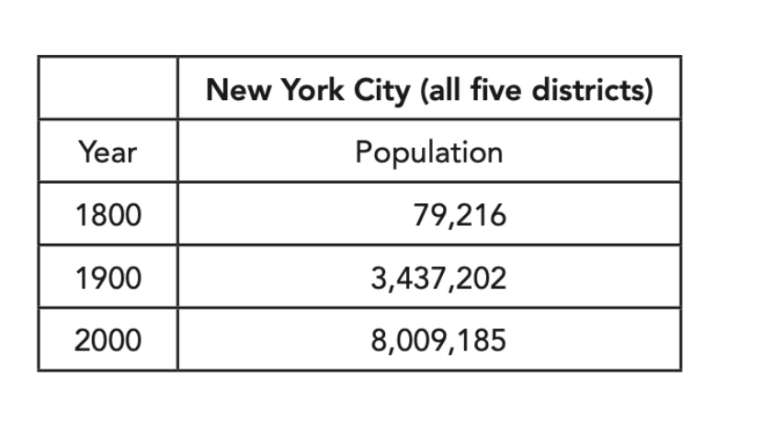
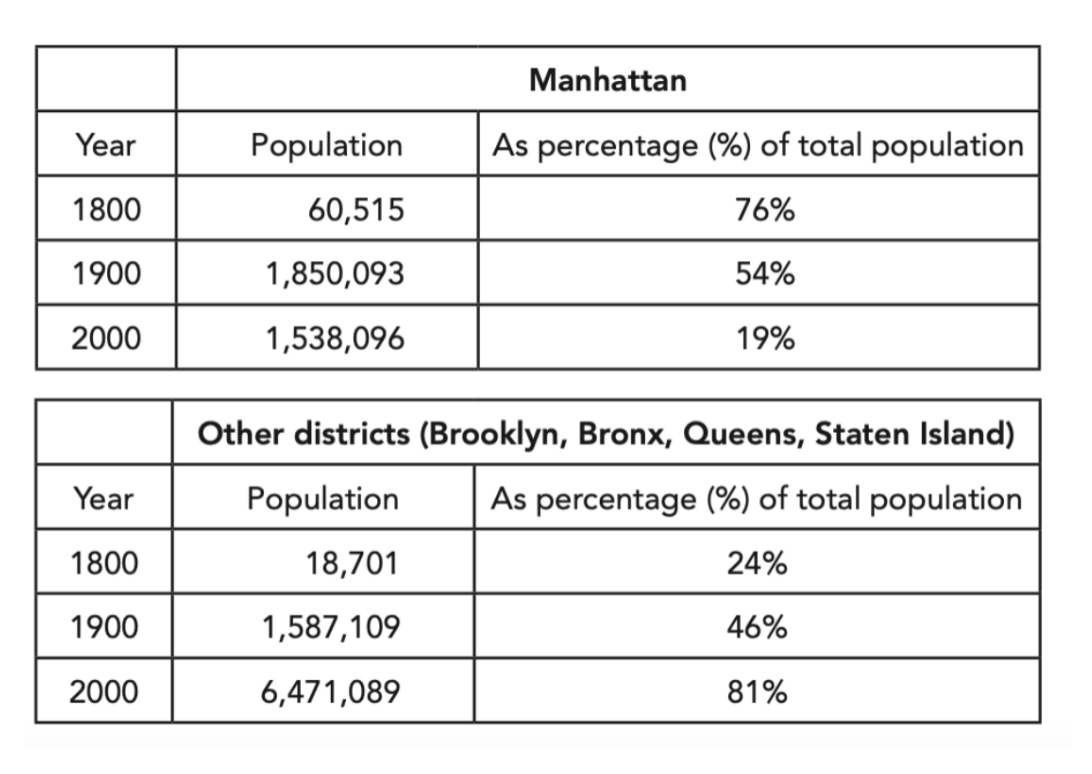
The first table below shows changes in the total population of New York City from 1800 to 2000. The second and third tables show changes in the population of the five districts of the city (Manhattan, Brooklyn, Bronx, Queens, Staten Island) over the same period.
Summarise the information by selecting and reporting the main features, and make comparisons where relevant.
Student answer (Band 6.0)
The table given shows the increase in population of new york city while also showing the chgange in population of five districts of new york over the year 1800 to 2000.
Overall the population of newyork city from year 1800 to 2000 experience explosive growth . In all these years manhattan district maintain dominant position in terms of population against other districts and losing that status in year 2000 .
In 1800 newyork entire population was 79,216 and manhattan holds 76% of total population of newyork while other districts make only 24% of total population.
In 1900 total population of newyork increased to the 3.4 million a century of exponential growth . Manhattan district lose ground to other districts but still remain dominant 54% of newyorkers live in manhattan district and 46% of total populas in other districts . The year 2000 shift everything population of newyork increase to 8 million however the dominant position in terms of population manhattan held is now lost. Manhattan only make 19% of total population and other districts make staggering 81% of population which live in newyork the year 2000.
AI examiner evaluation
| Criterion | Band |
|---|---|
| Task Achievement / Task Response | 6.5 |
| Coherence and Cohesion | 6.0 |
| Lexical Resource | 6.0 |
| Grammatical Range and Accuracy | 5.0 |
| Overall | 6.0 |
Task Achievement / Task Response: Band 6.5
You cover the main changes and provide a clear overview: New York’s population grew substantially, while Manhattan’s share fell and the other districts became dominant by 2000. The figures you report—79,216 in 1800, about 3.4 million in 1900, and about 8 million in 2000, alongside the changing percentages—are consistent with the tables. This meets the task well, and the comparison across the three dates is relevant. However, the overview says Manhattan maintained its dominant position before losing it in 2000, but the account could explain the population pattern more precisely: Manhattan’s actual population rose to 1,850,093 in 1900 and then declined to 1,538,096, while the other districts continued to grow. Including this contrast would make the key features more fully developed.
Coherence and Cohesion: Band 6.0
The response has a recognisable structure, with an introduction, an overview and chronological paragraphs covering 1800, 1900 and 2000. This makes the main progression easy to follow. Linking expressions such as “Overall,” “In 1900” and “however” help signal the stages and contrast. Cohesion is less controlled in places: the 1900 sentence beginning “Manhattan district lose ground” runs into several comparisons, and the final sentence contains repeated references to population and “the year 2000,” making the relationship between ideas less smooth. Some transitions also feel mechanical because each paragraph follows the same year-by-year pattern. Use clearer sentence boundaries and refer back to the figures or districts more precisely to strengthen the flow.
Lexical Resource: Band 6.0
You use a reasonable range of vocabulary for describing change, including “explosive growth,” “dominant position,” “lose ground” and “staggering.” These choices show an attempt to go beyond basic terms, and the meaning is generally clear. However, some expressions are imprecise or do not fit naturally in an academic data summary: “holds 76%,” “make only 24%,” and “shift everything” are less suitable than standard reporting collocations. There are also spelling and word-form errors, including “newyork,” “chgange” and “populas,” which reduce accuracy. Aim for consistent forms such as “accounted for,” “represented” and “share,” and use less dramatic language where a neutral description is more appropriate.
Grammatical Range and Accuracy: Band 5.0
You attempt both simple and more extended sentence forms, and the overall meaning can usually be understood. However, grammatical control is uneven, with errors in verb forms, agreement, articles and sentence construction. For example, “Manhattan district lose ground” needs a past-tense verb, while “Manhattan holds 76%” shifts tense within a description of 1800. The opening phrase “The table given shows” is also awkwardly constructed, and the 1900 sentence fragment after “3.4 million” needs to be joined or punctuated as a complete sentence. The final sentence is difficult to follow because several clauses are joined without clear structure. Practise accurate past-tense reporting and build complex sentences with clear subjects, verbs and punctuation.
See this exact question answered at other band scores. The same prompt compared across bands.
Browse more IELTS Writing model answers or get your own writing scored by the same AI examiner.