Band 6.0 IELTS Writing Task 1 Model Answer
Overall Band Score: 6.0 · Cambridge IELTS 20 · 2026-11-25
IELTS Writing Task 1 question
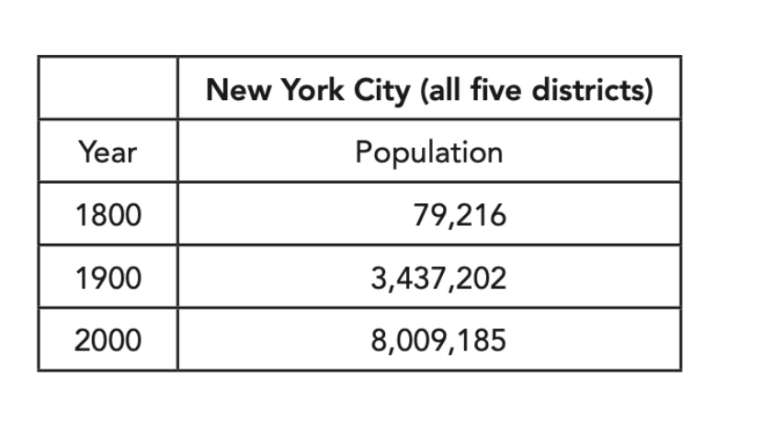
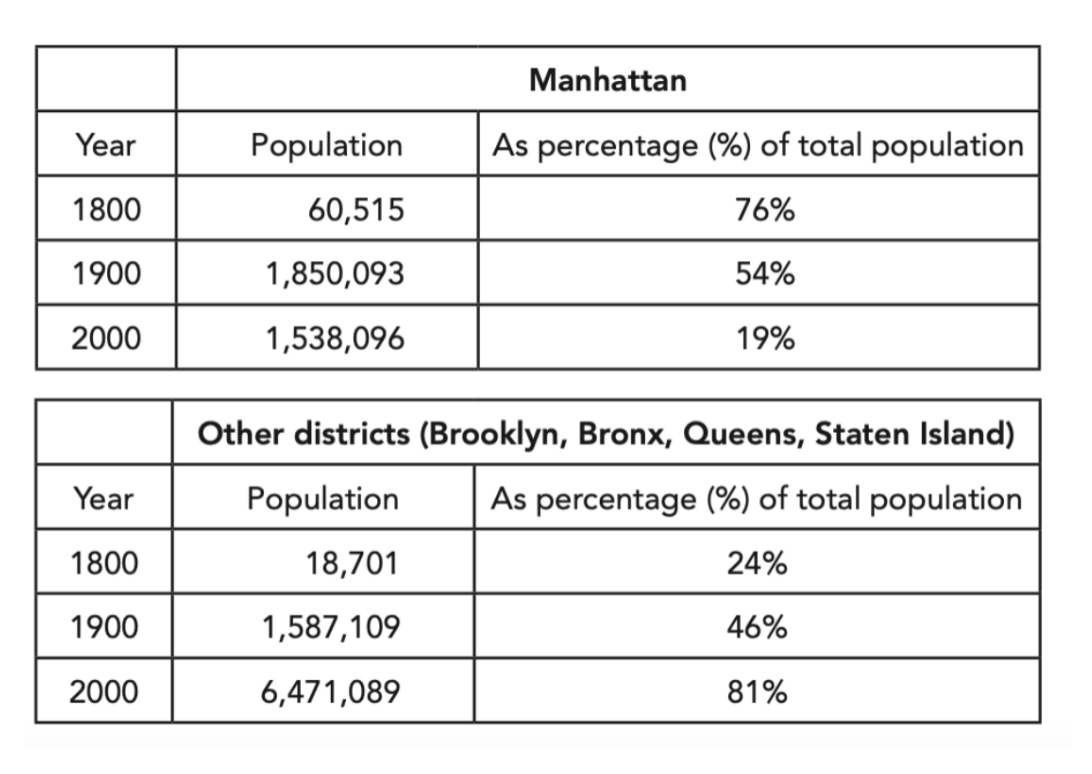
The first table below shows changes in the total population of New York City from 1800 to 2000. The second and third tables show changes in the population of the five districts of the city (Manhattan, Brooklyn, Bronx, Queens, Staten Island) over the same period.
Summarise the information by selecting and reporting the main features, and make comparisons where relevant.
Student answer (Band 6.0)
The first table illustrates the amount of changes in population occured in New York City from 1800 to 2000 while the second table shows changes in the population of Manhattan district and third table shows combined changes in other four districts for the same time period.
Total population changed very rapidly from 1800 to 1900.The percentage of Manhattan population in total was decreasing while the percentage for other four districts was increasing.
Total population became 2,437,202 in 1900 from 79,216 in 1800 which indicate almost 4.5 times rising in population in a thousand years.After the next thousand years, the population became more than double and reached to 8,009,185.
In 1800, population in Manhattan was 60,515 (76%) ,while the four other district combined population was only 24% of the total population and it was 18,701.The percentage share of total population began to decrease in Manhattan despite the increse in total population as the popution increased very sharply in that districts.In 2000, though the population of Manhattan increased to 1,538,096,it was only 19% of total population.However, 81% of the total popultion was in other districts and their combined population reached to 6,471,089.
AI examiner evaluation
| Criterion | Band |
|---|---|
| Task Achievement / Task Response | 6.5 |
| Coherence and Cohesion | 6.0 |
| Lexical Resource | 5.5 |
| Grammatical Range and Accuracy | 5.5 |
| Overall | 6.0 |
Task Achievement / Task Response: Band 6.5
You identify the main overall patterns: New York’s population grew substantially, Manhattan’s share fell, and the other districts’ share rose. You also include useful figures for 1800 and 2000 and compare the districts’ proportions. However, the 1900 total is reported as 2,437,202 rather than 3,437,202, and the statement that the population rose “almost 4.5 times” is therefore inaccurate. The account also omits the important 1900 district figures, including Manhattan’s peak population of 1,850,093 before its decline by 2000. The overview is relevant, but fuller and more accurate coverage of the middle year, alongside a clearer description of Manhattan’s changing population, would make the report more complete and precise.
Coherence and Cohesion: Band 6.0
The response has a generally coherent sequence: it introduces the tables, gives an overview, then discusses the total population and the district comparison. Paragraphing helps separate these functions, and linking expressions such as “while,” “despite,” and “However” show attempts to connect contrasting information. Some connections are less clear or repetitive, however. For example, “The percentage share of total population began to decrease in Manhattan despite the increse in total population” does not clearly distinguish Manhattan’s own population from its share of the city total. The report also moves from the 1800 figures directly to 2000, leaving the 1900 comparison under-integrated. More precise referencing and a consistent chronological progression would strengthen cohesion.
Lexical Resource: Band 5.5
You use relevant vocabulary for describing tables and trends, including “percentage,” “combined,” “decrease,” and “reached,” so the main information is generally understandable. There are also attempts at more formal phrasing, such as “percentage share” and “changed very rapidly.” However, several choices are awkward or imprecise: “amount of changes in population” is not a natural way to introduce the data, and “almost 4.5 times rising” is an unclear collocation. Spelling errors such as “occurred,” “increase,” “population,” and “districts” also reduce accuracy. Aim for standard trend language and check spelling carefully; this would make your vocabulary more precise and natural without requiring unnecessarily complex words.
Grammatical Range and Accuracy: Band 5.5
You attempt a mix of simple and complex sentences, including clauses with “while,” “despite,” and “though,” and the overall meaning can usually be followed. Some grammatical errors remain, particularly with articles, plurals, and sentence construction. For example, “the second table shows changes in the population of Manhattan district” needs a more accurate article or possessive construction, while “the four other district combined population” has an unclear noun phrase and incorrect plural agreement. In “which indicate almost 4.5 times rising,” the clause structure and agreement are also faulty. Punctuation spacing is inconsistent, especially around commas and full stops. More careful editing of noun phrases and clause structure would improve control while preserving your attempts at complex sentences.
See this exact question answered at other band scores. The same prompt compared across bands.
Browse more IELTS Writing model answers or get your own writing scored by the same AI examiner.