Band 5.0 IELTS Writing Task 1 Model Answer
Overall Band Score: 5.0 · Cambridge IELTS 20 · 2026-11-25
IELTS Writing Task 1 question
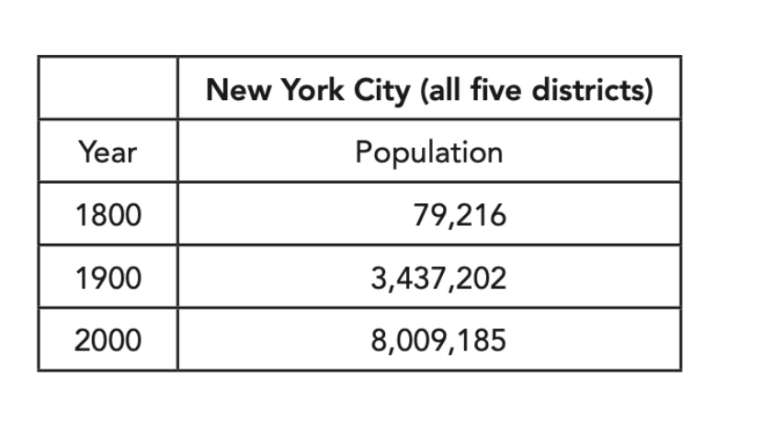
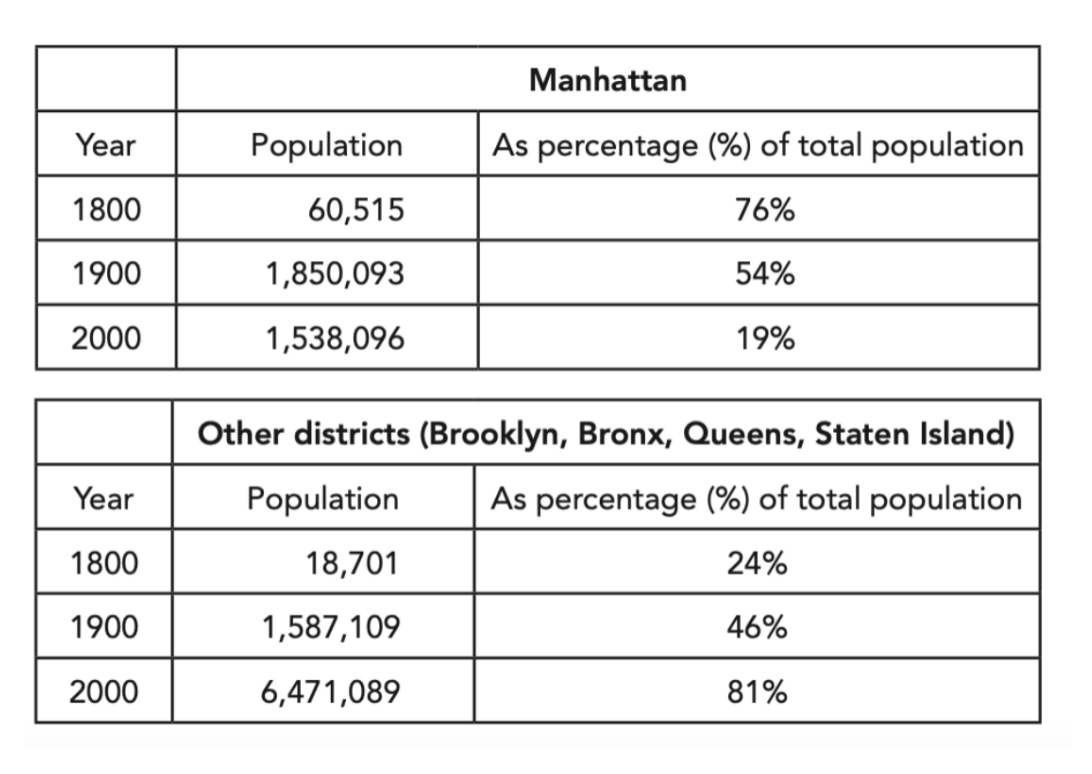
The first table below shows changes in the total population of New York City from 1800 to 2000. The second and third tables show changes in the population of the five districts of the city (Manhattan, Brooklyn, Bronx, Queens, Staten Island) over the same period.
Summarise the information by selecting and reporting the main features, and make comparisons where relevant.
Student answer (Band 5.0)
The first table illustrates the changes in the total population of New York City from 1800 to 2000. The second and third tables provide data changes in the population of the five districts of the city (Manhattan, Brooklyn, Bronx, Queens, Staten Island) over the same period.
Overall, It can be seen that in 2000, the population experienced an upwards trend. Whereas, in 1800 it was the lowest. but, in 1900 it was up and down.
In first table, population in five districts were the lessed in 1800, around 79,216, which increased to 3,437,202 in 1900. In 2000, the following numbers rosed to 8,009,185.
Second and third table shows the percentage of five districts. In 1800, Manhattan had approximately 60,515 population, which equal to 76% total population and other districts in same year doesn't hold up even 50% of total, only 24%, around 18,701. But, 1900 was the year when other cities came closer to overtake manhattan population, 46% in other districts and 54% in manhattan. Lastly, 81% of total population with 6,471,089 population in other districts overtake manhattan in 2000.
AI examiner evaluation
| Criterion | Band |
|---|---|
| Task Achievement / Task Response | 5.0 |
| Coherence and Cohesion | 5.0 |
| Lexical Resource | 5.0 |
| Grammatical Range and Accuracy | 5.0 |
| Overall | 5.0 |
Task Achievement / Task Response: Band 5.0
You report the main overall increase in New York’s population and include relevant figures for 1800, 1900 and 2000. You also identify the important shift in population share: Manhattan’s proportion falls from 76% to 19%, while the other districts rise to 81%. However, the overview is unclear and partly inaccurate: “in 1900 it was up and down” does not describe the steady increase in the city’s total population. Some comparisons are also imprecise, such as saying other districts “came closer to overtake” Manhattan in 1900, when Manhattan still had the larger share. The response is 141 words, below the required 150, and several features are only briefly reported. Develop a clearer overview and explain the key changes more fully.
Coherence and Cohesion: Band 5.0
The response has a basic paragraph structure: an introduction, an overview and two paragraphs covering the tables. This gives the reader some organisation, and time markers such as “In 1800,” “1900” and “Lastly” help indicate sequence. However, progression is not consistently clear because the overview says the population was “up and down” in 1900, which conflicts with the figures and leaves the main trend uncertain. Several connectors are awkward or incorrectly punctuated, including “Whereas,” and “But,” at the start of sentences. The final paragraph also moves between Manhattan and the other districts without a consistently clear comparison. Group the information around the overall population trend and the changing district shares, and use linking phrases to show contrast accurately.
Lexical Resource: Band 5.0
You use some relevant task vocabulary, including “population,” “percentage,” “total” and “overtake,” and the key figures remain understandable. However, the range is limited and several word choices or collocations are inaccurate, which makes parts of the report sound unclear. For example, “the lessed” is not an appropriate way to describe the lowest population, “numbers rosed” is incorrect, and “other cities” mislabels the other districts. “Upwards trend” is also less natural than a standard trend description. Aim for precise, conventional language for describing data, and check spelling and word forms. Repeating “population” is sometimes unavoidable, but you can vary phrasing with terms such as “share,” “figure” and “accounted for” where appropriate.
Grammatical Range and Accuracy: Band 5.0
You attempt some complex sentences, for example, “Manhattan had approximately 60,515 population, which equal to 76% total population,” and use time clauses to compare years. However, errors are frequent and sometimes make relationships difficult to follow. Examples include “which equal” instead of a correctly formed verb phrase, “other districts … doesn’t hold” despite the plural subject, and “Second and third table shows” without plural agreement. Sentence boundaries and punctuation are also unreliable: “Whereas,” begins a fragment, and “Overall, It” has incorrect capitalisation. Use simpler, complete sentences first, checking subject–verb agreement, articles and verb forms; then add complex clauses only when their structure is secure.
See this exact question answered at other band scores. The same prompt compared across bands.
Browse more IELTS Writing model answers or get your own writing scored by the same AI examiner.