Band 5.0 IELTS Writing Task 1 Model Answer
Overall Band Score: 5.0 · Cambridge IELTS 20 · 2026-11-25
IELTS Writing Task 1 question
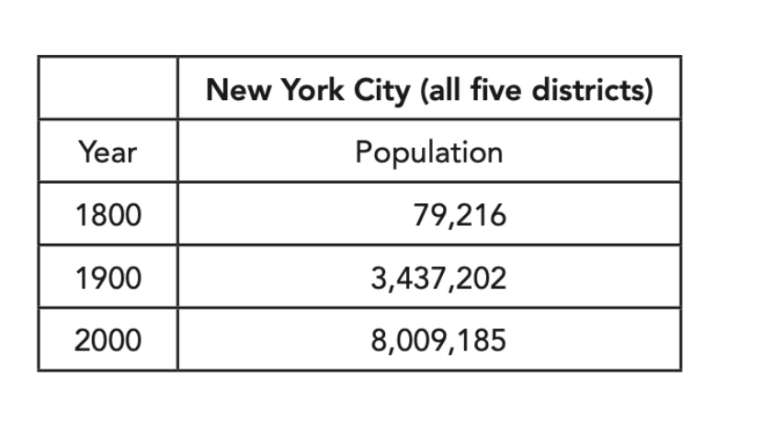
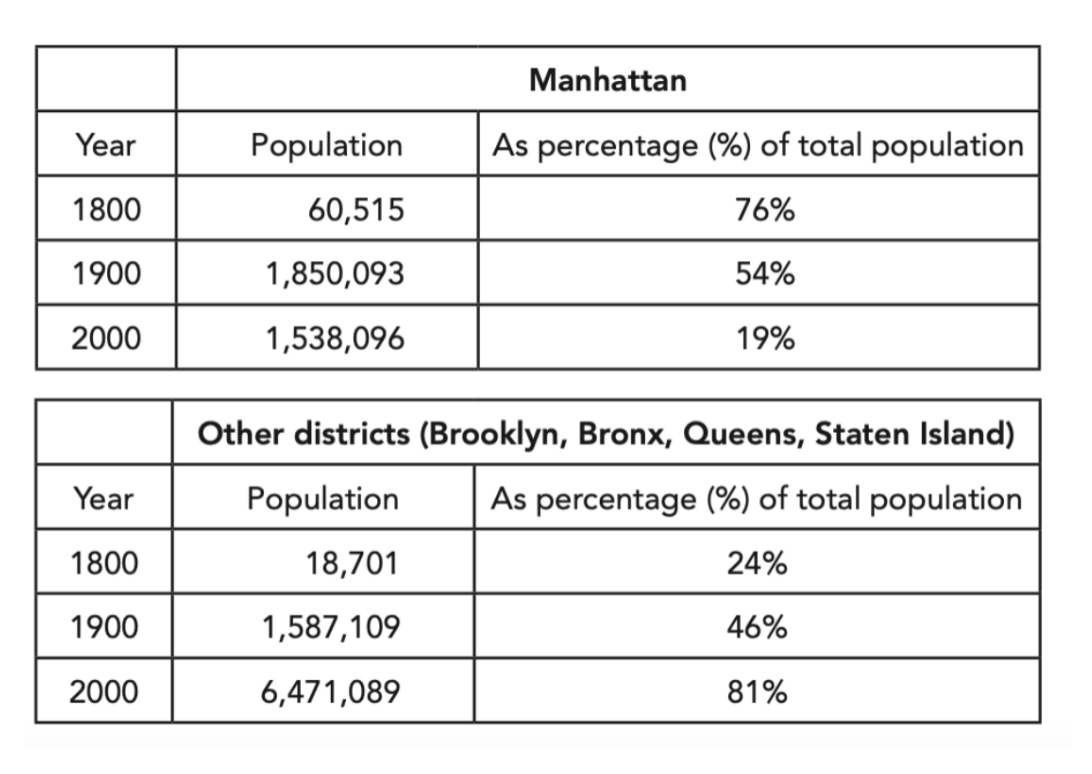
The first table below shows changes in the total population of New York City from 1800 to 2000. The second and third tables show changes in the population of the five districts of the city (Manhattan, Brooklyn, Bronx, Queens, Staten Island) over the same period.
Summarise the information by selecting and reporting the main features, and make comparisons where relevant.
Student answer (Band 5.0)
The first table illustrate the changes in the total population of New York City from 1800 to 2000. The second and third tables show changes in the population of the five districts of the city including Manhattan, Brooklyn, Bronx, Queens and Staten Island over the same period.
Overall, the popullation is increased in all five districts over 100 years. In 1800, the percentage of total popullation in Manhattan is comparetivaly more that other four districts. Whereas, in 2000 the data contras showing less percentage of total popolation in Manhattan comparetivaly other districts.
In 1800, the population in Manhattan is three fourth of total percentage of the overall population. While, in 1900, 54% of overall population located in Manhattan and other population seen in other districts.
In 2000, only 19% of total population seen in Manhattan that is only 1,538,096 while 81% of population seen in other districts that is 6,471,089.
AI examiner evaluation
| Criterion | Band |
|---|---|
| Task Achievement / Task Response | 5.0 |
| Coherence and Cohesion | 5.5 |
| Lexical Resource | 5.0 |
| Grammatical Range and Accuracy | 5.0 |
| Overall | 5.0 |
Task Achievement / Task Response: Band 5.0
You identify the broad shift from Manhattan’s dominance in 1800 to the other districts’ larger share by 2000, and the figures you give for 2000 are accurate. However, the response only partially covers the tables: it omits the total city population figures and does not explain that Manhattan’s population rose substantially by 1900 before falling by 2000. The overview also says population increased in all five districts, although the tables group the four other districts together and do not provide separate figures for each. The response is 120 words, below the required 150, which limits the opportunity to select and report the main features fully. Develop the comparison across all three years and include the citywide growth.
Coherence and Cohesion: Band 5.5
The response has a basic, useful structure: an introduction, an overview, and paragraphs referring to 1800–1900 and 2000. This makes the main topic easy to identify. However, progression is limited because the first detail paragraph gives only percentages and does not connect them clearly to the population figures or the overall city trend. Linking words such as “Whereas” and “While” are used, but the latter begins a sentence fragment, and the contrast between years is not consistently developed. The repeated references to “overall population” also make the account feel repetitive. Organise the details chronologically or by comparing Manhattan with the other districts, and use complete sentences to make each comparison explicit.
Lexical Resource: Band 5.0
The vocabulary is sufficient to communicate the general subject, with relevant terms such as “total population,” “percentage,” and “districts.” However, the range is limited and several noticeable spelling and word-choice errors reduce precision, including “popullation,” “contras,” and “data … showing.” Some phrases are also unnatural, such as “three fourth of total percentage” and “population seen in other districts.” These choices make parts of the report less clear, even though the intended comparisons can usually be understood. Use standard forms such as “population” and more precise reporting language, for example “accounted for,” “rose,” and “fell.” Avoid repeating “seen” and “overall population” when describing the figures.
Grammatical Range and Accuracy: Band 5.0
You attempt some complex sentence patterns, including contrasts introduced by “Whereas” and “While,” but these are often not controlled successfully. For example, “Whereas, in 2000…” is not joined to a complete main clause, and “While, in 1900…” is also a fragment. Verb forms and agreement are frequently inaccurate: “The first table illustrate” needs a plural subject–verb match, while “the population … is increased” uses an unsuitable tense and construction. Articles and sentence structure also cause problems in “three fourth of total percentage.” These errors sometimes make relationships between ideas difficult to follow. Practise complete comparative sentences and consistent past-tense reporting, such as “Manhattan accounted for 54% in 1900, whereas the other districts made up 46%.”
See this exact question answered at other band scores. The same prompt compared across bands.
Browse more IELTS Writing model answers or get your own writing scored by the same AI examiner.