Band 6.0 IELTS Writing Task 1 Model Answer
Overall Band Score: 6.0 · Cambridge IELTS 20 · 2026-11-26
IELTS Writing Task 1 question
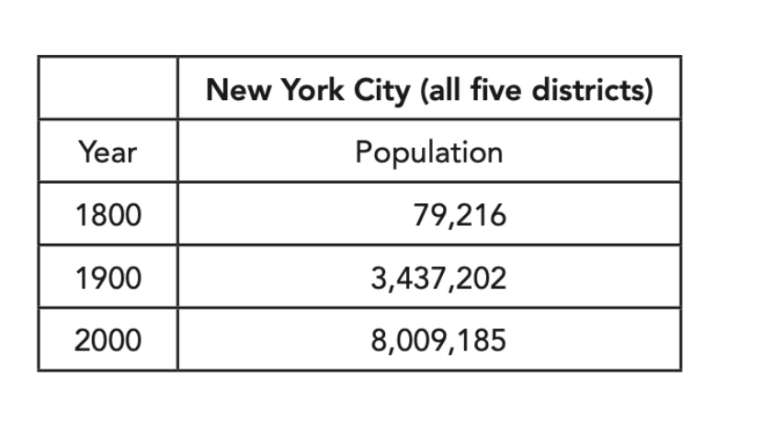
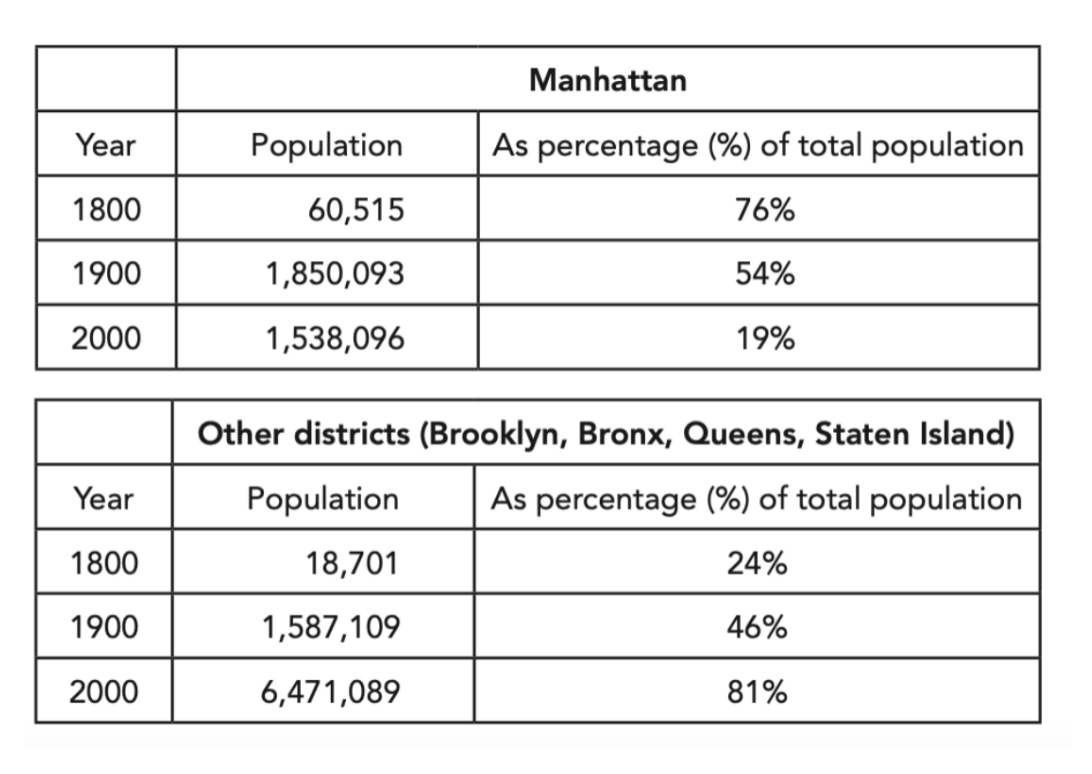
The first table below shows changes in the total population of New York City from 1800 to 2000. The second and third tables show changes in the population of the five districts of the city (Manhattan, Brooklyn, Bronx, Queens, Staten Island) over the same period.
Summarise the information by selecting and reporting the main features, and make comparisons where relevant.
Student answer (Band 6.0)
The three tables provides information about population of New York City and the five districts of the city between the time periods 1800 to 2000.
Overall, the first table displays the sum of population of all five districts in New York City from the year 1800 to 2000. Whereas, the second table shows the population of only Manhattan district. The final table displays remaining four districts Brooklyn, Bronx, Queens, Staten Island.The last two tables shows the total population as percentage as well.
In 1800, the population in New York city including all five districts was about 79,216 by 1900 the population increased approximately four times compared to 1800. By 2000 the population of New York city rose to 8,009,185. However, if we see the population in the individual districts in 1800 Manhattan total population was 76% and other four districts were only a quarter.
Meanwhile, in 1900 the total poulation in Manhattan and other districts was 54% and 46% respectively. By 2000 the population of Manhattan district drastically decreased to 19% comapared to other districts which as a vast majority of the population.
AI examiner evaluation
| Criterion | Band |
|---|---|
| Task Achievement / Task Response | 6.0 |
| Coherence and Cohesion | 6.0 |
| Lexical Resource | 6.0 |
| Grammatical Range and Accuracy | 5.5 |
| Overall | 6.0 |
Task Achievement / Task Response: Band 6.0
You identify the broad pattern: New York City’s total population grew substantially, while Manhattan’s share fell and the other districts’ share rose. The figures you give for 1800 and 2000, and the percentage comparisons, are grounded in the tables. However, the account of 1900 is inaccurate: the total population was 3,437,202, not approximately four times the 1800 figure; it was over forty times as large. You also omit the key change in Manhattan’s actual population, which rose to 1,850,093 in 1900 before falling to 1,538,096 in 2000. The overview mainly describes what each table contains rather than summarising the main trends. More precise comparisons and a clearer overview would make the response more complete.
Coherence and Cohesion: Band 6.0
The response has a recognisable structure, moving from an introduction and overview to details about the three years. Paragraphing helps separate these functions, and time markers such as “In 1800,” “Meanwhile, in 1900” and “By 2000” make the sequence easy to follow. However, the overview mostly explains the tables instead of synthesising their findings, and the final paragraph ends with an incomplete comparison rather than a clear concluding point. Some linking is mechanical, particularly the repeated use of “By” and “Meanwhile,” while “Whereas” begins a fragment after a full stop. Improve progression by grouping the total-population trend separately from the changing distribution between Manhattan and the other districts, and connect each comparison explicitly.
Lexical Resource: Band 6.0
You use an adequate range of task-related vocabulary, including “population,” “districts,” “increased,” “decreased” and “majority,” so the main subject remains clear. There are also attempts at more formal reporting language, such as “displays” and “respectively.” However, some choices are imprecise or awkward: “sum of population” is not a natural way to describe the citywide total, and “a vast majority of the population” does not clearly state that the other districts held 81% in 2000. Spelling errors such as “poulation” and “comapared” also reduce accuracy. Use precise terms for population shares and changes, and check spelling and collocations during proofreading.
Grammatical Range and Accuracy: Band 5.5
You attempt both simple and more complex sentence forms, and the main meaning is generally understandable. However, some errors in agreement, sentence boundaries and clause structure remain. For example, “The three tables provides” should use a plural verb, and “The last two tables shows” has the same agreement problem. “Whereas, the second table shows…” is a fragment when separated from the preceding sentence, while “Staten Island.The last…” needs a space and clearer punctuation. The sentence beginning “By 2000 the population of Manhattan district…” also lacks a possessive or suitable article and does not form a complete comparison. Review subject–verb agreement and ensure each sentence has a complete, clearly punctuated structure.
See this exact question answered at other band scores. The same prompt compared across bands.
Browse more IELTS Writing model answers or get your own writing scored by the same AI examiner.