Band 6.0 IELTS Writing Task 1 Model Answer
Overall Band Score: 6.0 · Cambridge IELTS 20 · 2026-11-26
IELTS Writing Task 1 question
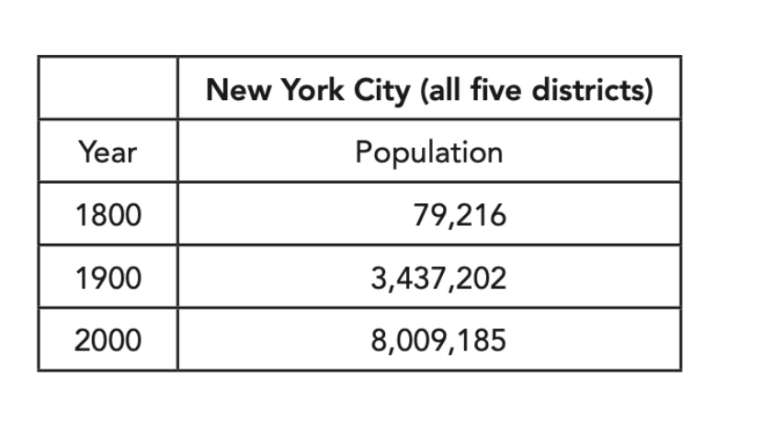
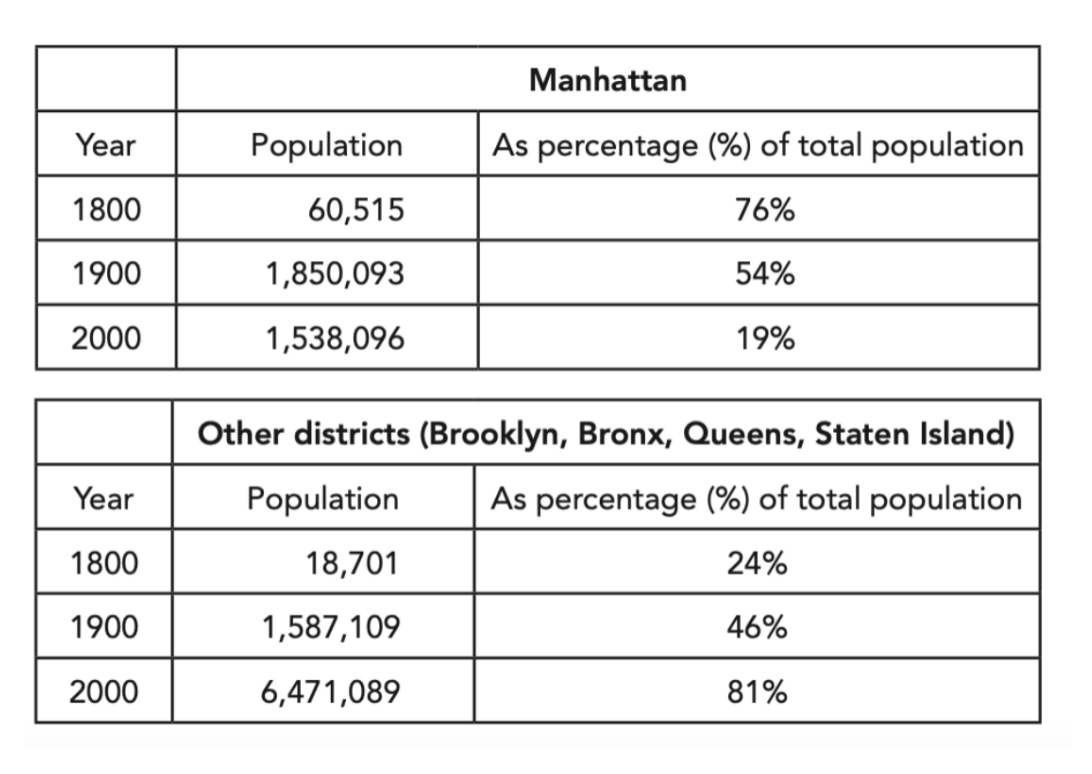
The first table below shows changes in the total population of New York City from 1800 to 2000. The second and third tables show changes in the population of the five districts of the city (Manhattan, Brooklyn, Bronx, Queens, Staten Island) over the same period.
Summarise the information by selecting and reporting the main features, and make comparisons where relevant.
Student answer (Band 6.0)
The tables illustrate the information about the population trends in the New York City along with its five districts in 1800,1900 and 2000.
Overall, there was a population increasing rate in the New York City and more than half of the total population lived in Manhattan between 1800 and 1900. However Other districts surpassed Manhattan in 2000 and Mahattan also faced a slight decrease.
In 1800, About 79,216 people lived in New York City, whereas 60,515 people lived in Manhattam which was 76% of the total popultion and rest of the population lived in other five districts. After 100 years, New York population increased to 3,437,202 where 54% of the total population was in Manhattan and 46% population lived in other five districts.
In 2000, the total population of New York city increased significanty to 8,009,185. However, there was a slight fall in Manhattam whereas, other districts population increased sharply. Only 19% of the total population lived in Manhattam and 81% in other districts (1,538,096 and 6,471,087 respectively).
AI examiner evaluation
| Criterion | Band |
|---|---|
| Task Achievement / Task Response | 6.0 |
| Coherence and Cohesion | 6.5 |
| Lexical Resource | 5.5 |
| Grammatical Range and Accuracy | 5.5 |
| Overall | 6.0 |
Task Achievement / Task Response: Band 6.0
You identify the main trends: the city’s population rose substantially, Manhattan held the majority in 1800 and 1900, and the other districts became dominant by 2000. The overview is relevant, and the response includes key figures and percentages. However, some details are less fully reported: the 1800 population of the other districts is not stated, and the 2000 comparison gives the district figures but does not clearly explain that Manhattan’s population first rose sharply by 1900 before declining. There is also a small numerical inaccuracy: the other districts’ 2000 population is 6,471,089, not 6,471,087. More precise coverage of the changes across all three years would make the summary more complete.
Coherence and Cohesion: Band 6.5
The response has a clear overall arrangement: an introduction, an overview, and chronological paragraphs covering 1800–1900 and 2000. This makes the main comparisons easy to follow, and linking expressions such as “Overall,” “After 100 years,” and “However” help signal relationships. The organisation is coherent, though some connections are mechanical or unclear. For example, “However Other districts surpassed Manhattan in 2000” would be clearer if the contrast were explicitly tied to their respective population shares. The final sentence also places two figures in parentheses without clearly labelling which belongs to each group. More precise referencing and smoother links between population totals and district shares would strengthen the progression.
Lexical Resource: Band 5.5
You use relevant vocabulary for describing data, including “increased,” “slight fall,” “surpassed,” and “increased sharply,” so the main trends are generally understandable. However, some word choices and collocations are noticeably inaccurate or awkward, such as “population increasing rate,” “the information about the population trends,” and “the rest of the population lived in other five districts.” Spelling errors in “Manhattam,” “popultion,” and “significanty” also reduce accuracy. The range is sufficient to communicate the key comparisons, but repeated use of “population” and imprecise phrasing limit flexibility. Aim for standard chart language such as “population grew,” “accounted for,” and “the remaining residents lived in the other districts.”
Grammatical Range and Accuracy: Band 5.5
You attempt a mix of simple and complex sentences, including comparisons with “whereas” and contrast with “However,” and the overall meaning remains clear. Some grammatical errors persist, particularly with articles, sentence construction, and punctuation. For example, “in the New York City” uses an unnecessary article, while “there was a population increasing rate” is not a well-formed noun phrase. In “where 54% of the total population was in Manhattan,” the clause is understandable but awkwardly constructed. Capitalisation and comma placement are also inconsistent, as in “In 1800, About” and “Manhattam whereas, other districts.” More controlled sentence patterns and careful proofreading would improve accuracy while preserving your attempts at complex structures.
See this exact question answered at other band scores. The same prompt compared across bands.
Browse more IELTS Writing model answers or get your own writing scored by the same AI examiner.