Band 5.5 IELTS Writing Task 1 Model Answer
Overall Band Score: 5.5 · Cambridge IELTS 20 · 2026-11-27
IELTS Writing Task 1 question
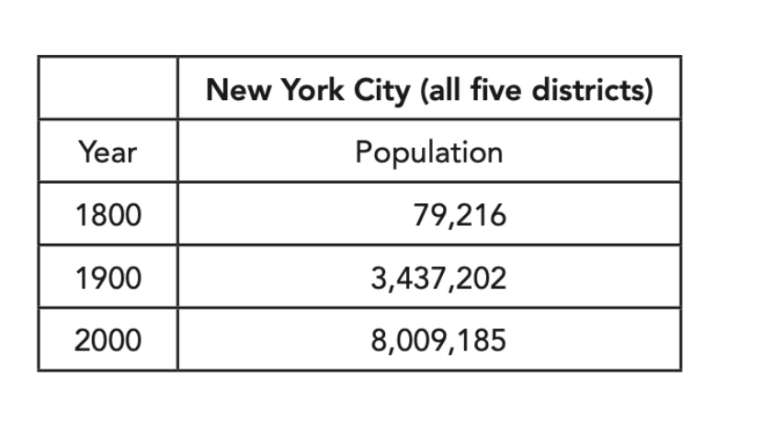
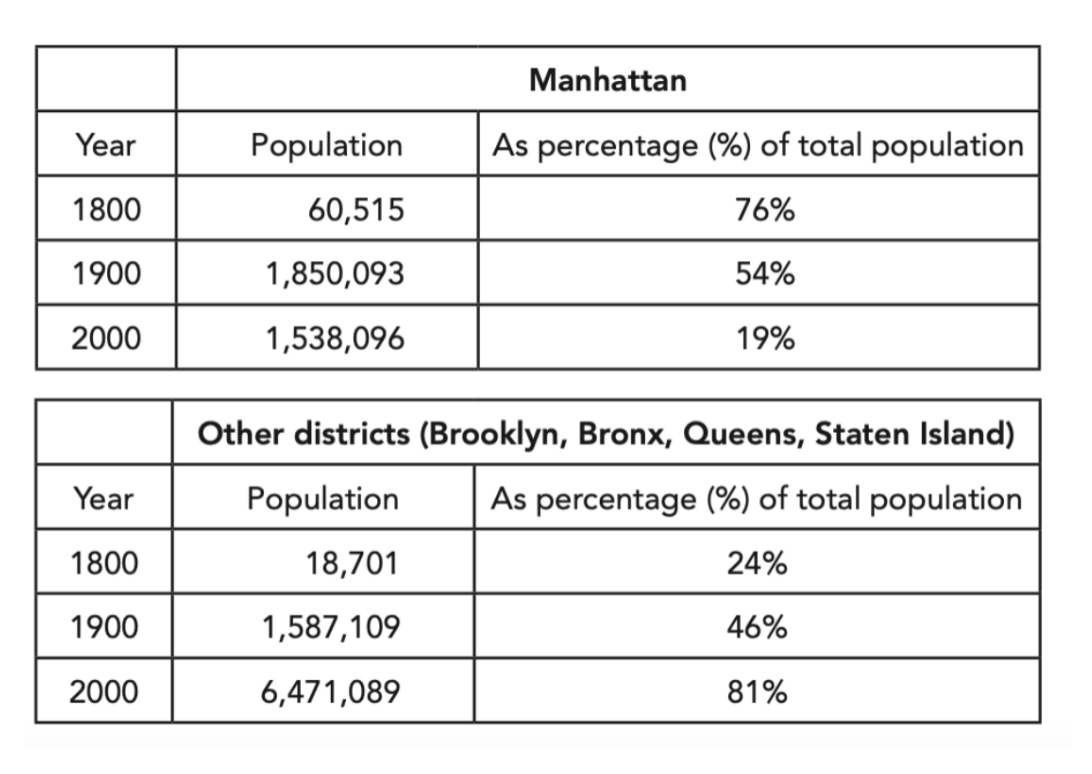
The first table below shows changes in the total population of New York City from 1800 to 2000. The second and third tables show changes in the population of the five districts of the city (Manhattan, Brooklyn, Bronx, Queens, Staten Island) over the same period.
Summarise the information by selecting and reporting the main features, and make comparisons where relevant.
Student answer (Band 5.5)
These three tables illustrate the variation in total population of New York City along with the four districts of the another city including Manhattan.
Overall, the population of New Yark and Manhattan was above sixty thousands.The population of other districts was not too much. After 1800, the population of New York city and other districts increased rapidly.
In 1800, the population of New Yark along with five districts was 79216.In 1900, these numbers increased to 3,437,202. In the end of 2000 the population grew up more and it was 8,009,185.
Moreover, the population of the city Manhattan in 1800 was 60,515 and it was 76 percent of the total population.In the next century, the population increased upto 1,850,093 and it was 54 percent of the total population.In 2000, these numbers rised up and were about 1,538,096 which became 19 percent of the total population.
In addition, other districts like Brooklyn, Bronx, Queens, and the Staten Island. In 1800, the total population of other disticts was 24 percent which was too lower than Manhattan and New Yark City. In 1900, the population increased to 1,587,109 which was 46 percent of the total poulation. In 2000, this population became double to previous century.
AI examiner evaluation
| Criterion | Band |
|---|---|
| Task Achievement / Task Response | 5.5 |
| Coherence and Cohesion | 6.0 |
| Lexical Resource | 5.0 |
| Grammatical Range and Accuracy | 5.0 |
| Overall | 5.5 |
Task Achievement / Task Response: Band 5.5
You report the main overall population figures accurately and include relevant comparisons for Manhattan and the combined other districts. However, the overview is unclear and partly inaccurate: saying Manhattan’s population “was above sixty thousands” does not capture that it rose sharply to 1.85 million by 1900 and then fell by 2000, while its share declined throughout. The statement that the other districts’ 2000 population “became double to previous century” is incorrect; it rose from about 1.59 million to 6.47 million, more than quadrupling. The response also says the city had “four districts” and describes the other districts as “not too much,” which obscures the data. A clearer overview of the contrasting trends and more accurate comparisons would make the report more complete.
Coherence and Cohesion: Band 6.0
The response has a recognisable structure: an introduction, an overview, and separate paragraphs for the total population, Manhattan, and the other districts. This gives the reader a basic route through the information, and connectors such as “Moreover” and “In addition” help signal new points. However, progression is sometimes weakened by unclear references, including “these numbers” and “this population,” which can refer to more than one figure. Some linking is mechanical, and the final paragraph ends without a clear comparison or summary. Organise the details more deliberately—for example, compare Manhattan’s falling share with the other districts’ rising share—and use precise references to the population or percentage being discussed.
Lexical Resource: Band 5.0
You use some relevant task vocabulary, including “total population,” “increased,” “percent,” and “districts,” so the topic is generally understandable. However, the range is limited and several word choices or collocations are inaccurate or informal for a data report. “Variation” is less precise than “changes,” “grew up more” is awkward, and “too lower” is not a suitable comparative expression. There are also spelling errors in “Yark,” “disticts,” and “poulation,” alongside repeated use of “population” and “increased.” Choose precise reporting verbs such as “rose,” “declined,” and “accounted for,” and vary phrasing while keeping the language formal and accurate.
Grammatical Range and Accuracy: Band 5.0
You attempt both simple and longer sentences, and the reader can usually follow the main figures. However, grammatical control is inconsistent, particularly in sentence boundaries, articles, and verb forms. For example, “In 1800, the population of New Yark along with five districts was 79216.In 1900” runs two sentences together, while “the population of New York city and other districts increased rapidly” has an unclear subject relationship. The phrase “In addition, other districts like Brooklyn, Bronx, Queens, and the Staten Island” is a sentence fragment, and “these numbers rised up” uses an incorrect verb form. Use complete sentences, check subject–verb relationships and past-tense forms, and punctuate each sentence clearly.
See this exact question answered at other band scores. The same prompt compared across bands.
Browse more IELTS Writing model answers or get your own writing scored by the same AI examiner.