Band 5.0 IELTS Writing Task 1 Model Answer
Overall Band Score: 5.0 · Cambridge IELTS 20 · 2026-11-27
IELTS Writing Task 1 question
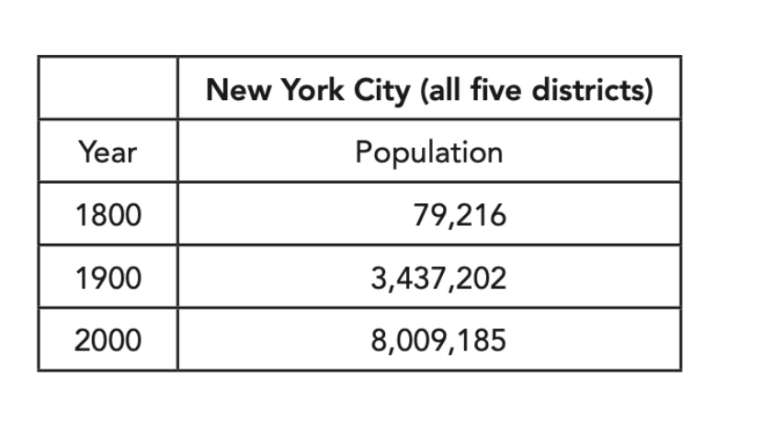
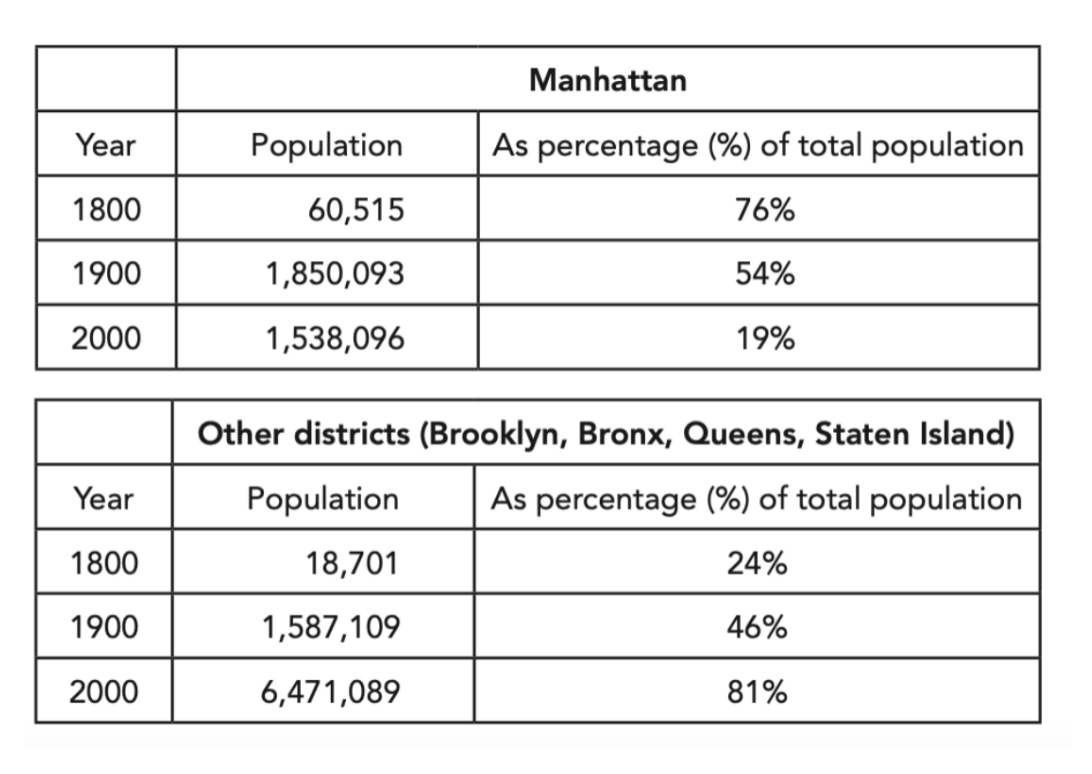
The first table below shows changes in the total population of New York City from 1800 to 2000. The second and third tables show changes in the population of the five districts of the city (Manhattan, Brooklyn, Bronx, Queens, Staten Island) over the same period.
Summarise the information by selecting and reporting the main features, and make comparisons where relevant.
Student answer (Band 5.0)
We have a table shows changes in the total population of new york city from 1800 to 2000, and we have two other tables shows us changes in the population in the five districts of the sity.
In the first table we see that the population in year 1800 is 79,216 but it increse with anormus amount with more than 4300 % and reched 3,437,202 , However after that it incresed by more than 250 % to be at 8,009,185 , We can see that the population groth is decresed from 4300 % to just 250 %.
In the second and third tables we can see that in the year 1800 more than 76 % of the city population positioning in Manhattan and just 24 % stayes on other four districts, but after the year 1900 the sitution changes the population of manhattan decreses to 54 % of new york's population and in the year 2000 droped to 19 %, in the other hand the population of the other four districts ireses to 46% in 1900 to 81% in 2000
AI examiner evaluation
| Criterion | Band |
|---|---|
| Task Achievement / Task Response | 5.5 |
| Coherence and Cohesion | 5.0 |
| Lexical Resource | 5.0 |
| Grammatical Range and Accuracy | 5.0 |
| Overall | 5.0 |
Task Achievement / Task Response: Band 5.5
You identify the main overall rise in New York City’s population and the changing balance between Manhattan and the other districts. The figures for 1800 and 2000, including the shares of 76% and 19% for Manhattan, are relevant and accurate. However, the report is only partly developed: it gives no clear overview summarising the key contrast, and it omits the actual district population figures. The 1900 share for the other districts is also not reported, while the wording “after the year 1900” makes the timing of the change unclear. In addition, the growth percentages are not the most useful comparison and are not fully accurate. Select the major trends, include key figures, and state the overall pattern explicitly.
Coherence and Cohesion: Band 5.0
The response follows a broadly sensible order, moving from the citywide population table to the district tables, and it uses some linking expressions such as “but,” “after that,” and “in the other hand.” However, the ideas are packed into two long paragraphs, with no distinct overview and little separation between the main comparisons. Several links are awkward or unclear: “but after the year 1900” does not clearly connect the 1800 and 1900 data, and “in the other hand” does not smoothly introduce the contrasting trend. The repeated use of “we can see” also makes the progression mechanical. Organise the report into an introduction, an overview, and focused detail paragraphs, using precise links between years and trends.
Lexical Resource: Band 5.0
You use some relevant task vocabulary, including “population,” “districts,” “increased,” and “decreased,” so the main subject is generally understandable. However, the range is limited and several spelling and word-choice errors are noticeable, including “anormus,” “groth,” “sity,” and “ireses.” Some phrases are also unnatural or imprecise: “population positioning in Manhattan” and “stayes on other four districts” do not express the data clearly. Repeating “population” and “we can see” further restricts the vocabulary. Aim for accurate collocations such as “accounted for,” “share,” and “rose,” and check spelling carefully. More precise language would make the comparisons easier to follow.
Grammatical Range and Accuracy: Band 5.0
The response attempts longer sentences and uses some time and contrast clauses, but control is inconsistent, and errors sometimes make relationships between ideas difficult to follow. For example, “We have a table shows” lacks a grammatical link between the subject and the verb, while “two other tables shows us” has subject–verb disagreement. The sentence beginning “In the first table” runs several clauses together, with unclear punctuation around “However.” There are also problems with articles and sentence construction in “after the year 1900 the sitution changes.” Use a wider mix of accurately formed simple and complex sentences, check singular and plural agreement, and divide long sentences where each comparison needs its own clause.
See this exact question answered at other band scores. The same prompt compared across bands.
Browse more IELTS Writing model answers or get your own writing scored by the same AI examiner.