Band 6.0 IELTS Writing Task 1 Model Answer
Overall Band Score: 6.0 · Cambridge IELTS 20 · 2026-11-27
IELTS Writing Task 1 question
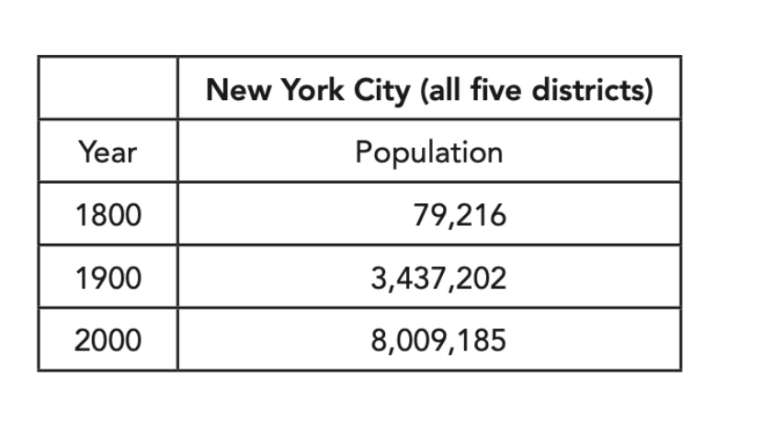
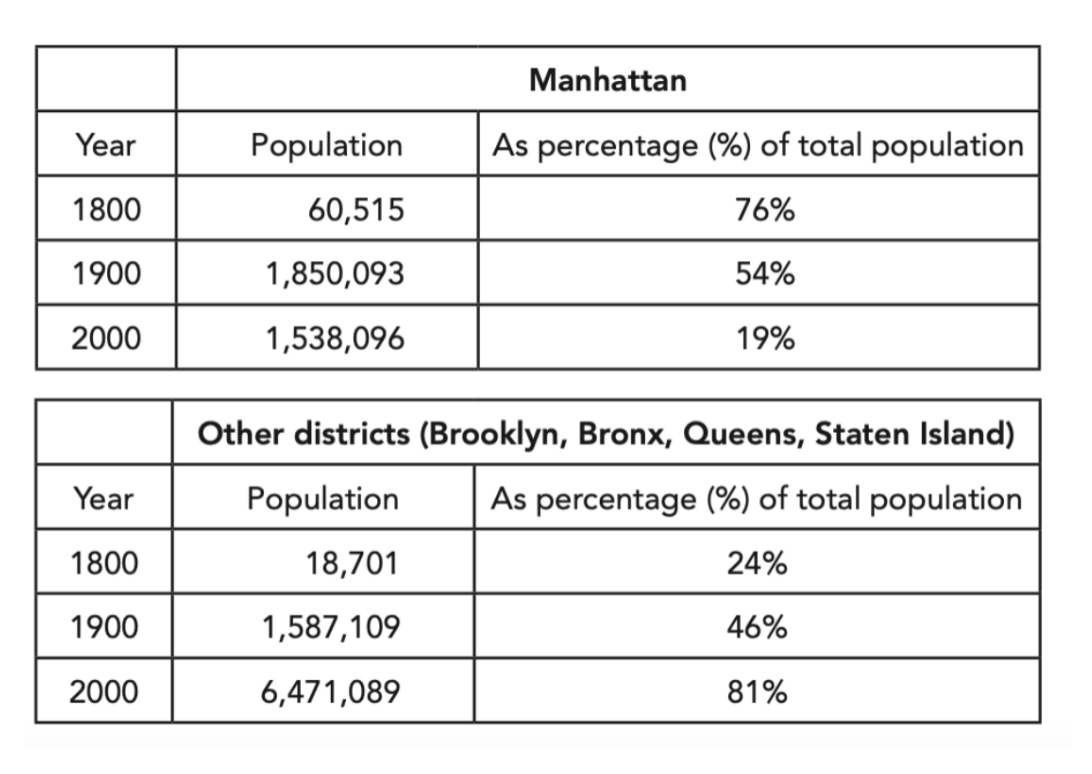
The first table below shows changes in the total population of New York City from 1800 to 2000. The second and third tables show changes in the population of the five districts of the city (Manhattan, Brooklyn, Bronx, Queens, Staten Island) over the same period.
Summarise the information by selecting and reporting the main features, and make comparisons where relevant.
Student answer (Band 6.0)
The first table illustrate the total number of people lived in the New York city in the years of 1800, 1900 and 2000, in additionally, other two tables depicts how it has changed over the time by districts.
Overall, the population in New York city dramatically rose through out the 3 centuries. Manhattan was the most populated district among all in 1800 nevertheless, the population of other districts had grown steadily in next 2 centuries. Whereas, it had lead to a significant number at the end of 2000.
The number of people used to live in New York was 79,216 in 1800. Furthermore, it has reached 3.5 million of individuals in 1900 with an incredible growth. The development of population continued to 2000 by adding nearly 5 million citizens to the city(8,009,185).
The main city Manhattan had been the home to most of community in 1800 and 1900 in percentages 76% and 54%.
Only 24% of the population lived apart from the Manhattan in 1800 moreover it had surged to 46% during the next century(1900). By the time in 2000, Manhattan lost the popularity, as well as other districts were attracted by the residents. A proportion of 19% people used to live in Manhattan while the rest was in other districts (81%) in 2000.
AI examiner evaluation
| Criterion | Band |
|---|---|
| Task Achievement / Task Response | 6.0 |
| Coherence and Cohesion | 6.0 |
| Lexical Resource | 6.0 |
| Grammatical Range and Accuracy | 5.5 |
| Overall | 6.0 |
Task Achievement / Task Response: Band 6.0
You cover the main trends accurately: the city’s population rose substantially, Manhattan’s share fell, and the other districts’ share increased. The figures for 1800 and 2000 are used effectively, and the comparison between Manhattan and the other districts gives the response a relevant overview. However, some key details are less fully reported. For example, Manhattan’s population itself rose from 60,515 to 1,850,093 by 1900 before declining to 1,538,096 in 2000; your account focuses mainly on its changing percentage and describes it as losing “popularity.” The overview could also state more precisely that the other districts overtook Manhattan in population by 2000. More direct reporting of these absolute figures would make the summary more complete and precise.
Coherence and Cohesion: Band 6.0
The response has a clear overall structure: an introduction, an overview, and paragraphs covering the city total and district shares. This makes the information generally easy to follow, and time markers such as “in 1800,” “in 1900,” and “in 2000” help establish the comparisons. Some linking is less controlled, however. The overview’s “nevertheless” and “Whereas” create an awkward connection, while “Furthermore” and “moreover” sometimes join information mechanically rather than showing a precise relationship. The reference in “Whereas, it had lead” is also unclear. To improve progression, group the district population figures and percentages together, and use fewer, more exact transitions so each comparison follows naturally from the previous one.
Lexical Resource: Band 6.0
You use an adequate range of vocabulary to describe change, including “dramatically rose,” “surged,” and “continued,” and the meaning is generally clear. There are also attempts at more formal wording, such as “a significant number” and “an incredible growth,” but some choices are unnatural or imprecise for describing population data. “The main city Manhattan” and “lost the popularity” do not express the intended ideas naturally, and “people used to live” suggests a past habit rather than simply reporting a historical figure. “Development of population” is also an awkward collocation. Choose standard data-reporting language and use it consistently; this will make your comparisons more precise without requiring more elaborate vocabulary.
Grammatical Range and Accuracy: Band 5.5
You attempt a mix of simple and complex sentences, including clauses beginning with “Whereas” and “while,” and most of the message remains understandable. Some grammatical errors recur, though. In the opening, “The first table illustrate” needs subject–verb agreement, and “people lived” would be more accurate as “people living” or “people who lived.” The phrase “it has reached” shifts inappropriately to the present perfect when describing completed historical years; use the past simple. “It had lead” also has an incorrect past participle, and the sentence beginning “Whereas” is incomplete as written. Review agreement, tense consistency, and the construction of subordinate clauses, then check punctuation around long sentences. Greater control of these forms would make the range you attempt more effective.
See this exact question answered at other band scores. The same prompt compared across bands.
Browse more IELTS Writing model answers or get your own writing scored by the same AI examiner.