Band 5.5 IELTS Writing Task 1 Model Answer
Overall Band Score: 5.5 · Cambridge IELTS 20 · 2026-11-28
IELTS Writing Task 1 question
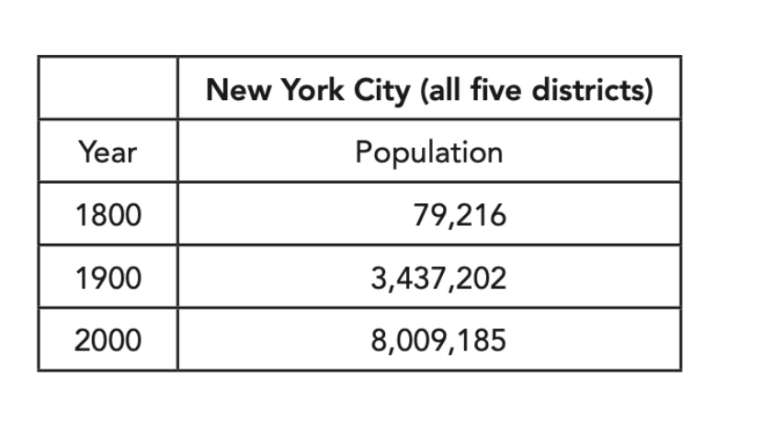
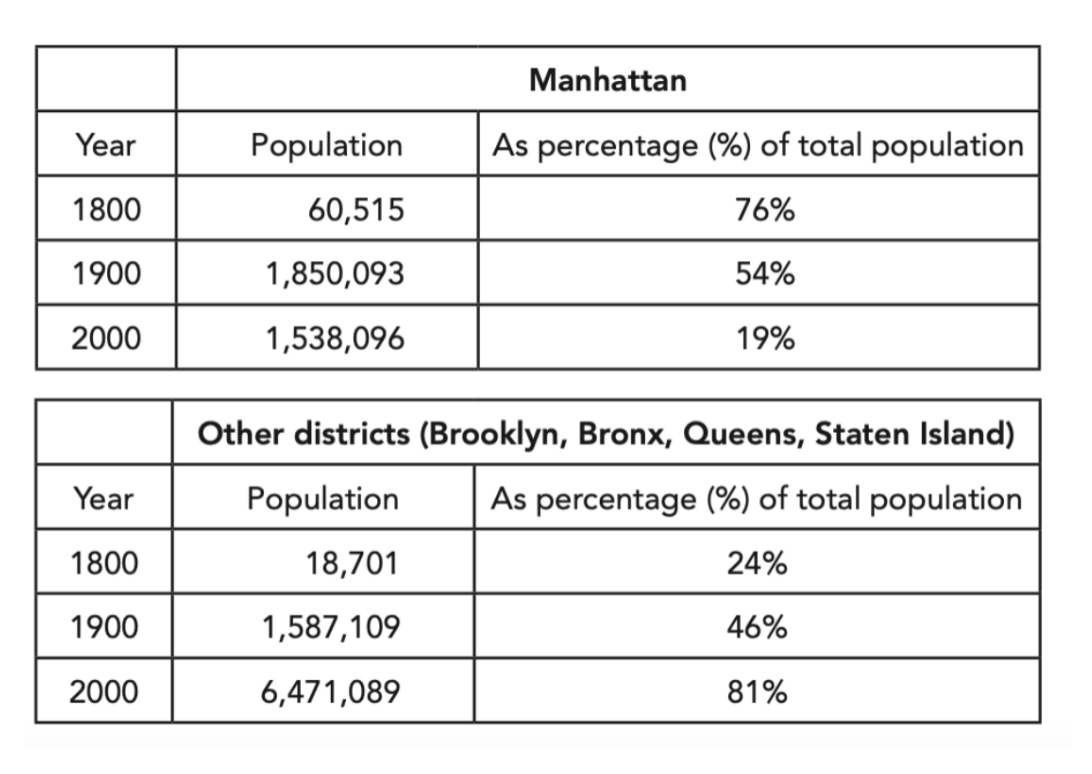
The first table below shows changes in the total population of New York City from 1800 to 2000. The second and third tables show changes in the population of the five districts of the city (Manhattan, Brooklyn, Bronx, Queens, Staten Island) over the same period.
Summarise the information by selecting and reporting the main features, and make comparisons where relevant.
Student answer (Band 5.5)
The table shows a comparison of the overall population of America City (New York) over two centuries, across other five districts at the same period of time.
Overall, the USA city (New York) population increased sharply over two centuries, also Manhattan percentage of total population declined steadily and other districts total population increased gradually.
In the first table of New York city, the population is under one lakh in 1800 followed by sharp increase in 1900 as the people grows over 3 lakh but the population grows sharply under 1 million in 2000. The highest increase in New York city is from 1800 to 1900 followed by 1900 to 2000.
Manhattan which is a district of main city is the only one whose popualtion decrease from 76% to 19%. It is the exceptional case that the population of this city only was on declined stage. In 1800 the percentage of total population in Manhattan is 76% but in 2000 it is fell to 19% which is a severe decreased . On the other hand, other districts total population also increases sharply from 24% in 1800 to 81% in 2000. As other districts population also grows from approximately figure of 18700 to over 6 million.
AI examiner evaluation
| Criterion | Band |
|---|---|
| Task Achievement / Task Response | 6.0 |
| Coherence and Cohesion | 6.0 |
| Lexical Resource | 5.0 |
| Grammatical Range and Accuracy | 5.0 |
| Overall | 5.5 |
Task Achievement / Task Response: Band 6.0
You identify the main overall patterns: New York’s population grew substantially, Manhattan’s share fell, and the other districts’ share rose. You also include relevant figures, such as Manhattan’s 76% to 19% change and the other districts’ growth from about 18,700 to over 6 million. However, several figures are seriously misreported: the city had about 3.4 million people in 1900 and 8 million in 2000, not “over 3 lakh” and “under 1 million.” The overview also says the other districts grew “gradually,” although their increase was very large. The response addresses the tables, but some comparisons are unclear or inaccurate. Report the population totals precisely and distinguish changes in population from changes in percentage share.
Coherence and Cohesion: Band 6.0
The response has a recognisable structure: an introduction, an overview, and separate discussion of the city total and district figures. This makes the main topics easy to identify, and transitions such as “On the other hand” help signal a contrast. However, progression within paragraphs is sometimes unclear. The first-table paragraph repeats that growth was sharp without clearly comparing the two periods, while the Manhattan paragraph shifts between population and percentage share, making the reference of “population” confusing. Some linking phrases, including “followed by,” are used mechanically. Organise the details around clear comparisons—first the city total, then Manhattan versus the other districts—and use precise references to keep each figure’s meaning clear.
Lexical Resource: Band 5.0
You use relevant vocabulary for describing trends, including “increased sharply,” “declined,” and “percentage of total population.” These choices show awareness of the language needed for a table summary. However, the range is limited and several word choices or collocations are inaccurate, which sometimes makes the meaning difficult to follow. For example, “the people grows,” “was on declined stage,” and “a severe decreased” are not natural expressions. “America City (New York)” and “USA city” are also imprecise labels; use “New York City” consistently. Aim for accurate trend language and avoid repeating “sharp” when a more exact description, such as “rose substantially,” would better fit the data.
Grammatical Range and Accuracy: Band 5.0
You attempt both simple and more extended sentence forms, and the overall meaning is generally recoverable. However, errors in verb forms, agreement, articles, and sentence construction occur across the response. Examples include “the people grows,” “it is fell to 19%,” and “other districts total population also increases”; these should use appropriate past-tense forms and clearer grammatical relationships. The sentence beginning “Manhattan which is a district…” also needs punctuation around the relative clause. Some sentences combine several ideas without clear grammatical control, particularly the description of the city’s population changes. Practise accurate past-tense reporting and build longer sentences from a clear subject and verb, checking agreement and punctuation before adding extra clauses.
See this exact question answered at other band scores. The same prompt compared across bands.
Browse more IELTS Writing model answers or get your own writing scored by the same AI examiner.