Band 6.0 IELTS Writing Task 1 Model Answer
Overall Band Score: 6.0 · Cambridge IELTS 20 · 2026-11-28
IELTS Writing Task 1 question
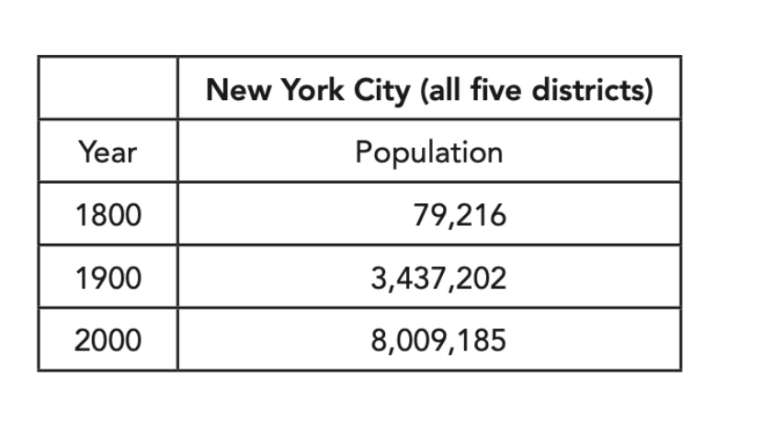
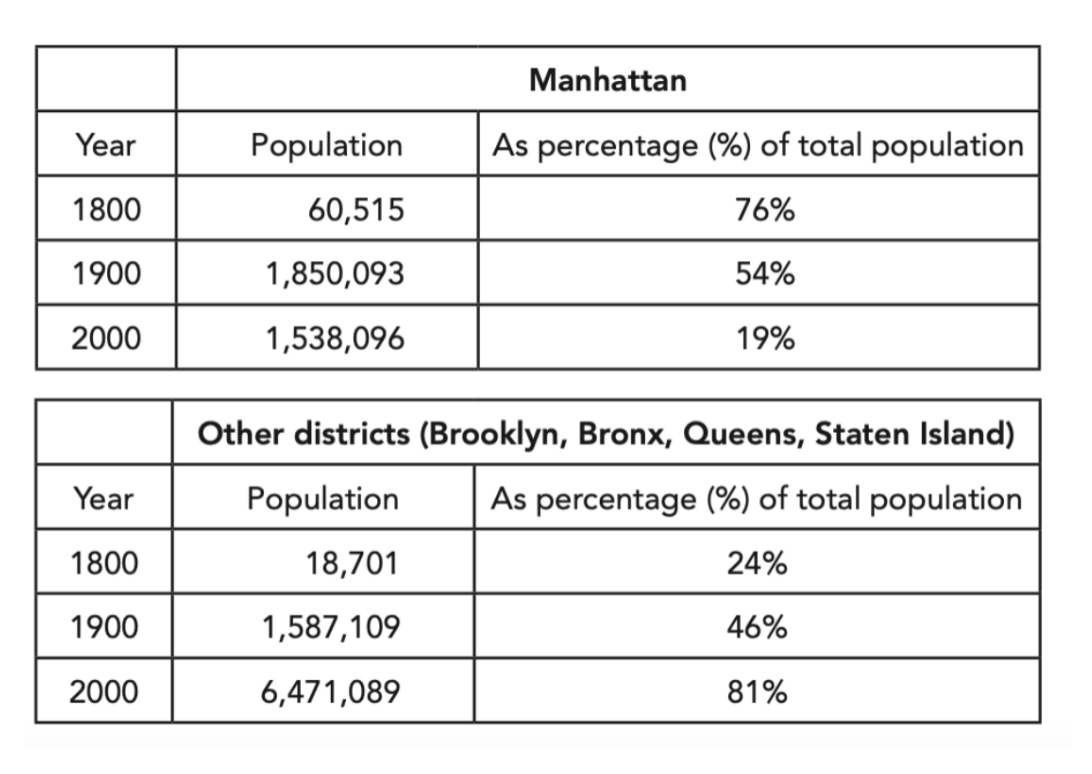
The first table below shows changes in the total population of New York City from 1800 to 2000. The second and third tables show changes in the population of the five districts of the city (Manhattan, Brooklyn, Bronx, Queens, Staten Island) over the same period.
Summarise the information by selecting and reporting the main features, and make comparisons where relevant.
Student answer (Band 6.0)
The table depicts the data of total population changes in NEWYORK city and few districts of the city from 1800 to 2000
the overall population in newyork city has highly increased from the year 1800 to 2000 with manhattan being the highest in 1800 and other districts in 2000
The total population in newyork city in year 1800 is 79,216 whereas in 1900 it has hicked to 3,437,202 and by 2000 it reached to 8,009,185.
In 1800 manhattan comprised the most number of population compared to other districts and by 1900 the percentage is almost equal with manhattan being slightly highest and by 2000 there is reversal of the popultion with increase in poulation in other districs and decline in manhattan.
In manhattan the total population comprised of 76%in year 1800 which has declined to 54%by year 1900 and ending with 19% by 2000 whereas in other districts there has been a rise in the total population over the years from 24%in 1800 to 46% in 1900 and hike to 81% by 2000
AI examiner evaluation
| Criterion | Band |
|---|---|
| Task Achievement / Task Response | 6.5 |
| Coherence and Cohesion | 6.0 |
| Lexical Resource | 5.5 |
| Grammatical Range and Accuracy | 5.5 |
| Overall | 6.0 |
Task Achievement / Task Response: Band 6.5
You identify the main trends accurately: New York’s total population rose substantially, Manhattan’s share fell, and the other districts’ share increased. The figures for the city total and the percentage changes are reported correctly, and the comparison between Manhattan and the other districts gives the response a clear overview. This meets the task well, with some features developed more fully than others. However, the statement that the percentages were “almost equal” in 1900 is imprecise: Manhattan had 54% compared with 46% in the other districts. You also say Manhattan had the highest population in 1800 and the other districts in 2000, but could support this comparison with their actual population figures. More precise comparisons would strengthen the report further.
Coherence and Cohesion: Band 6.0
The response has a recognisable structure: an introduction, an overview, and paragraphs covering the total population and district shares. Its progression from the overall city trend to the changing distribution is generally logical, and linking expressions such as “whereas” and “by 2000” help show contrast and time. However, the paragraphing and sentence boundaries are not consistently controlled: the opening and overview are not clearly separated, and the long final sentence combines several changes without enough punctuation. Some connections are also repetitive, particularly the repeated use of “by” and “over the years.” Grouping the figures into clearer comparisons—Manhattan versus the other districts at each date—would make the organisation more cohesive and easier to follow.
Lexical Resource: Band 5.5
You use relevant vocabulary for describing trends and proportions, including “declined,” “rise,” “comprised,” and “reversal,” so the main information is usually understandable. However, the range and control are uneven, with noticeable spelling and word-choice problems. “Hicked” and “hike” are unsuitable for formal data description, while “comprised of 76%” is an awkward collocation; “accounted for 76%” would be more natural. There are also misspellings such as “popultion,” “poulation,” and “districs,” and “NEWYORK” is incorrectly presented as one word and in capitals. Aim for accurate, neutral reporting verbs and check spelling carefully, especially for key terms repeated throughout the response.
Grammatical Range and Accuracy: Band 5.5
You attempt both simple and more complex sentence forms, including a contrast with “whereas” and clauses describing changes over time. The intended meaning is generally recoverable, but some grammatical errors remain. For example, “the overall population … has highly increased” uses an unsuitable tense construction for a completed historical period, and “in 1900 it has hicked” has the same problem. In “in year 1800 is 79,216,” the article and sentence structure are incomplete; use “In 1800, the population was 79,216.” Punctuation and spacing are also inconsistent, with missing spaces around percentages and limited sentence-ending punctuation. More consistent past-tense reporting and carefully punctuated sentences would improve accuracy.
See this exact question answered at other band scores. The same prompt compared across bands.
Browse more IELTS Writing model answers or get your own writing scored by the same AI examiner.