Band 6.5 IELTS Writing Task 1 Model Answer
Overall Band Score: 6.5 · Cambridge IELTS 20 · 2026-11-05
IELTS Writing Task 1 question
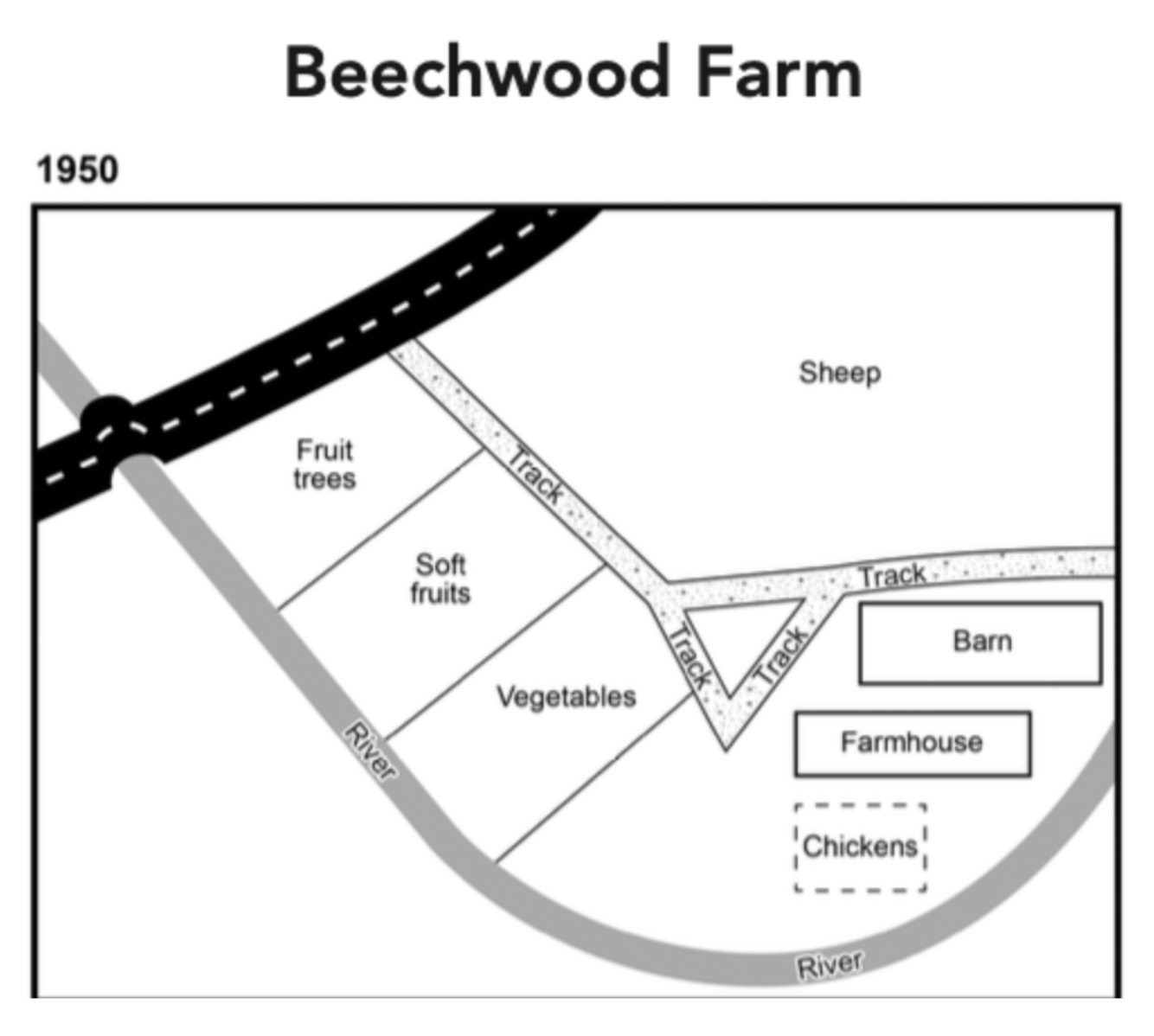
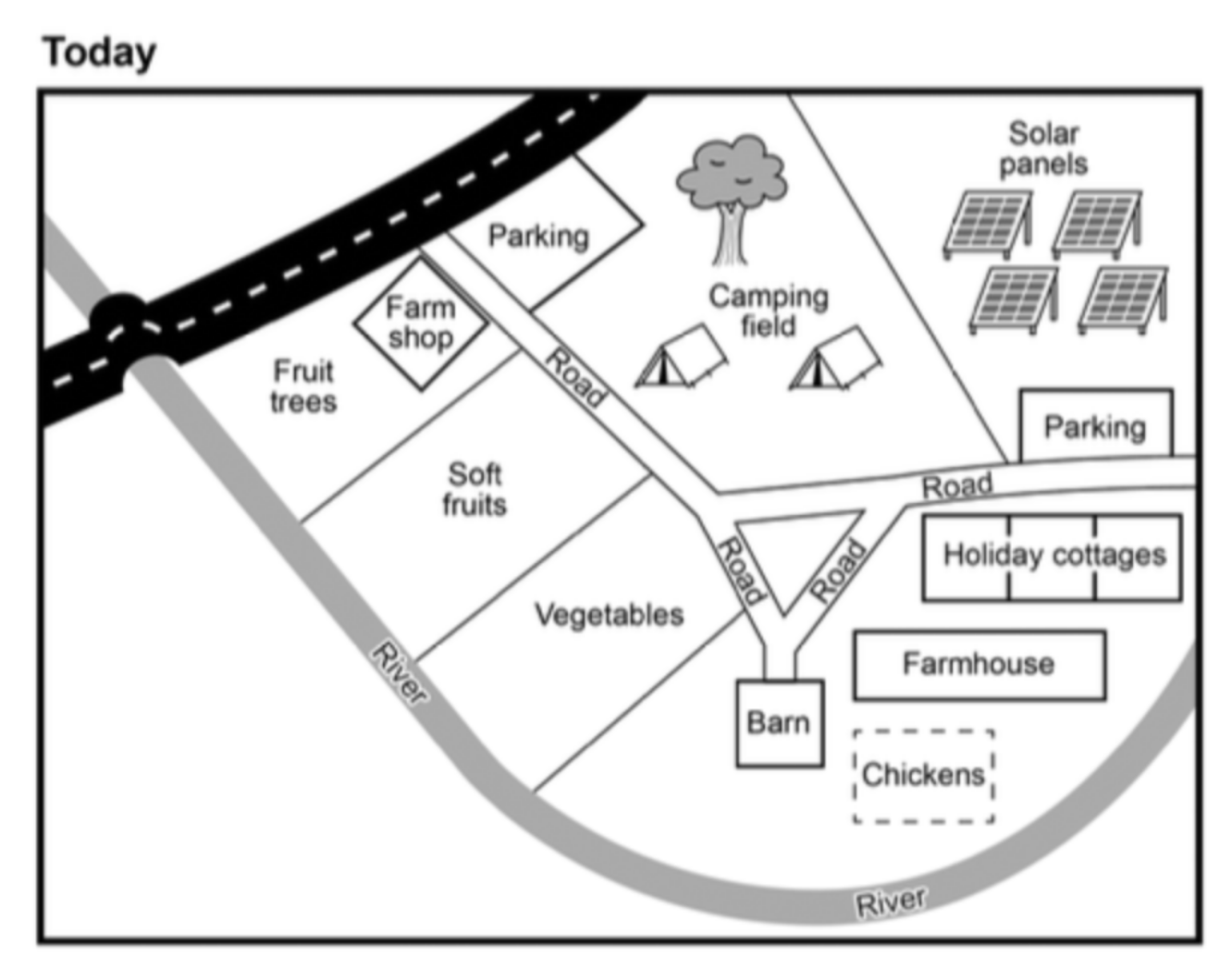
The plans below show the site of a farm in 1950 and the same site today.
Summarise the information by selecting and reporting the main features, and make comparisons where relevant.
Student answer (Band 6.5)
The two pictures show the plans for Beechwood farm in two different years that are 1950 and present day. The plans represent a large number of changes being made in the farm as compared to 1950. In 1950 the farm was just being used for vegetation and sheep and chicken farming along with the residance at one side. There is a track line that connects farm with the main road. It lacks many of the important structures which can be seen in today's plan.
However, in the second picture, many additions can be seen that makes the farm more a recreational or holiday spot. The most important is the addition of parking space just at the start of the farm next to main road. This will allow more people to visit the farm without stressing for parking space. The second addition is the farm shop just near to fruit trees that is actually the entry or leaving point of the farm. The barn is moved to other side and on its place three holiday cottages are built. Addition of holiday cottages along with camping feild can play a perfect role for recreation and holidays. Solar panels have been installed which makes the place more enery efficient.
Hence the comparison shows that with the change of time the farm has become more structurely organized. The additions will also play role in economic stability that can be useful for the futher developments of the area.
AI examiner evaluation
| Criterion | Band |
|---|---|
| Task Achievement / Task Response | 6.5 |
| Coherence and Cohesion | 6.5 |
| Lexical Resource | 6.0 |
| Grammatical Range and Accuracy | 6.0 |
| Overall | 6.5 |
Task Achievement / Task Response: Band 6.5
You identify the main transformation accurately: the farm has gained visitor facilities, including parking, a shop, camping, cottages and solar panels, while retaining agricultural areas and the farmhouse. The comparison that the barn has moved and cottages occupy its former area is also relevant. This gives the response a clear overall direction. However, some important spatial details are vague or inaccurate: the shop is not described as an entry or exit point, and the barn’s new position is not specified. The opening also says the farm was used for “vegetation,” which does not clearly report the vegetable plots, and the conclusion about economic stability is speculative rather than map-based. More precise coverage of retained features and the layout would make the summary more complete.
Coherence and Cohesion: Band 6.5
The response has a coherent overall arrangement: it introduces the two plans, describes the earlier farm, contrasts it with today’s visitor-oriented additions, and ends with a concluding statement. Linking expressions such as “However,” “The second addition,” and “Hence” help signal the progression. The main limitation is that the description is organised largely as a list of additions rather than by location or by clear groups of changes. Some references are also unclear, particularly “on its place,” which requires the reader to infer that this means the barn’s former site. The final comments about recreation and economic stability interrupt the map-focused progression. Grouping changes by area and using clearer references would make cohesion more flexible and precise.
Lexical Resource: Band 6.0
You use a relevant range of vocabulary for describing land use and development, including “additions,” “holiday cottages,” “camping field,” “solar panels,” and “recreational.” These choices communicate the broad changes and show some ability to use topic-specific language. However, several word choices or collocations are imprecise, such as “vegetation” for the vegetable plots, “track line,” and “entry or leaving point.” There are also spelling errors in “residance,” “feild,” “enery,” “structurely,” and “futher.” These do not prevent understanding, but they reduce accuracy and polish. Aim for precise map vocabulary and check spelling; for example, distinguish “vegetables” from general plant life and use “access road” where appropriate.
Grammatical Range and Accuracy: Band 6.0
You use both simple statements and more complex forms, including “which can be seen in today’s plan” and “which makes the place more…” The overall meaning remains clear, and some sentences are controlled. However, there are several grammatical inaccuracies. In “two different years that are 1950 and present day,” the time reference needs a more natural construction; “many additions … that makes” has a plural subject requiring agreement; and “the farm was just being used for vegetation and sheep and chicken farming” has an awkward, unclear structure. Articles and prepositions are also sometimes missing, as in “next to main road” and “connects farm with the main road.” More consistent agreement and complete, natural sentence patterns would improve accuracy.
See this exact question answered at other band scores. The same prompt compared across bands.
Browse more IELTS Writing model answers or get your own writing scored by the same AI examiner.